Immunology Translational Research Programme, Department of Microbiology and Immunology, Yong Loo Lin School of Medicine, National University of Singapore, Singapore, Singapore.
Immunology Programme, Life Sciences Institute, National University of Singapore, Singapore, Singapore.
Cell Death Dis. 2024 Jul 4;15(7):479. doi: 10.1038/s41419-024-06871-8.
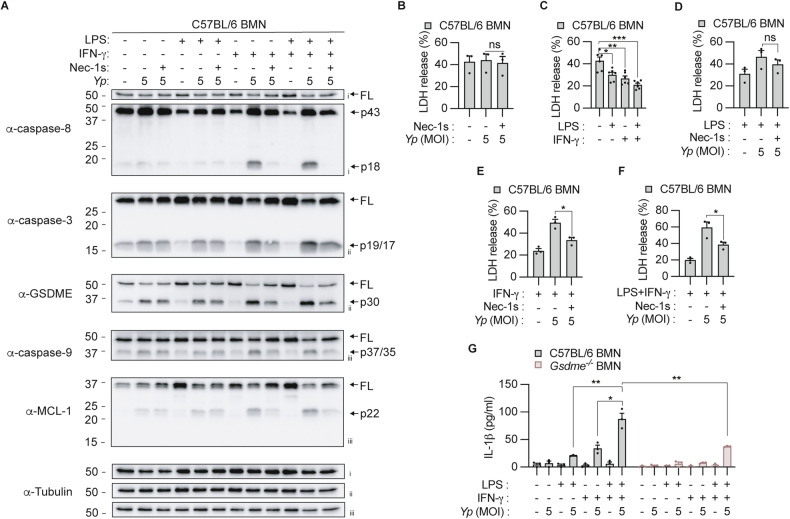
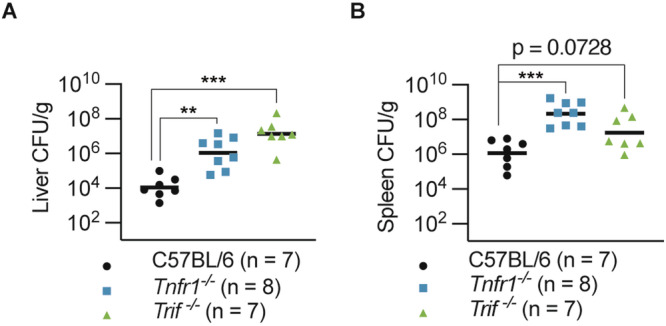
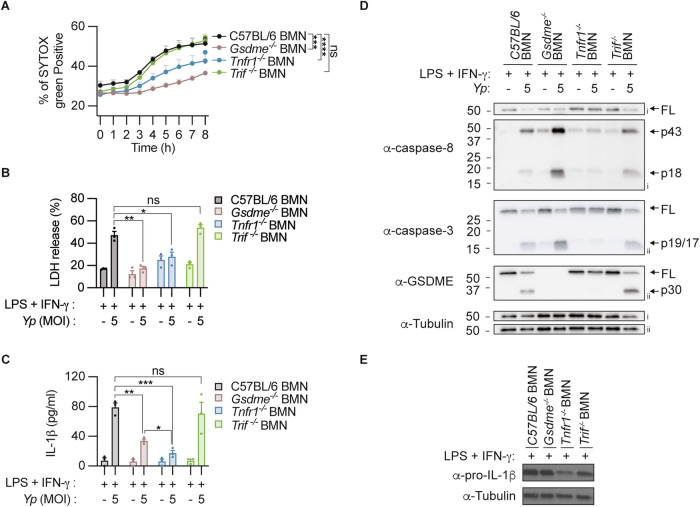
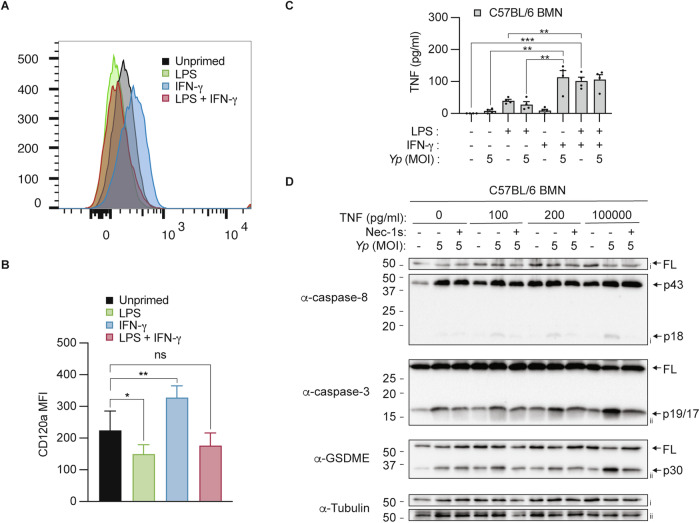
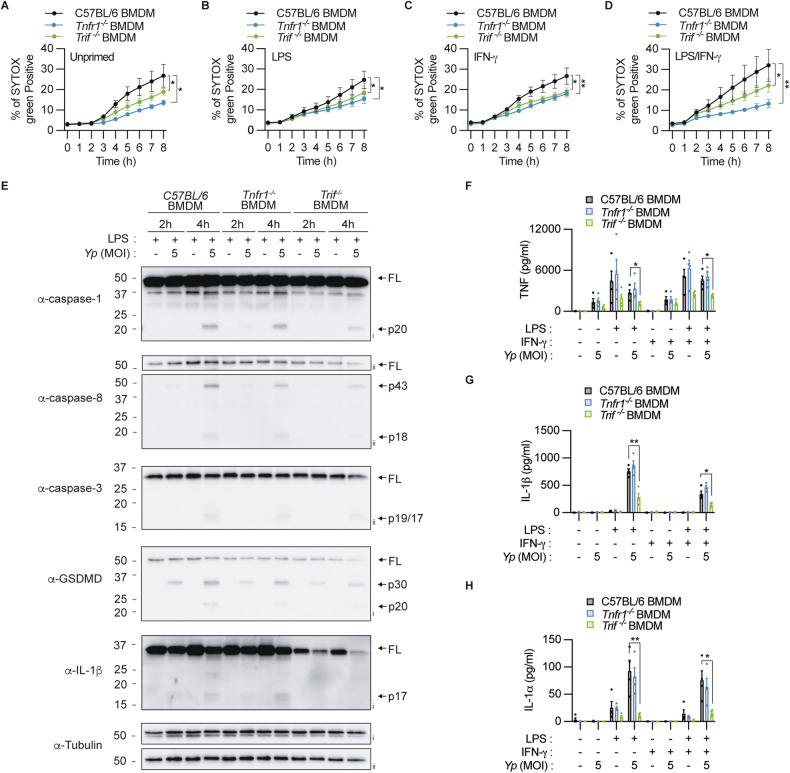
TLR4 and TNFR1 signalling promotes potent proinflammatory signal transduction events, thus, are often hijacked by pathogenic microorganisms. We recently reported that myeloid cells retaliate Yersinia blockade of TAK1/IKK signalling by triggering RIPK1-dependent caspase-8 activation that promotes downstream GSDMD and GSDME-mediated pyroptosis in macrophages and neutrophils respectively. However, the upstream signalling events for RIPK1 activation in these cells are not well defined. Here, we demonstrate that unlike in macrophages, RIPK1-driven pyroptosis and cytokine priming in neutrophils are driven through TNFR1 signalling, while TLR4-TRIF signalling is dispensable. Furthermore, we demonstrate that activation of RIPK1-dependent pyroptosis in neutrophils during Yersinia infection requires IFN-γ priming, which serves to induce surface TNFR1 expression and amplify soluble TNF secretion. In contrast, macrophages utilise both TNFR1 and TLR4-TRIF signalling to trigger cell death, but only require TRIF but not autocrine TNFR1 for cytokine production. Together, these data highlight the emerging theme of cell type-specific regulation in cell death and immune signalling in myeloid cells.
TLR4 和 TNFR1 信号通路促进强烈的促炎信号转导事件,因此,经常被致病微生物劫持。我们最近报道称,髓样细胞通过触发 RIPK1 依赖性半胱天冬酶-8 的激活来报复耶尔森氏菌对 TAK1/IKK 信号的阻断,该激活分别促进巨噬细胞和中性粒细胞中下游 GSDMD 和 GSDME 介导的细胞焦亡。然而,这些细胞中 RIPK1 激活的上游信号事件尚不清楚。在这里,我们证明与巨噬细胞不同,RIPK1 驱动的中性粒细胞细胞焦亡和细胞因子预激活是通过 TNFR1 信号通路驱动的,而 TLR4-TRIF 信号通路是可有可无的。此外,我们证明在耶尔森氏菌感染期间,中性粒细胞中 RIPK1 依赖性细胞焦亡的激活需要 IFN-γ 启动,这有助于诱导表面 TNFR1 表达并放大可溶性 TNF 的分泌。相比之下,巨噬细胞利用 TNFR1 和 TLR4-TRIF 信号通路来触发细胞死亡,但细胞因子产生仅需要 TRIF 而不需要自分泌的 TNFR1。总之,这些数据强调了细胞死亡和髓样细胞中免疫信号转导中细胞类型特异性调控的新兴主题。