Viroscience, Erasmus University Medical Center, Rotterdam, 3015 GD, the Netherlands.
National Institute for Public Health and the Environment (RIVM), Bilthoven, 3721 MA, the Netherlands.
BMC Public Health. 2024 Jul 4;24(1):1781. doi: 10.1186/s12889-024-19293-0.
Recently, Europe has seen an emergence of mosquito-borne viruses (MBVs). Understanding citizens' perceptions of and behaviours towards mosquitoes and MBVs is crucial to reduce disease risk. We investigated and compared perceptions, knowledge, and determinants of citizens' behavioural intentions related to mosquitoes and MBVs in the Netherlands and Spain, to help improve public health interventions.
Using the validated MosquitoWise survey, data was collected through participant panels in Spain (N = 475) and the Netherlands (N = 438). Health Belief Model scores measuring behavioural intent, knowledge, and information scores were calculated. Confidence Interval-Based Estimation of Relevance was used, together with potential for change indexes, to identify promising determinants for improving prevention measure use.
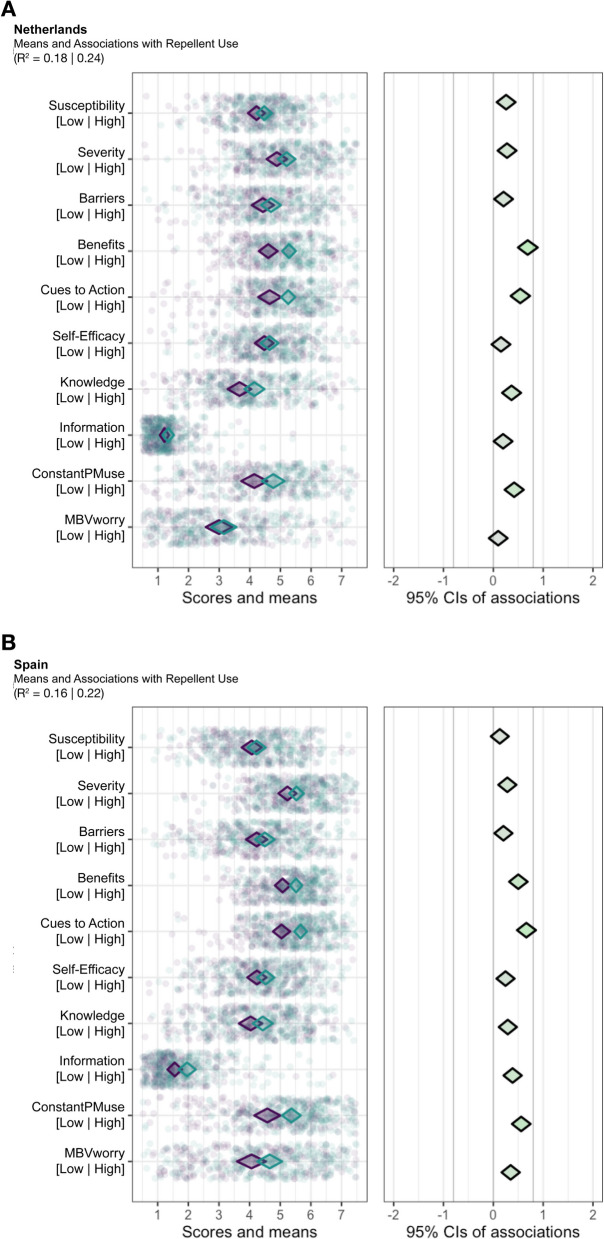
Spanish participants' responses showed slightly higher intent to use prevention measures compared to those of Dutch participants (29.1 and 28.2, respectively, p 0.03). Most participants in Spain (92.2%) and the Netherlands (91.8%) indicated they used at least one prevention measure, but differences were observed in which types they used. More Spanish participants indicated to have received information on mosquitoes and MBVs compared to Dutch participants. Spanish participants preferred health professional information sources, while Dutch participants favoured government websites. Determinants for intent to use prevention measures included "Knowledge", "Reminders to Use Prevention Measures", and "Information" in the Netherlands and Spain. Determinants for repellent use included "Perceived Benefits" and "Cues to Action", with "Perceived Benefits" having a high potential for behavioural change in both countries. "Self-Efficacy" and "Knowledge" were determinants in both countries for breeding site removal.
This study found differences in knowledge between the Netherlands and Spain but similarities in determinants for intent to use prevention measures, intent to use repellents and intent to remove mosquito breeding sites. Identified determinants can be the focus for future public health interventions to reduce MBV risks.
最近,欧洲出现了蚊媒病毒(MBV)。了解公民对蚊子和 MBV 的看法和行为对于降低疾病风险至关重要。我们调查并比较了荷兰和西班牙公民对蚊子和 MBV 的看法、知识和行为意向的决定因素,以帮助改善公共卫生干预措施。
使用经过验证的 MosquitoWise 调查,通过西班牙(N=475)和荷兰(N=438)的参与者小组收集数据。计算健康信念模型得分,以衡量行为意向、知识和信息得分。使用置信区间相关性估计,结合潜在变化指数,确定改善预防措施使用的有希望的决定因素。
西班牙参与者的反应表明,与荷兰参与者相比,他们使用预防措施的意愿略高(分别为 29.1%和 28.2%,p<0.03)。西班牙(92.2%)和荷兰(91.8%)的大多数参与者表示他们至少使用了一种预防措施,但他们使用的类型存在差异。与荷兰参与者相比,更多的西班牙参与者表示他们收到了有关蚊子和 MBV 的信息。西班牙参与者更喜欢健康专业人员的信息来源,而荷兰参与者则更喜欢政府网站。荷兰和西班牙的行为意向决定因素包括“知识”、“使用预防措施的提醒”和“信息”。预防措施使用意向的决定因素包括“感知益处”和“行动提示”,而“感知益处”在两个国家都具有很高的行为改变潜力。“自我效能”和“知识”是两国决定去除滋生地的因素。
本研究发现荷兰和西班牙在知识方面存在差异,但在预防措施、驱虫剂和去除蚊子滋生地的使用意向决定因素方面存在相似之处。确定的决定因素可以成为未来减少 MBV 风险的公共卫生干预措施的重点。