Findlay Rebecca W, Anstice Nicola S, Black Joanna M, Grant Cameron C, Chelimo Carol
School of Optometry and Vision Science, University of Auckland, Auckland, New Zealand.
Caring Futures Institute, College of Nursing and Health Science, Flinders University, Adelaide, Australia.
J Paediatr Child Health. 2024 Sep;60(9):436-442. doi: 10.1111/jpc.16613. Epub 2024 Jul 4.
This study aimed to determine adherence with follow-up from the New Zealand pre-school vision screening programme. The study also examined associations between pre-school vision screening outcomes and cognitive measures assessed at the 54-month follow-up in the Growing Up in New Zealand study cohort.
A cross-sectional retrospective record review of pre-school vision screening outcomes and hospital ophthalmology records with linkage to Growing Up in New Zealand cohort study data.
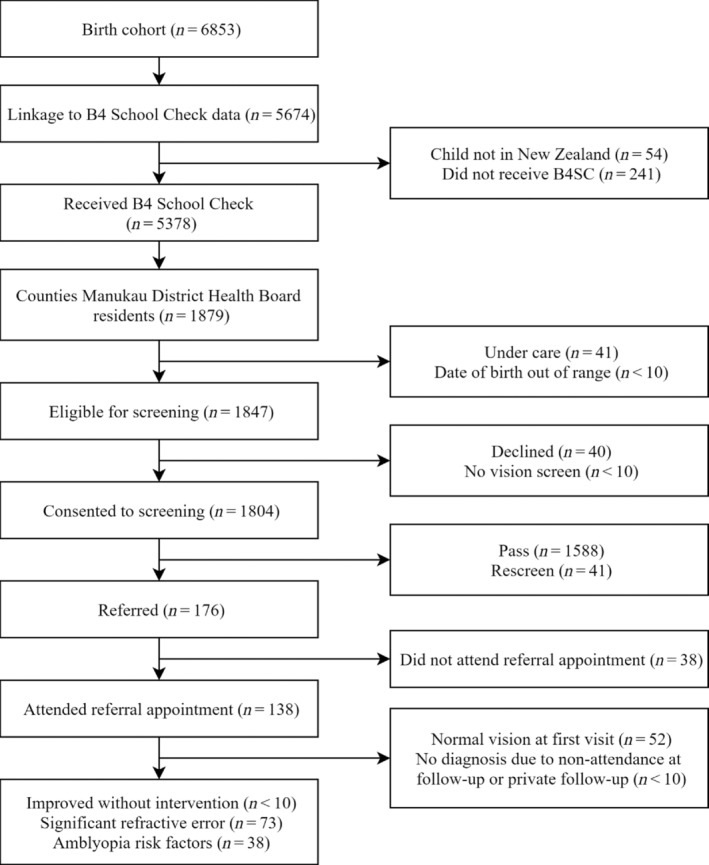
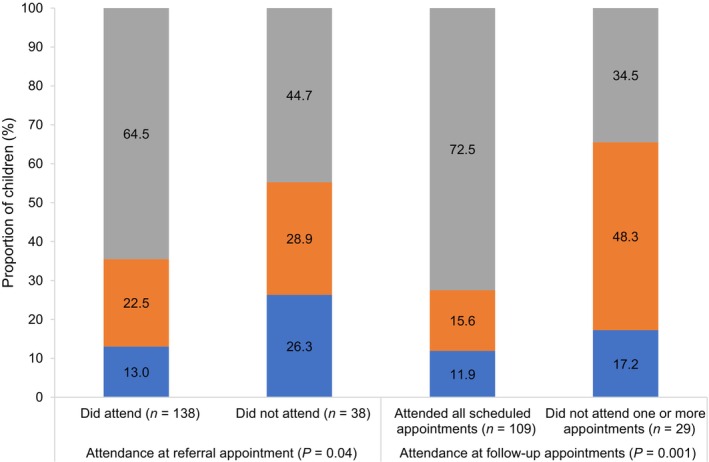
Of 176 children referred from vision screening, 21.6% did not attend a referral appointment. Of 138 children who attended a referral appointment, 21.0% did not attend one or more follow-up appointments. Ethnic differences were observed in attendance at referral appointments (attended Māori 13%, Pacific 22.5%, European/Other 64.5%; not attended Māori 26.3%, Pacific 28.9%, European/Other 44.7%; P = 0.04) and follow-up appointments (attended Māori 11.9%, Pacific 15.6%, European/Other 72.5%; not attended Māori 17.2%, Pacific 48.3%, European/Other 34.5%; P = 0.001). Vision screening outcome was significantly associated with letter naming fluency scores (P = 0.01) but not name and numbers scores (P = 0.05).
Non-attendance at referral and follow-up appointments limits the efficacy of vision screening, particularly for children of Māori and Pacific ethnicity. Children referred from vision screening achieve lower scores on letter naming fluency, a key predictor of reading ability in later childhood. Equity-based improvements are required to ensure that all children referred from vision screening receive appropriate follow-up eye care.
本研究旨在确定新西兰学前视力筛查项目的随访依从性。该研究还在“新西兰成长”研究队列中,考察了学前视力筛查结果与54个月随访时评估的认知指标之间的关联。
对学前视力筛查结果和医院眼科记录进行横断面回顾性记录审查,并与“新西兰成长”队列研究数据相联系。
在176名经视力筛查转诊的儿童中,21.6%未参加转诊预约。在138名参加了转诊预约的儿童中,21.0%未参加一次或多次后续预约。在转诊预约的出席情况(出席的毛利人占13%,太平洋岛民占22.5%,欧洲/其他族裔占64.5%;未出席的毛利人占26.3%,太平洋岛民占28.9%,欧洲/其他族裔占44.7%;P = 0.04)和后续预约的出席情况(出席的毛利人占11.9%,太平洋岛民占15.6%,欧洲/其他族裔占72.5%;未出席的毛利人占17.2%,太平洋岛民占48.3%,欧洲/其他族裔占34.5%;P = 0.001)方面观察到种族差异。视力筛查结果与字母命名流畅性得分显著相关(P = 0.01),但与姓名和数字得分无关(P = 0.05)。
不参加转诊和后续预约限制了视力筛查的效果,尤其是对毛利族和太平洋岛民儿童。经视力筛查转诊的儿童在字母命名流畅性方面得分较低,而字母命名流畅性是儿童后期阅读能力的关键预测指标。需要基于公平性进行改进,以确保所有经视力筛查转诊的儿童都能获得适当的后续眼部护理。