Selvam Esun, Yu Kewei, Ngu Jacqueline, Najmi Sean, Vlachos Dionisios G
Center for Plastics Innovation, University of Delaware, 221 Academy St., Newark, DE, USA.
Department of Chemical and Biomolecular Engineering, University of Delaware, 150 Academy St, Newark, DE, USA.
Nat Commun. 2024 Jul 5;15(1):5662. doi: 10.1038/s41467-024-50035-3.
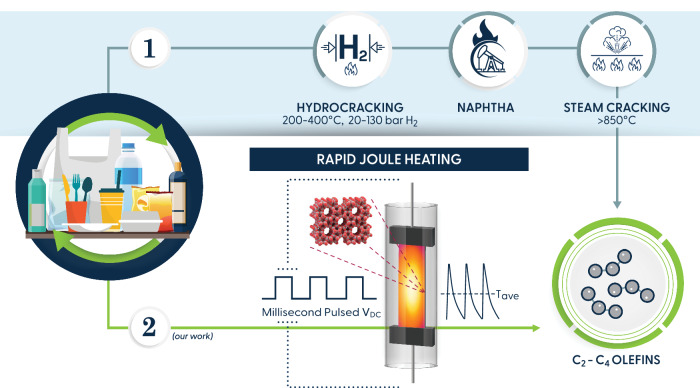
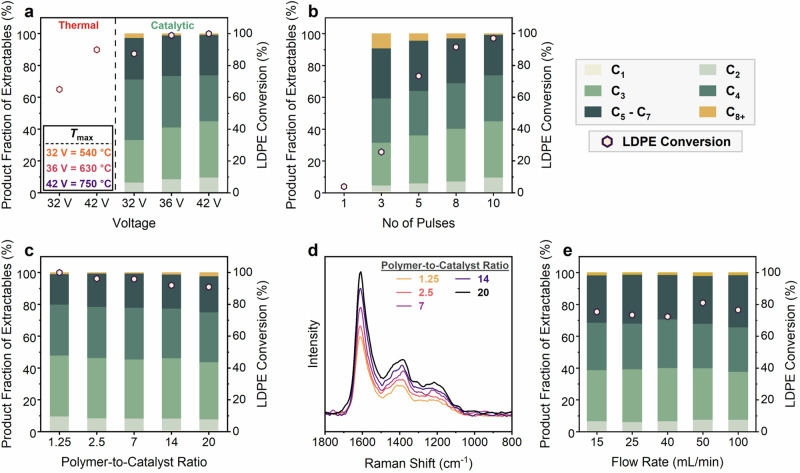
The chemical deconstruction of polyolefins to fuels, lubricants, and waxes offers a promising strategy for mitigating their accumulation in landfills and the environment. Yet, achieving true recyclability of polyolefins into C-C monomers with high yields, low energy demand, and low carbon dioxide emissions under realistic polymer-to-catalyst ratios remains elusive. Here, we demonstrate a single-step electrified approach utilizing Rapid Joule Heating over an H-ZSM-5 catalyst to efficiently deconstruct polyolefin plastic waste into light olefins (C-C) in milliseconds, with high productivity at much higher polymer-to-catalyst ratio than prior work. The catalyst is essential in producing a narrow distribution of light olefins. Pulsed operation and steam co-feeding enable highly selective deconstruction (product fraction of >90% towards C-C hydrocarbons) with minimal catalyst deactivation compared to Continuous Joule Heating. This laboratory-scale approach demonstrates effective deconstruction of real-life waste materials, resilience to additives and impurities, and versatility for circular polyolefin plastic waste management.
将聚烯烃化学解构为燃料、润滑剂和蜡,为减少其在垃圾填埋场和环境中的积累提供了一种很有前景的策略。然而,在实际的聚合物与催化剂比例下,以高收率、低能量需求和低二氧化碳排放将聚烯烃真正回收为碳 - 碳单体仍然难以实现。在此,我们展示了一种单步电气化方法,利用在H - ZSM - 5催化剂上的快速焦耳加热,在几毫秒内将聚烯烃塑料废料高效解构为轻质烯烃(碳 - 碳),在比先前工作高得多的聚合物与催化剂比例下具有高生产率。该催化剂对于产生窄分布的轻质烯烃至关重要。与连续焦耳加热相比,脉冲操作和蒸汽共进料能够实现高度选择性的解构(碳 - 碳烃的产物分数>90%),同时催化剂失活最小。这种实验室规模的方法展示了对实际废料的有效解构、对添加剂和杂质的耐受性以及用于聚烯烃塑料废料循环管理的通用性。