Department of Ultrasound, The Central Hospital of Wuhan, Tongji Medical College, Huazhong University of Science and Technology, Wuhan, 430014, China.
Department of Medical Ultrasound, Tongji Hospital, Tongji Medical College, Huazhong University of Science and Technology, Wuhan, 430014, China.
BMC Cancer. 2024 Jul 7;24(1):810. doi: 10.1186/s12885-024-12546-6.
The recurrence of papillary thyroid carcinoma (PTC) is not unusual and associated with risk of death. This study is aimed to construct a nomogram that combines clinicopathological characteristics and ultrasound radiomics signatures to predict the recurrence in PTC.
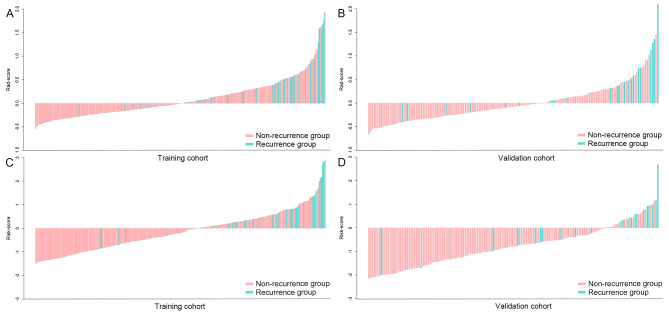
A total of 554 patients with PTC who underwent ultrasound imaging before total thyroidectomy were included. Among them, 79 experienced at least one recurrence. Then 388 were divided into the training cohort and 166 into the validation cohort. The radiomics features were extracted from the region of interest (ROI) we manually drew on the tumor image. The feature selection was conducted using Cox regression and least absolute shrinkage and selection operator (LASSO) analysis. And multivariate Cox regression analysis was used to build the combined nomogram using radiomics signatures and significant clinicopathological characteristics. The efficiency of the nomogram was evaluated by receiver operating characteristic (ROC) curves, calibration curves and decision curve analysis (DCA). Kaplan-Meier analysis was used to analyze the recurrence-free survival (RFS) in different radiomics scores (Rad-scores) and risk scores.
The combined nomogram demonstrated the best performance and achieved an area under the curve (AUC) of 0.851 (95% CI: 0.788 to 0.913) in comparison to that of the radiomics signature and the clinical model in the training cohort at 3 years. In the validation cohort, the combined nomogram (AUC = 0.885, 95% CI: 0.805 to 0.930) also performed better. The calibration curves and DCA verified the clinical usefulness of combined nomogram. And the Kaplan-Meier analysis showed that in the training cohort, the cumulative RFS in patients with higher Rad-score was significantly lower than that in patients with lower Rad-score (92.0% vs. 71.9%, log rank P < 0.001), and the cumulative RFS in patients with higher risk score was significantly lower than that in patients with lower risk score (97.5% vs. 73.5%, log rank P < 0.001). In the validation cohort, patients with a higher Rad-score and a higher risk score also had a significantly lower RFS.
We proposed a nomogram combining clinicopathological variables and ultrasound radiomics signatures with excellent performance for recurrence prediction in PTC patients.
甲状腺乳头状癌(PTC)的复发并不罕见,且与死亡风险相关。本研究旨在构建一个列线图,该列线图结合临床病理特征和超声放射组学特征,以预测 PTC 的复发。
共纳入 554 例在全甲状腺切除术前接受超声成像的 PTC 患者,其中 79 例至少经历了一次复发。然后将其中 388 例患者分为训练队列,166 例患者分为验证队列。从我们手动绘制在肿瘤图像上的感兴趣区域(ROI)中提取放射组学特征。使用 Cox 回归和最小绝对值收缩和选择算子(LASSO)分析进行特征选择。然后使用多变量 Cox 回归分析将放射组学特征和有意义的临床病理特征结合起来构建联合列线图。通过接收者操作特征(ROC)曲线、校准曲线和决策曲线分析(DCA)评估列线图的效率。Kaplan-Meier 分析用于分析不同放射组学评分(Rad-scores)和风险评分的无复发生存率(RFS)。
与放射组学特征和临床模型相比,联合列线图在训练队列中 3 年时的表现最佳,其曲线下面积(AUC)为 0.851(95%CI:0.788 至 0.913)。在验证队列中,联合列线图(AUC=0.885,95%CI:0.805 至 0.930)也表现更好。校准曲线和 DCA 验证了联合列线图的临床实用性。Kaplan-Meier 分析表明,在训练队列中,Rad-score 较高的患者累积 RFS 明显低于 Rad-score 较低的患者(92.0% vs. 71.9%,对数秩 P<0.001),风险评分较高的患者累积 RFS 明显低于风险评分较低的患者(97.5% vs. 73.5%,对数秩 P<0.001)。在验证队列中,Rad-score 和风险评分较高的患者也具有显著较低的 RFS。
我们提出了一种结合临床病理变量和超声放射组学特征的列线图,该列线图在预测 PTC 患者的复发方面具有出色的性能。