Department of Otorhinolaryngology, Gangnam Severance Hospital, Yonsei University College of Medicine, 211 Eonju-ro, Gangnam-gu, Seoul, 06273, Korea.
Department of Otorhinolaryngology-Head and Neck Surgery, Pusan National University School of Medicine, Pusan National University and Biomedical Research Institute, Pusan National University Hospital, 1-10 Ami-Dong, Seo-Gu, Busan, 602-739, Korea.
Sci Rep. 2021 Mar 2;11(1):4948. doi: 10.1038/s41598-021-84504-2.
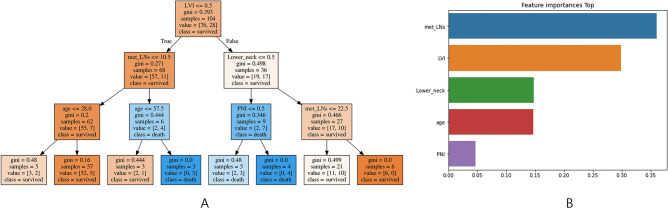
This study analyzed the prognostic significance of clinico-pathologic factors, including the number of metastatic lymph nodes (LNs) and lymph node ratio (LNR), in patients with papillary thyroid carcinoma (PTC), and attempted to construct a disease recurrence prediction model using machine learning techniques. We retrospectively analyzed clinico-pathologic data from 1040 patients diagnosed with PTC between 2003 and 2009. We analyzed clinico-pathologic factors related to recurrence through logistic regression analysis. Among the factors that we included, only sex and tumor size were significantly correlated with disease recurrence. Parameters such as age, sex, tumor size, tumor multiplicity, ETE, ENE, pT, pN, ipsilateral central LN metastasis, contralateral central LNs metastasis, number of metastatic LNs, and LNR were input for construction of a machine learning prediction model. The performance of five machine learning models related to recurrence prediction was compared based on accuracy. The Decision Tree model showed the best accuracy at 95%, and the lightGBM and stacking model together showed 93% accuracy. Among those factors mentioned above, LNR and contralateral LN metastasis were used as important features in all machine learning prediction models. We confirmed that all machine learning prediction models showed an accuracy of 90% or more for predicting disease recurrence in PTC. LNR and contralateral LN metastasis were used as important features for constructing a robust machine learning prediction model. In the future, we have a plan to perform large-scale multicenter clinical studies to improve the performance of our prediction models and verify their clinical effectiveness.
本研究分析了包括转移淋巴结(LNs)数量和淋巴结比率(LNR)在内的临床病理因素对甲状腺乳头状癌(PTC)患者的预后意义,并尝试使用机器学习技术构建疾病复发预测模型。我们回顾性分析了 2003 年至 2009 年间诊断为 PTC 的 1040 例患者的临床病理数据。我们通过逻辑回归分析分析了与复发相关的临床病理因素。在我们纳入的因素中,只有性别和肿瘤大小与疾病复发显著相关。年龄、性别、肿瘤大小、肿瘤多发性、ETE、ENE、pT、pN、同侧中央淋巴结转移、对侧中央淋巴结转移、转移淋巴结数量和 LNR 等参数被输入到机器学习预测模型中进行构建。基于准确性比较了五种与复发预测相关的机器学习模型的性能。决策树模型的准确性最高,为 95%,而 lightGBM 和堆叠模型的准确性均为 93%。在上述因素中,LNR 和对侧淋巴结转移是所有机器学习预测模型中重要的特征。我们证实,所有机器学习预测模型对预测 PTC 疾病复发的准确性均达到 90%或更高。LNR 和对侧淋巴结转移是构建稳健机器学习预测模型的重要特征。未来,我们计划进行大规模多中心临床研究,以提高预测模型的性能并验证其临床效果。