Kienbacher Calvin Lukas, Schoergenhofer Christian, Ruzicka Gerhard, Grafeneder Jürgen, Hufnagl Christine, Jilma Bernd, Schwameis Michael, Herkner Harald
Department of Emergency Medicine, Medical University of Vienna, Vienna, Austria.
Department of Clinical Pharmacology, Medical University of Vienna, Vienna, Austria.
Res Pract Thromb Haemost. 2024 Apr 27;8(4):102425. doi: 10.1016/j.rpth.2024.102425. eCollection 2024 May.
Biomarkers of fibrinolysis are elevated during acute immunologic reactions (allergic reactions and angioedema), although it is unclear whether fibrinolysis is associated with disease severity.
We investigated a possible association between maximum lysis (ML) measured by thromboelastography and the severity of acute immunologic reactions.
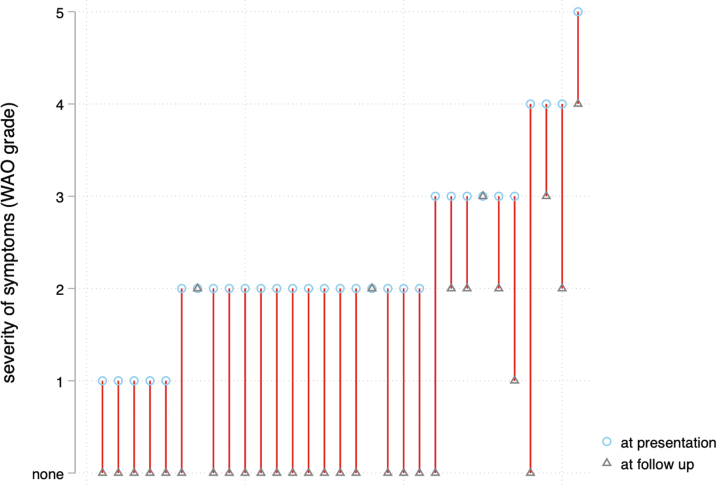
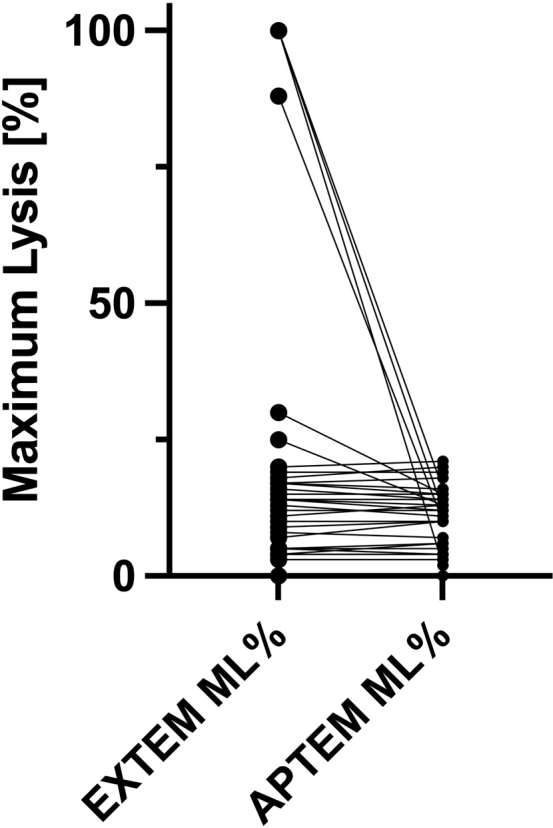
We recruited patients with acute immunologic reactions at a high-volume emergency department. Clinical disease severity at presentation and at the end of the emergency department stay was assessed using a 5-grade scale, ranging from local symptoms to cardiac arrest. We determined ML on admission by thromboelastography (ROTEM's extrinsic [EXTEM], and aprotinin [APTEM] tests), expressed as ML%. Hyperfibrinolysis was defined as an ML of >15% in EXTEM, which was reversed by adding aprotinin (APTEM). We used exact logistic regression to investigate an association between ML% and disease severity (grades 1 and 2 [mild] vs 3-5 [severe]) and between hyperfibrinolysis and disease severity.
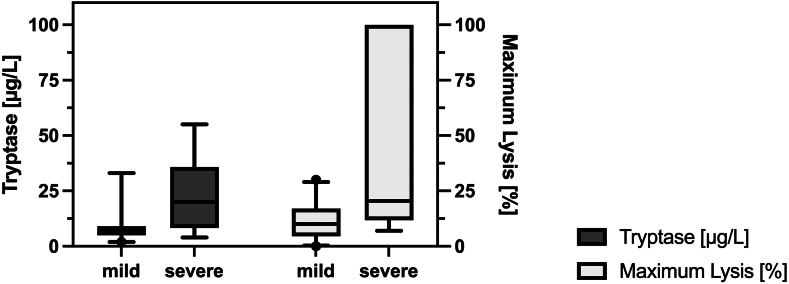
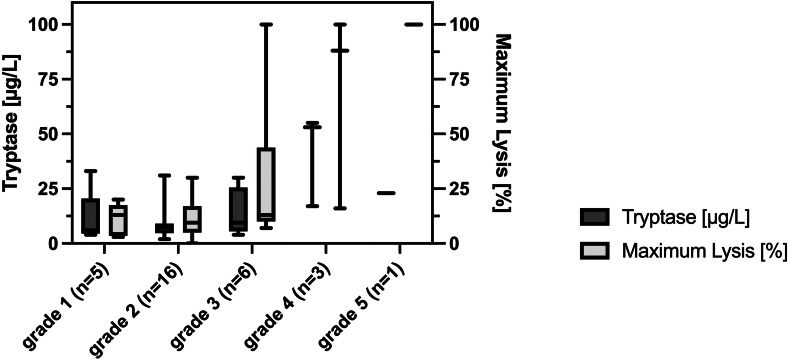
We included 31 patients (71% female; median age, 52 [IQR, 35-58] years; 10 [32%] with a severe reaction). ML% was higher in patients with severe symptoms (21 [IQR, 12-100] vs 10 [IQR, 4-17]). Logistic regression found a significant association between ML% and symptom severity (odds ratio, 1.07; 95% CI, 1.01-1.21; = .003). Hyperfibrinolysis was detected in 6 patients and found to be associated with severe symptoms (odds ratio, 17.59; 95% CI, 1.52-991.09; = .02). D-dimer, tryptase, and immunoglobulin E concentrations increased with the severity of immunologic reactions.
ML, quantified by thromboelastography, is associated with the severity of acute immunologic reactions.
尽管尚不清楚纤维蛋白溶解是否与疾病严重程度相关,但在急性免疫反应(过敏反应和血管性水肿)期间,纤维蛋白溶解的生物标志物会升高。
我们研究了通过血栓弹力图测量的最大溶解率(ML)与急性免疫反应严重程度之间的可能关联。
我们在一家大型急诊科招募了急性免疫反应患者。使用从局部症状到心脏骤停的5级量表评估就诊时和急诊科留观结束时的临床疾病严重程度。我们通过血栓弹力图(ROTEM的外源性[EXTEM]和抑肽酶[APTEM]检测)在入院时测定ML,以ML%表示。高纤维蛋白溶解定义为EXTEM中ML>15%,添加抑肽酶(APTEM)后可逆转。我们使用精确逻辑回归来研究ML%与疾病严重程度(1级和2级[轻度]与3 - 5级[重度])之间以及高纤维蛋白溶解与疾病严重程度之间的关联。
我们纳入了31例患者(71%为女性;中位年龄52岁[四分位间距,35 - 58岁];10例[32%]有严重反应)。有严重症状的患者ML%更高(21[四分位间距,12 - 100]对10[四分位间距,4 -