Abed Amin, Torabi Mahmoud, Mashreghi Zeinab
Department of Community Health Sciences, University of Manitoba, Winnipeg, Manitoba, R3E 0W3, Canada.
Department of Mathematics and Statistics, University of Winnipeg, Winnipeg, Manitoba, R3B 2E9, Canada.
Infect Dis Model. 2024 May 31;9(4):1045-1056. doi: 10.1016/j.idm.2024.05.009. eCollection 2024 Dec.
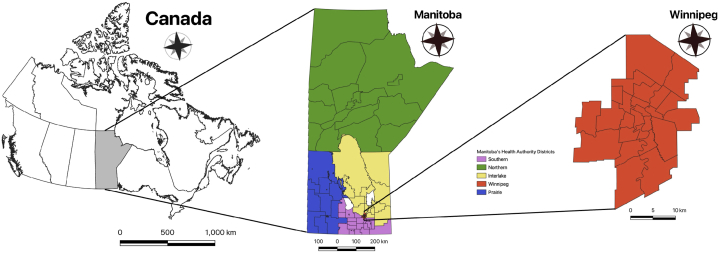
In Canada, Gonorrhea infection ranks as the second most prevalent sexually transmitted infection. In 2018, Manitoba reported an incidence rate three times greater than the national average. This study aims to investigate the spatial, temporal, and spatio-temporal patterns of Gonorrhea infection in Manitoba, using individual-level laboratory-confirmed administrative data provided by Manitoba Health from 2000 to 2016. Age and sex patterns indicate that females are affected by infections at younger ages compared to males. Moreover, there is an increase in repeated infections in 2016, accounting for 16% of the total infections. Spatial analysis at the 96 Manitoba regional health authority districts highlights significant positive spatial autocorrelation, demonstrating a clustered distribution of the infection. Northern districts of Manitoba and central Winnipeg were identified as significant clusters. Temporal analysis shows seasonal patterns, with higher infections in late summer and fall. Additionally, spatio-temporal analysis reveals clusters during high-risk periods, with the most likely cluster in the northern districts of Manitoba from January 2006 to June 2014, and a secondary cluster in central Winnipeg from June 2004 to November 2012. This study identifies that Gonorrhea infection transmission in Manitoba has temporal, spatial, and spatio-temporal variations. The findings provide vital insights for public health and Manitoba Health by revealing high-risk clusters and emphasizing the need for focused and localized prevention, control measures, and resource allocation.
在加拿大,淋病感染是第二大最常见的性传播感染。2018年,曼尼托巴省报告的发病率是全国平均水平的三倍。本研究旨在利用曼尼托巴省卫生部提供的2000年至2016年个人层面实验室确诊的行政数据,调查曼尼托巴省淋病感染的空间、时间和时空模式。年龄和性别模式表明,与男性相比,女性在更年轻的时候受到感染影响。此外,2016年重复感染有所增加,占总感染数的16%。对曼尼托巴省96个地区卫生当局辖区的空间分析突出了显著的正空间自相关性,表明感染呈聚集分布。曼尼托巴省北部地区和温尼伯市中心被确定为显著聚集区。时间分析显示出季节性模式,夏末和秋季感染率较高。此外,时空分析揭示了高危时期的聚集情况,2006年1月至2014年6月曼尼托巴省北部地区是最可能的聚集区,2004年6月至2012年11月温尼伯市中心是次要聚集区。本研究确定,曼尼托巴省淋病感染传播存在时间、空间和时空变异。这些发现通过揭示高危聚集区并强调需要有针对性的局部预防、控制措施和资源分配,为公共卫生和曼尼托巴省卫生部提供了重要见解。