Department of Animal Science and Biotechnology, College of Ecology and Environmental Science, Kyungpook National University, Sangju, Republic of Korea.
Department of Ecological Science, College of Ecology and Environmental Science, Kyungpook National University, Sangju, Republic of Korea.
PLoS Negl Trop Dis. 2024 Jul 8;18(7):e0012306. doi: 10.1371/journal.pntd.0012306. eCollection 2024 Jul.
Rodents are recognized as major reservoirs of numerous zoonotic pathogens and are involved in the transmission and maintenance of infectious diseases. Furthermore, despite their importance, diseases transmitted by rodents have been neglected. To date, there have been limited epidemiological studies on rodents, and information regarding their involvement in infectious diseases in the Republic of Korea (ROK) is still scarce.
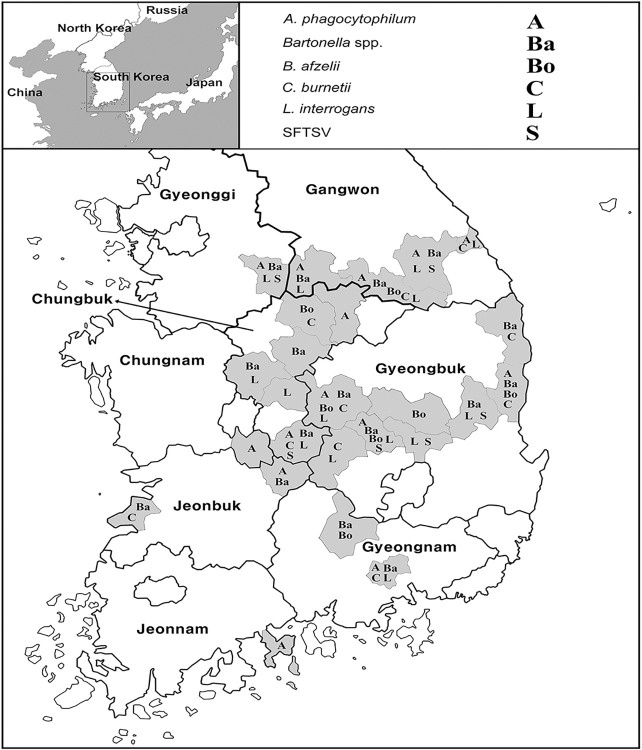
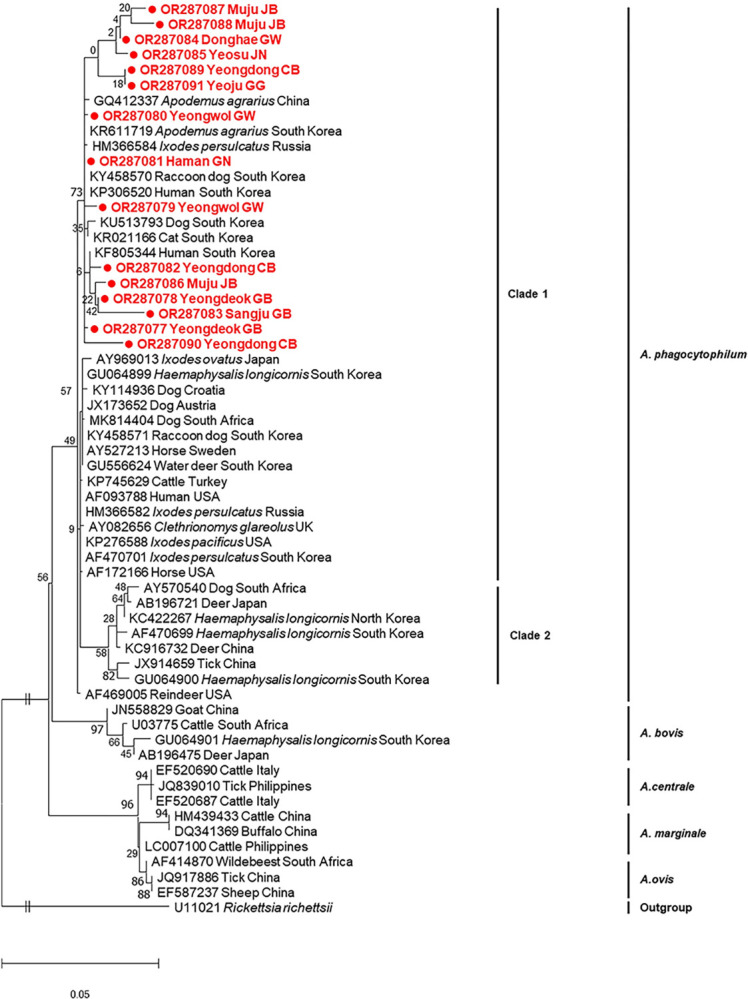
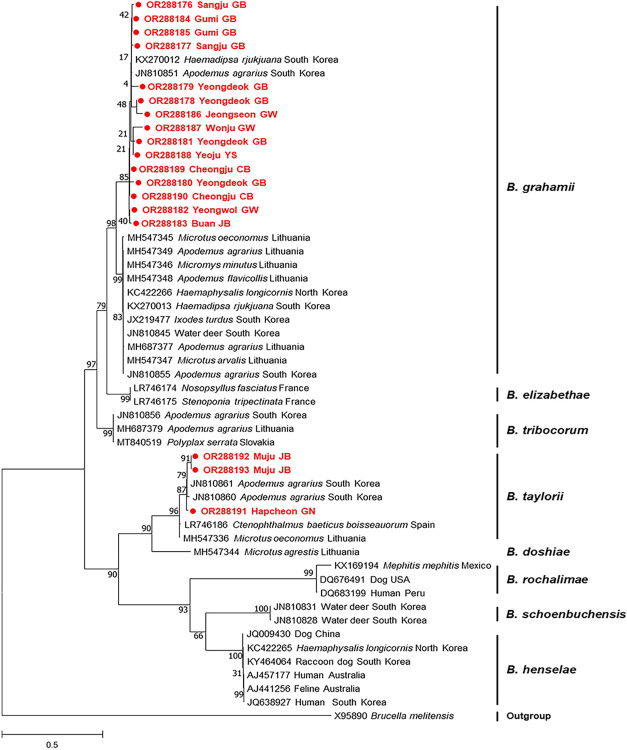
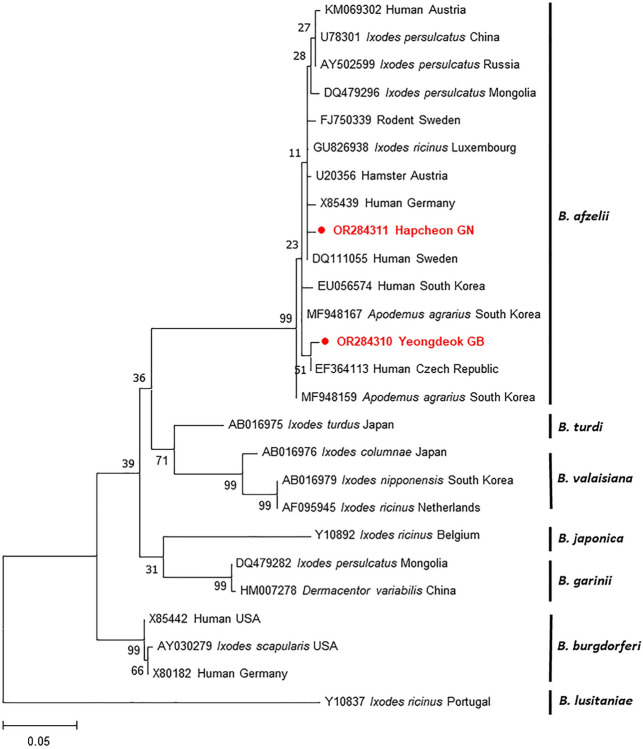
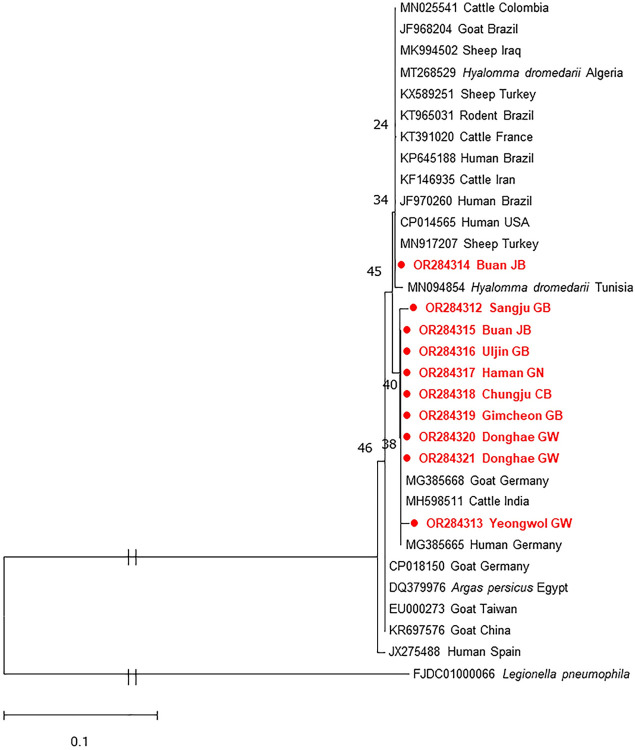
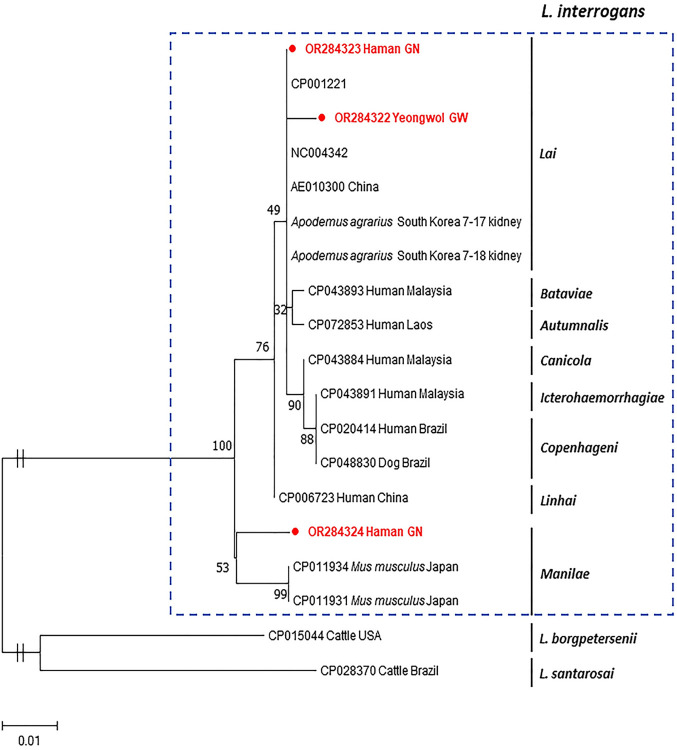
METHODOLOGY/PRINCIPAL FINDINGS: We investigated rodent-borne pathogens using nested PCR/RT-PCR from 156 rodents including 151 Apodemus agrarius and 5 Rattus norvegicus from 27 regions in eight provinces across the ROK between March 2019 and November 2020. Spleen, kidney, and blood samples were used to detect Anaplasma phagocytophilum, Bartonella spp., Borrelia burgdorferi sensu lato group, Coxiella burnetii, Leptospira interrogans, and severe fever with thrombocytopenia syndrome virus (SFTSV). Of the 156 rodents, 73 (46.8%) were infected with Bartonella spp., 25 (16.0%) with C. burnetii, 24 (15.4%) with L. interrogans, 21 (13.5%) with A. phagocytophilum, 9 (5.8%) with SFTSV, and 5 (3.2%) with Borrelia afzelii. Co-infections with two and three pathogens were detected in 33 (21.1%) and 11 rodents (7.1%), respectively. A. phagocytophilum was detected in all regions, showing a widespread occurrence in the ROK. The infection rates of Bartonella spp. were 83.3% for B. grahamii and 16.7% for B. taylorii.
CONCLUSIONS/SIGNIFICANCE: To the best of our knowledge, this is the first report of C. burnetii and SFTSV infections in rodents in the ROK. This study also provides the first description of various rodent-borne pathogens through an extensive epidemiological survey in the ROK. These results suggest that rodents harbor various pathogens that pose a potential threat to public health in the ROK. Our findings provide useful information on the occurrence and distribution of zoonotic pathogens disseminated among rodents and emphasize the urgent need for rapid diagnosis, prevention, and control strategies for these zoonotic diseases.
啮齿动物被认为是许多人畜共患病病原体的主要宿主,它们在传染病的传播和维持中发挥作用。此外,尽管它们很重要,但由啮齿动物传播的疾病却被忽视了。迄今为止,对啮齿动物的流行病学研究有限,关于它们在韩国(ROK)传染病中的作用的信息仍然很少。
方法/主要发现:我们使用巢式 PCR/RT-PCR 从 2019 年 3 月至 2020 年 11 月在 ROK 的八个省份的 27 个地区从 156 只啮齿动物(包括 151 只 A. agrarius 和 5 只 R. norvegicus)中检测到啮齿动物传播的病原体。脾、肾和血样用于检测嗜吞噬细胞无形体、巴尔通体属、伯氏疏螺旋体、贝纳柯克斯体、钩端螺旋体和发热伴血小板减少综合征病毒(SFTSV)。在 156 只啮齿动物中,73 只(46.8%)感染了巴尔通体属,25 只(16.0%)感染了贝纳柯克斯体,24 只(15.4%)感染了钩端螺旋体,21 只(13.5%)感染了嗜吞噬细胞无形体,9 只(5.8%)感染了发热伴血小板减少综合征病毒,5 只(3.2%)感染了伯氏疏螺旋体。在 33 只(21.1%)和 11 只啮齿动物(7.1%)中检测到两种和三种病原体的合并感染。嗜吞噬细胞无形体在所有地区均有检出,在 ROK 广泛存在。巴尔通体属的感染率为 83.3%的 B. grahamii 和 16.7%的 B. taylorii。
结论/意义:据我们所知,这是在 ROK 首次报告啮齿动物感染贝纳柯克斯体和发热伴血小板减少综合征病毒。本研究还通过在 ROK 进行广泛的流行病学调查,首次描述了各种啮齿动物传播的病原体。这些结果表明,啮齿动物携带各种对 ROK 公共卫生构成潜在威胁的病原体。我们的研究结果提供了有关在啮齿动物中传播的人畜共患病病原体的发生和分布的有用信息,并强调迫切需要针对这些人畜共患病制定快速诊断、预防和控制策略。