Marine Science Institute, University of California, Santa Barbara, CA 93106.
Bren School of Environmental Science and Management, University of California, Santa Barbara, CA 93106.
Proc Natl Acad Sci U S A. 2024 Jul 16;121(29):e2400592121. doi: 10.1073/pnas.2400592121. Epub 2024 Jul 9.
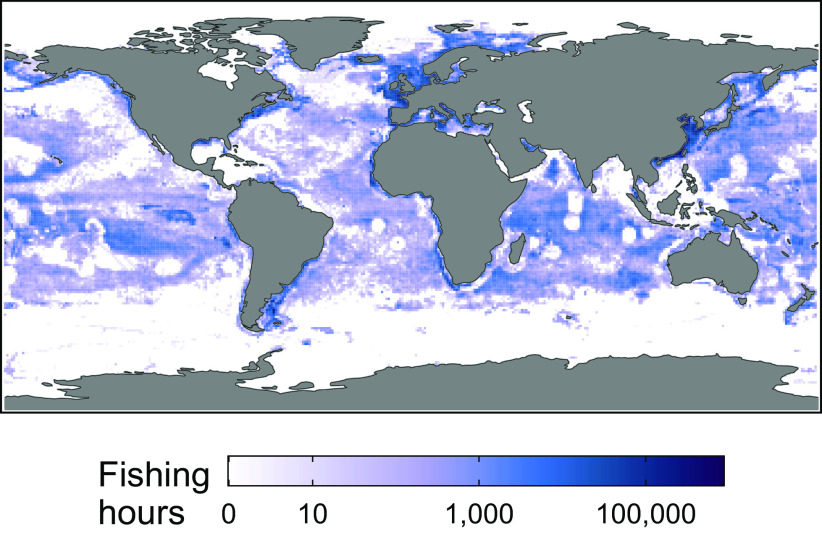
The expansion of marine protected areas (MPAs) is a core focus of global conservation efforts, with the "30x30" initiative to protect 30% of the ocean by 2030 serving as a prominent example of this trend. We consider a series of proposed MPA network expansions of various sizes, and we forecast the impact this increase in protection would have on global patterns of fishing effort. We do so by building a predictive machine learning model trained on a global dataset of satellite-based fishing vessel monitoring data, current MPA locations, and spatiotemporal environmental, geographic, political, and economic features. We then use this model to predict future fishing effort under various MPA expansion scenarios compared to a business-as-usual counterfactual scenario that includes no new MPAs. The difference between these scenarios represents the predicted change in fishing effort associated with MPA expansion. We find that regardless of the MPA network objectives or size, fishing effort would decrease inside the MPAs, though by much less than 100%. Moreover, we find that the reduction in fishing effort inside MPAs does not simply redistribute outside-rather, fishing effort outside MPAs would also decline. The overall magnitude of the predicted decrease in global fishing effort principally depends on where networks are placed in relation to existing fishing effort. MPA expansion will lead to a global redistribution of fishing effort that should be accounted for in network design, implementation, and impact evaluation.
扩大海洋保护区 (MPA) 是全球保护努力的核心重点,到 2030 年保护 30%的海洋的“30x30”倡议就是这一趋势的突出例证。我们考虑了一系列不同规模的拟议 MPA 网络扩展,并预测了这种保护增加对全球渔业努力模式的影响。我们通过构建一个基于卫星渔业船只监测数据、当前 MPA 位置以及时空环境、地理、政治和经济特征的全球数据集的预测性机器学习模型来做到这一点。然后,我们使用该模型在各种 MPA 扩展情景下预测未来的渔业努力,与不包括新 MPA 的常规情景进行比较。这些情景之间的差异代表了与 MPA 扩展相关的渔业努力的预测变化。我们发现,无论 MPA 网络目标或规模如何,MPA 内的渔业努力都会减少,但减少幅度远低于 100%。此外,我们发现 MPA 内渔业努力的减少并不是简单地重新分配,而是 MPA 外的渔业努力也会减少。全球渔业努力预计减少的总体幅度主要取决于网络相对于现有渔业努力的位置。MPA 扩展将导致渔业努力的全球重新分配,在网络设计、实施和影响评估中应考虑到这一点。