Leibovitzh Haim, Nayeri Shadi, Borowski Krzysztof, Hernandez-Rocha Cristian, Lee Sun-Ho, Turpin Williams, Stempak Joanne M, Sandhu Iqbaljit, Milgrom Raquel, Smith Michelle I, Croitoru Kenneth, Hirschfield Gideon M, Gulamhusein Aliya, Silverberg Mark S
Temetry Faculty of Medicine, Department of Medicine, University of Toronto, Toronto, Canada.
Zane Cohen Centre for Digestive Diseases - Mount Sinai Hospital, Lunenfeld-Tanenbaum Research Institute, Sinai Health System, Toronto, Canada.
J Crohns Colitis. 2024 Jul 9;18(12):1957-66. doi: 10.1093/ecco-jcc/jjae096.
Primary sclerosing cholangitis associated with inflammatory bowel disease (IBD-PSC) carries significant morbidity compared to IBD without PSC. Alterations in microbial composition and bile acid (BA) profiles have been shown to modulate chronic inflammation in IBD, but data in IBD-PSC is scarce. We aimed to assess the differences in gut microbiome composition as well as in the BA profile and BA-related microbial functions between IBD-PSC and IBD-only.
54 IBD-PSC and 62 IBD-only subjects were enrolled from 2012 to 2021. Baseline samples were collected for fecal DNA shotgun metagenomic sequencing, fecal and serum BA quantitation using mass spectrometry and fecal calprotectin. Liver fibrosis measured by transient elastography (TE) was assessed in the IBD-PSC group. Data was analyzed using general linear regression models and Spearman rank correlation tests.
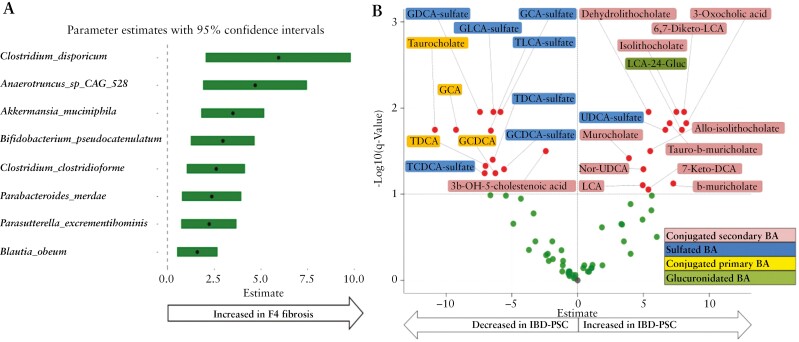
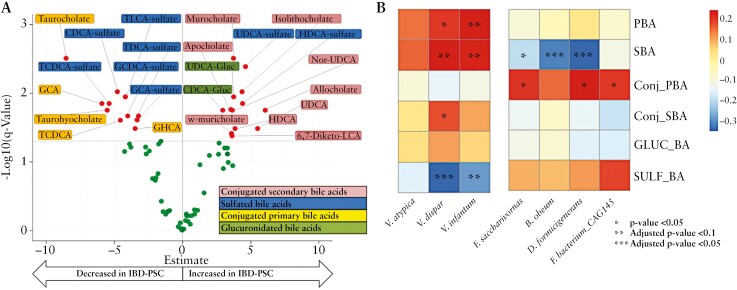
Patients with IBD-PSC had reduced microbial gene richness (p=0.004) and significant compositional shifts (PERMANOVA: R2=0.01, p=0.03) compared to IBD-only. IBD-PSC was associated with altered microbial composition and function, including decreased abundance of Blautia obeum, increased abundance of Veillonella atypica, Veillonella dispar and Clostridium scindens (q<0.05 for all), and increased abundance of microbial genes involved in secondary BA metabolism. Decreased serum sulfated and increased serum conjugated secondary BA were associated with IBD-PSC and increased liver fibrosis.
We identified differences in microbial species, functional capacity and serum BA profiles in IBD-PSC compared with IBD-only. Our findings provide insight into the pathophysiology of IBD associated with PSC and suggest possible targets for modulating the risk and course of IBD in subjects with PSC.
与无原发性硬化性胆管炎(PSC)的炎症性肠病(IBD)相比,IBD相关的原发性硬化性胆管炎(IBD-PSC)具有更高的发病率。微生物组成和胆汁酸(BA)谱的改变已被证明可调节IBD中的慢性炎症,但IBD-PSC方面的数据较少。我们旨在评估IBD-PSC与单纯IBD在肠道微生物群组成、BA谱以及与BA相关的微生物功能方面的差异。
2012年至2021年纳入了54例IBD-PSC患者和62例单纯IBD患者。采集基线样本用于粪便DNA鸟枪法宏基因组测序、使用质谱法进行粪便和血清BA定量以及粪便钙卫蛋白检测。在IBD-PSC组中通过瞬时弹性成像(TE)评估肝纤维化情况。使用一般线性回归模型和Spearman等级相关检验对数据进行分析。
与单纯IBD相比,IBD-PSC患者的微生物基因丰富度降低(p=0.004),且有显著的组成变化(PERMANOVA:R2=0.01,p=0.03)。IBD-PSC与微生物组成和功能改变有关,包括奥氏布劳特氏菌丰度降低、非典型韦荣球菌、差异韦荣球菌和分裂梭菌丰度增加(所有q<0.05),以及参与次级BA代谢的微生物基因丰度增加。血清硫酸化BA降低和血清结合次级BA增加与IBD-PSC及肝纤维化增加有关。
我们发现IBD-PSC与单纯IBD相比,在微生物种类、功能能力和血清BA谱方面存在差异。我们的研究结果为与PSC相关的IBD的病理生理学提供了见解,并为调节PSC患者IBD的风险和病程提出了可能的靶点。