Kong Ling-Xia, Zhao Yan-Hong, Feng Zhi-Lin, Liu Ting-Ting
Department of Breast Surgery, The First Affiliated Hospital of Hebei North University, Zhangjiakou 075000, Hebei Province, China.
Operating Room, The First Affiliated Hospital of Hebei North University, Zhangjiakou 075000, Hebei Province, China.
World J Psychiatry. 2024 Jun 19;14(6):876-883. doi: 10.5498/wjp.v14.i6.876.
Breast cancer is among the most common malignancies worldwide. With progress in treatment methods and levels, the overall survival period has been prolonged, and the demand for quality care has increased.
To investigate the effect of individualized and continuous care intervention in patients with breast cancer.
Two hundred patients with breast cancer who received systemic therapy at The First Affiliated Hospital of Hebei North University (January 2021 to July 2023) were retrospectively selected as research participants. Among them, 134 received routine care intervention (routing group) and 66 received personalized and continuous care (intervention group). Self-rating anxiety scale (SAS), self-rating depression scale (SDS), and Functional Assessment of Cancer Therapy-Breast (FACT-B) scores, including limb shoulder joint activity, complication rate, and care satisfaction, were compared between both groups after care.
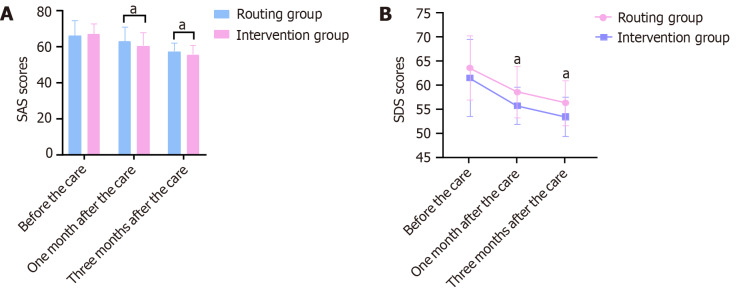
SAS and SDS scores were lower in the intervention group than in the routing group at one and three months after care. The total FACT-B scores and five dimensions in the intervention group were higher than those in the routing group at three months of care. The range of motion of shoulder anteflexion, posterior extension, abduction, internal rotation, and external rotation in the intervention group was higher than that in the routing group one month after care. The incidence of postoperative complications was 18.18% lower in the intervention group than in the routing group (34.33%; <0.05). Satisfaction with care was 90.91% higher in the intervention group than in the routing group (78.36%; <0.05).
Personalized and continuous care can alleviate negative emotions in patients with breast cancer, quicken rehabilitation of limb function, decrease the incidence of complications, and improve living quality and care satisfaction.
乳腺癌是全球最常见的恶性肿瘤之一。随着治疗方法和水平的进步,总体生存期得以延长,对优质护理的需求也在增加。
探讨个体化延续性护理干预对乳腺癌患者的影响。
回顾性选取2021年1月至2023年7月在河北北方学院附属第一医院接受系统治疗的200例乳腺癌患者作为研究对象。其中,134例接受常规护理干预(常规组),66例接受个性化延续性护理(干预组)。比较两组护理后自我评定焦虑量表(SAS)、自我评定抑郁量表(SDS)及癌症治疗功能评价量表-乳腺癌(FACT-B)评分,包括肢体肩关节活动度、并发症发生率及护理满意度。
护理后1个月及3个月时,干预组SAS、SDS评分低于常规组。护理3个月时,干预组FACT-B总分及5个维度得分高于常规组。护理1个月时,干预组肩关节前屈、后伸、外展、内旋及外旋活动度均高于常规组。干预组术后并发症发生率低于常规组18.18%(34.33%;<0.05)。干预组护理满意度高于常规组90.91%(78.36%;<0.05)。
个性化延续性护理可缓解乳腺癌患者负面情绪,加快肢体功能康复,降低并发症发生率,提高生活质量及护理满意度。