Omotoye Samuel, Singleton Matthew J, Zagrodzky Jason, Clark Bradley, Sharma Dinesh, Metzl Mark D, Gallagher Mark M, Meininghaus Dirk Grosse, Leung Lisa, Garg Jalaj, Warrier Nikhil, Panico Ambrose, Tamirisa Kamala, Sanchez Javier, Mickelsen Steven, Sardana Mayank, Shah Dipak, Athill Charles, Hayat Jamal, Silva Rogelio, Clark Audra T, Gray Maria, Levi Benjamin, Kulstad Erik, Girouard Steven, Zagrodzky Will, Montoya Marcela Mercado, Bustamante Tatiana Gomez, Berjano Enrique, González-Suárez Ana, Daniels James
Cleveland Clinic, Cleveland, Ohio.
WellSpan York Hospital, York, Pennsylvania.
Heart Rhythm O2. 2024 May 15;5(6):403-416. doi: 10.1016/j.hroo.2024.05.002. eCollection 2024 Jun.
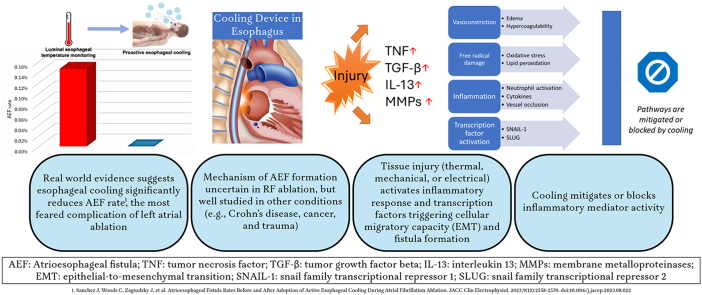
Proactive esophageal cooling for the purpose of reducing the likelihood of ablation-related esophageal injury resulting from radiofrequency (RF) cardiac ablation procedures is increasingly being used and has been Food and Drug Administration cleared as a protective strategy during left atrial RF ablation for the treatment of atrial fibrillation. In this review, we examine the evidence supporting the use of proactive esophageal cooling and the potential mechanisms of action that reduce the likelihood of atrioesophageal fistula (AEF) formation. Although the pathophysiology behind AEF formation after thermal injury from RF ablation is not well studied, a robust literature on fistula formation in other conditions (eg, Crohn disease, cancer, and trauma) exists and the relationship to AEF formation is investigated in this review. Likewise, we examine the abundant data in the surgical literature on burn and thermal injury progression as well as the acute and chronic mitigating effects of cooling. We discuss the relationship of these data and maladaptive healing mechanisms to the well-recognized postablation pathophysiological effects after RF ablation. Finally, we review additional important considerations such as patient selection, clinical workflow, and implementation strategies for proactive esophageal cooling.
为降低射频(RF)心脏消融手术导致消融相关食管损伤的可能性而进行的预防性食管冷却正越来越多地被使用,并且已获得美国食品药品监督管理局批准,作为治疗心房颤动的左心房RF消融期间的一种保护策略。在本综述中,我们研究了支持使用预防性食管冷却的证据以及降低房室食管瘘(AEF)形成可能性的潜在作用机制。尽管对于RF消融热损伤后AEF形成背后的病理生理学尚未进行充分研究,但关于其他情况(如克罗恩病、癌症和创伤)中瘘管形成的文献丰富,本综述探讨了其与AEF形成的关系。同样,我们研究了外科文献中关于烧伤和热损伤进展以及冷却的急性和慢性缓解作用的大量数据。我们讨论了这些数据和适应不良愈合机制与RF消融后公认的消融后病理生理效应之间的关系。最后,我们回顾了其他重要考虑因素,如患者选择、临床工作流程以及预防性食管冷却的实施策略。