Department of Neurology, Jeonbuk National University Hospital & School of Medicine, Jeonju, South Korea.
Research Institute of Clinical Medicine of Jeonbuk National University-Jeonbuk National University Hospital, Jeonju, South Korea.
Sci Rep. 2024 Jul 11;14(1):16013. doi: 10.1038/s41598-024-66906-0.
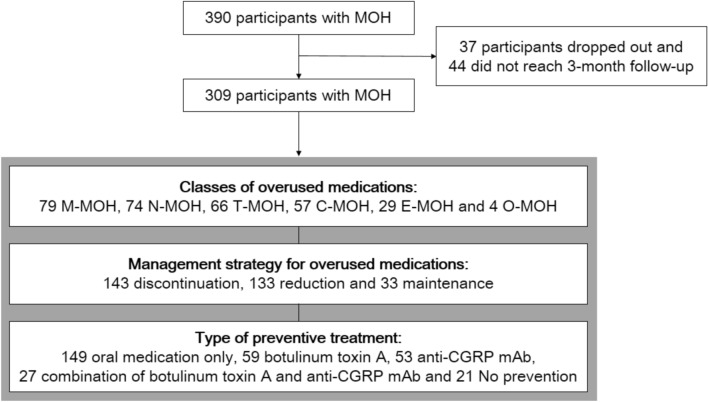
Medication overuse headache (MOH) is a chronic headache disorder that results from excessive use of acutely symptomatic headache medications, leading to more frequent and severe headaches. This study aims to assess the 3-month treatment outcomes in MOH patients, focusing on the types and usage of overused medications, as well as preventive treatments. This prospective cross-sectional study analyzed the treatment outcomes of 309 MOH patients from April 2020 to March 2022. Patients were advised to discontinue overused medications immediately and offered preventive treatments based on clinical judgment. Data on headache characteristics, medication use, and impact on daily life were collected at baseline and 3 months. Results showed overall significant improvements in headache-related variables in patients completing the 3-month treatment follow-up. The median number of headache days per month decreased from 15 days at baseline to 8 days after 3 months (p < 0.001). Patients who overused multiple drug classes demonstrated increased disability levels (mean Headache Impact Test-6 score: 62 at baseline vs. 56 at 3 months, p < 0.01). Those who continued overusing medications reported more days of severe headache (mean 18 days at baseline vs. 14 days at 3 months, p < 0.05) and greater impact (mean Migraine Disability Assessment score: 35 at baseline vs. 28 after 3 months, p < 0.05) compared to the baseline. Differences in headache outcomes were evident across different preventive treatment groups, with generalized estimating equation analyses highlighting significant associations between clinical characteristics, overused medication classes, and preventive treatments. Most MOH clinical features significantly improved after 3 months of treatment. However, notable interactions were observed with certain clinical presentations, suggesting possible influences of overused medication classes, usage patterns, and preventive treatment types on MOH treatment outcomes. This study underscores the importance of individualized treatment strategies and the potential benefits of discontinuing overused medications.
药物过度使用性头痛(MOH)是一种慢性头痛障碍,由过度使用急性对症治疗头痛药物引起,导致头痛更频繁和更严重。本研究旨在评估 MOH 患者的 3 个月治疗结果,重点关注过度使用药物的类型和使用情况,以及预防治疗。这项前瞻性横断面研究分析了 2020 年 4 月至 2022 年 3 月期间 309 名 MOH 患者的治疗结果。建议患者立即停止使用过度使用的药物,并根据临床判断提供预防治疗。在基线和 3 个月时收集头痛特征、药物使用和对日常生活影响的数据。结果显示,完成 3 个月治疗随访的患者的头痛相关变量总体有显著改善。每月头痛天数中位数从基线时的 15 天减少到 3 个月后的 8 天(p < 0.001)。过度使用多种药物类别的患者表现出更高的残疾水平(平均头痛影响测试-6 评分:基线时为 62,3 个月时为 56,p < 0.01)。继续过度使用药物的患者报告更严重的头痛天数(基线时平均 18 天,3 个月时平均 14 天,p < 0.05)和更大的影响(平均偏头痛残疾评估评分:基线时为 35,3 个月后为 28,p < 0.05)与基线相比。不同预防治疗组之间的头痛结果存在差异,广义估计方程分析强调了临床特征、过度使用药物类别和预防治疗之间的显著关联。大多数 MOH 临床特征在治疗 3 个月后显著改善。然而,观察到某些临床表现之间存在显著相互作用,表明过度使用药物类别、使用模式和预防治疗类型可能对 MOH 治疗结果产生影响。本研究强调了个体化治疗策略的重要性,以及停止过度使用药物的潜在益处。