Department of Emergency, The First Affiliated Hospital of Xiamen University, School of Medicine, Xiamen University, Xiamen, 361003, China.
Xiamen Key Laboratory for Clinical Efficacy and Evidence-Based Research of Traditional Chinese Medicine, The First Affiliated Hospital of Xiamen University, Xiamen, 361003, China.
Sci Rep. 2024 Jul 12;14(1):16078. doi: 10.1038/s41598-024-67143-1.
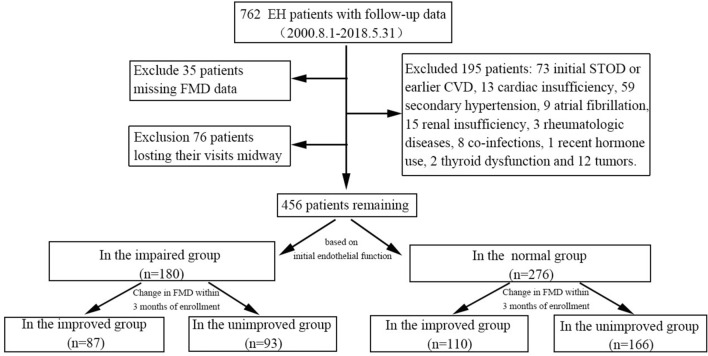
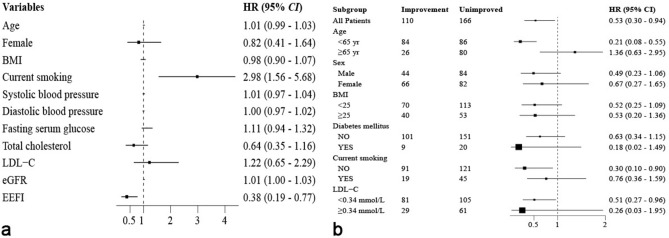
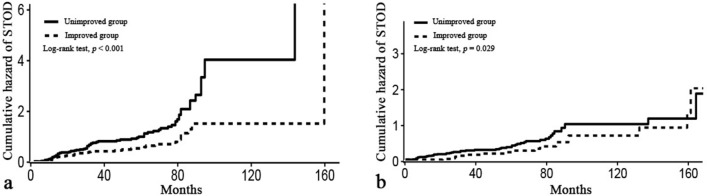
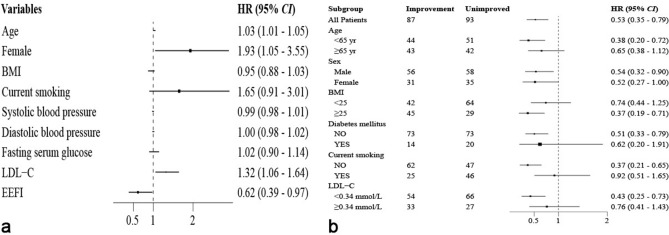
Endothelial dysfunction is acknowledged as a marker for subclinical target organ damage (STOD) in hypertension, though its therapeutic potential has not yet been clarified. This study assessed whether early endothelial function improvement (EEFI) reduced STOD in patients with essential hypertension (EH). We conducted a retrospective cohort analysis of 456 EH patients initially free from STOD. Endothelial function was assessed using brachial artery flow-mediated dilation (FMD), with values ≤ 7.1% indicating dysfunction. Patients were initially categorized by endothelial status (dysfunction: n = 180, normal: n = 276), and further divided into improved or unimproved groups based on changes within three months post-enrollment. During a median follow-up of 25 months, 177 patients developed STOD. The incidence of STOD was significantly higher in patients with initial dysfunction compared to those with normal function. Kaplan-Meier analysis indicated that the improved group had a lower cumulative incidence of STOD compared to the unimproved group (p < 0.05). Multivariable Cox regression confirmed EEFI as an independent protective factor against STOD in EH patients (p < 0.05), regardless of their baseline endothelial status, especially in those under 65 years old, non-smokers, and with low-density lipoprotein cholesterol levels ≤ 3.4 mmol/L. In conclusion, EEFI significantly reduces STOD incidence in EH patients, particularly in specific subgroups, emphasizing the need for early intervention in endothelial function to prevent STOD.
内皮功能障碍被认为是高血压亚临床靶器官损害(STOD)的标志物,但其治疗潜力尚未明确。本研究评估了原发性高血压(EH)患者早期内皮功能改善(EEFI)是否降低了 STOD。我们对最初无 STOD 的 456 例 EH 患者进行了回顾性队列分析。使用肱动脉血流介导的扩张(FMD)评估内皮功能,值≤7.1%表示功能障碍。根据内皮状态(功能障碍:n=180,正常:n=276)将患者最初分类,并根据入组后三个月内的变化进一步分为改善或未改善组。在中位数为 25 个月的随访期间,177 例患者发生了 STOD。与正常功能患者相比,初始功能障碍患者 STOD 的发生率明显更高。Kaplan-Meier 分析表明,与未改善组相比,改善组的 STOD 累积发生率较低(p<0.05)。多变量 Cox 回归证实,EEFI 是 EH 患者 STOD 的独立保护因素(p<0.05),无论其基线内皮状态如何,特别是在 65 岁以下、不吸烟且低密度脂蛋白胆固醇水平≤3.4mmol/L 的患者中。总之,EEFI 可显著降低 EH 患者的 STOD 发生率,特别是在特定亚组中,强调需要早期干预内皮功能以预防 STOD。