Case Western Reserve University, 10900 Euclid Ave., Cleveland, OH, 44106, USA.
Emory University, 1364 Clifton Road NE, Atlanta, GA, 30322, USA.
Cogn Res Princ Implic. 2024 Jul 12;9(1):46. doi: 10.1186/s41235-024-00572-8.
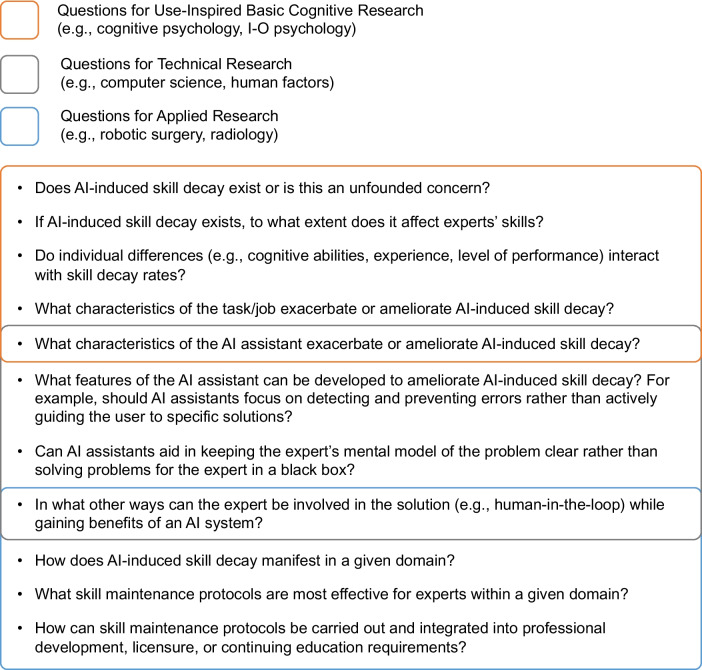
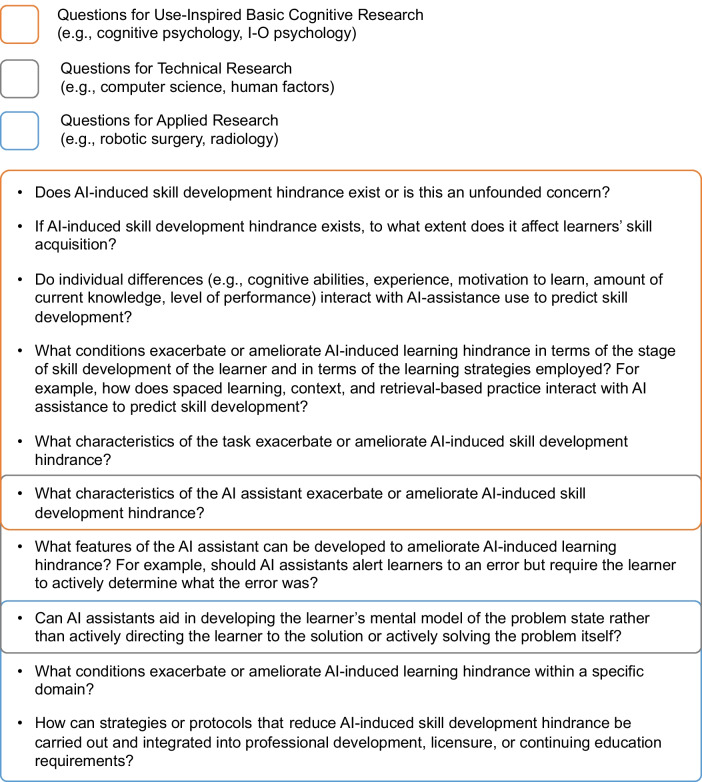
Artificial intelligence in the workplace is becoming increasingly common. These tools are sometimes used to aid users in performing their task, for example, when an artificial intelligence tool assists a radiologist in their search for abnormalities in radiographic images. The use of artificial intelligence brings a wealth of benefits, such as increasing the efficiency and efficacy of performance. However, little research has been conducted to determine how the use of artificial intelligence assistants might affect the user's cognitive skills. In this theoretical perspective, we discuss how artificial intelligence assistants might accelerate skill decay among experts and hinder skill acquisition among learners. Further, we discuss how AI assistants might also prevent experts and learners from recognizing these deleterious effects. We then discuss the types of questions: use-inspired basic cognitive researchers, applied researchers, and computer science researchers should seek to answer. We conclude that multidisciplinary research from use-inspired basic cognitive research, domain-specific applied research, and technical research (e.g., human factors research, computer science research) is needed to (a) understand these potential consequences, (b) design artificial intelligence systems to mitigate these impacts, and (c) develop training and use protocols to prevent negative impacts on users' cognitive skills. Only by answering these questions from multidisciplinary perspectives can we harness the benefits of artificial intelligence in the workplace while preventing negative impacts on users' cognitive skills.
人工智能在工作场所中变得越来越普遍。这些工具有时被用于帮助用户完成任务,例如,当人工智能工具帮助放射科医生在放射图像中寻找异常时。人工智能的使用带来了许多好处,例如提高了效率和效果。然而,很少有研究来确定人工智能助手的使用如何影响用户的认知技能。在这个理论视角中,我们讨论了人工智能助手如何加速专家技能的衰退,并阻碍学习者技能的获取。此外,我们还讨论了人工智能助手如何阻止专家和学习者认识到这些有害影响。然后,我们讨论了使用启发式基础认知研究、应用研究和计算机科学研究人员应该寻求回答的问题类型。我们得出结论,需要多学科的研究,包括使用启发式基础认知研究、特定领域的应用研究和技术研究(例如,人类因素研究、计算机科学研究),以(a)了解这些潜在的后果,(b)设计人工智能系统以减轻这些影响,以及(c)制定培训和使用协议,以防止对用户认知技能产生负面影响。只有从多学科的角度回答这些问题,我们才能在利用人工智能在工作场所中的好处的同时,防止对用户认知技能产生负面影响。