Africa Health Research Institute, KwaZulu-Natal, Durban, South Africa.
Division of Infectious Diseases, Massachusetts General Hospital, Boston, MA, United States of America.
BMC Infect Dis. 2024 Jul 11;24(1):690. doi: 10.1186/s12879-024-09583-8.
Growing evidence suggests that chronic inflammation caused by tuberculosis (TB) may increase the incidence of diabetes. However, the relationship between post-TB pulmonary abnormalities and diabetes has not been well characterized.
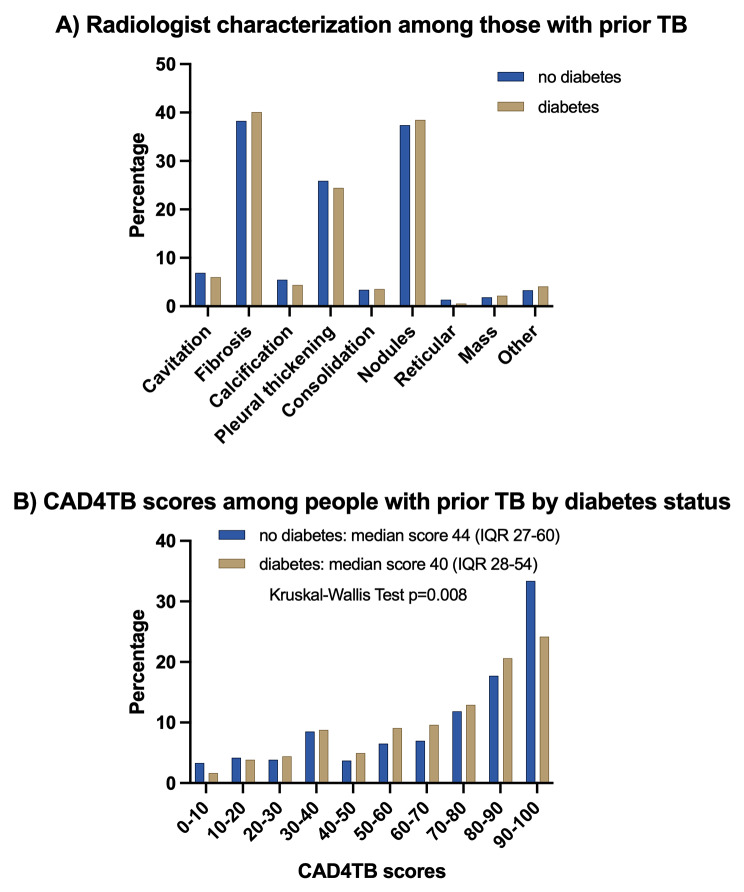
We analyzed data from a cross-sectional study in KwaZulu-Natal, South Africa, of people 15 years and older who underwent chest X-ray and diabetes screening with hemoglobin A1c testing. The analytic sample was restricted to persons with prior TB, defined by either (1) a self-reported history of TB treatment, (2) radiologist-confirmed prior TB on chest radiography, and (3) a negative sputum culture and GeneXpert. Chest X-rays of all participants were evaluated by the study radiologist to determine the presence of TB lung abnormalities. To assess the relationships between our outcome of interest, prevalent diabetes (HBA1c ≥6.5%), and our exposure of interest, chest X-ray abnormalities, we fitted logistic regression models adjusted for potential clinical and demographic confounders. In secondary analyses, we used the computer-aided detection system CAD4TB, which scores X-rays from 10 to 100 for detection of TB disease, as our exposure interest, and repeated analyses with a comparator group that had no history of TB disease.
In the analytic cohort of people with prior TB (n = 3,276), approximately two-thirds (64.9%) were women, and the average age was 50.8 years (SD 17.4). The prevalence of diabetes was 10.9%, and 53.0% of people were living with HIV. In univariate analyses, there was no association between diabetes prevalence and radiologist chest X-ray abnormalities (OR 1.23, 95%CI 0.95-1.58). In multivariate analyses, the presence of pulmonary abnormalities was associated with an 29% reduction in the odds of prevalent diabetes (aOR 0.71, 95%CI 0.53-0.97, p = 0.030). A similar inverse relationship was observed for diabetes with each 10-unit increase in the CAD4TB chest X-ray scores among people with prior TB (aOR 0.92, 95%CI 0.87-0.97; p = 0.002), but this relationship was less pronounced in the no TB comparator group (aOR 0.96, 95%CI 0.94-0.99).
Among people with prior TB, pulmonary abnormalities on digital chest X-ray are inversely associated with prevalent diabetes. The severity of radiographic post-TB lung disease does not appear to be a determinant of diabetes in this South African population.
越来越多的证据表明,由结核病(TB)引起的慢性炎症可能会增加糖尿病的发病率。然而,TB 后肺部异常与糖尿病之间的关系尚未得到很好的描述。
我们分析了南非夸祖鲁-纳塔尔省一项横断面研究的数据,该研究对象为 15 岁及以上的人群,他们接受了胸部 X 光检查和糖尿病筛查,采用血红蛋白 A1c 检测。分析样本仅限于曾患有 TB 的人,通过以下三种方法之一来定义:(1)自述有 TB 治疗史,(2)放射科医生确认胸部 X 光片上有既往 TB,(3)痰培养和 GeneXpert 均为阴性。所有参与者的胸部 X 光片均由研究放射科医生进行评估,以确定是否存在 TB 肺部异常。为评估我们感兴趣的结果(HbA1c≥6.5%的现患糖尿病)与我们感兴趣的暴露因素(胸部 X 射线异常)之间的关系,我们拟合了调整了潜在临床和人口统计学混杂因素的逻辑回归模型。在二次分析中,我们使用计算机辅助检测系统 CAD4TB 作为暴露因素,该系统对 X 射线进行评分,范围为 10 到 100,用于检测结核病,同时使用无 TB 病史的对照组进行重复分析。
在曾患有 TB 的人群的分析队列中(n=3276),约三分之二(64.9%)为女性,平均年龄为 50.8 岁(SD 17.4)。糖尿病的患病率为 10.9%,53.0%的人携带 HIV。在单变量分析中,糖尿病的患病率与放射科医生的胸部 X 射线异常之间没有关联(OR 1.23,95%CI 0.95-1.58)。在多变量分析中,肺部异常与现患糖尿病的几率降低 29%相关(aOR 0.71,95%CI 0.53-0.97,p=0.030)。在曾患有 TB 的人群中,CAD4TB 胸部 X 射线评分每增加 10 分,与糖尿病的关系呈负相关(aOR 0.92,95%CI 0.87-0.97;p=0.002),但在无 TB 的对照组中,这种关系不太明显(aOR 0.96,95%CI 0.94-0.99)。
在曾患有 TB 的人群中,数字胸部 X 光片上的肺部异常与现患糖尿病呈负相关。在南非人群中,TB 后肺部疾病的严重程度似乎不是糖尿病的决定因素。