Serrano Rebeca, Solar Málaga Soraya, González-Fernández Lauro, Gervasi María Gracia, García-Marín Luis Jesús, Bragado María Julia, Martin-Hidalgo David
Grupo de Investigación Señalización Intracelular y Tecnología de la Reproducción (SINTREP), Instituto de Investigación INBIO G+C. Universidad de Extremadura, Avenida de Elvas s/n, Badajoz, Spain.
Department of Animal Science, University of Connecticut, Connecticut, Storrs, USA.
Andrology. 2025 Mar;13(3):637-649. doi: 10.1111/andr.13691. Epub 2024 Jul 11.
Mammalian spermatozoa need to undergo a process named capacitation to be able to fertilize an oocyte. During their journey in the female tract, spermatozoa obtain energy while exposed to a changing environment containing a variety of metabolic substrates. The energy requirements for sperm capacitation are species-specific. In addition, the available energy source can hinder the process of sperm capacitation and eventually the acrosome reaction.
To evaluate whether the metabolic substrates available in the in vitro sperm capacitation medium allow or interfere with the pig sperm capacitation process.
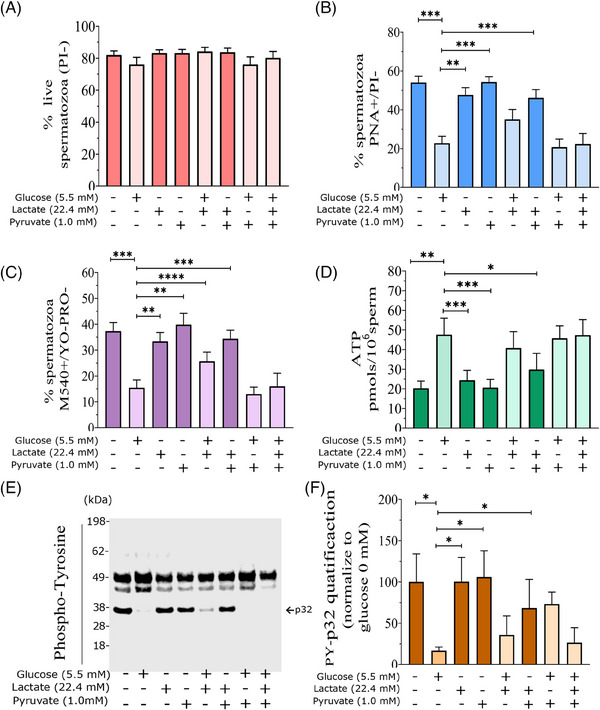
The effect of different metabolic substrates on sperm capacitation process was evaluated by analyzing phosphorylation in the p32 protein; the acrosome reaction and the ATP intracellular content.
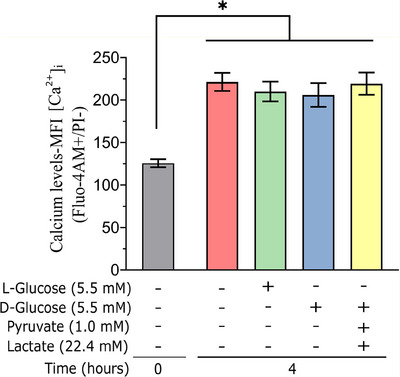
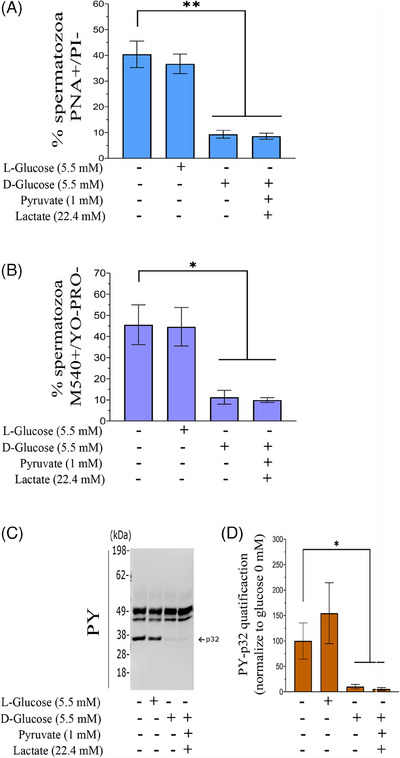
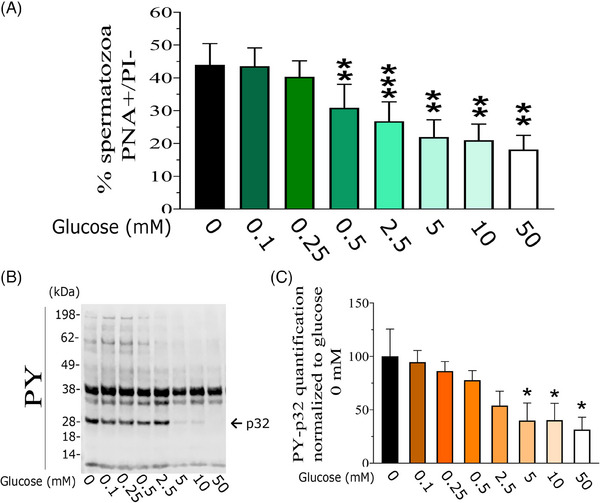
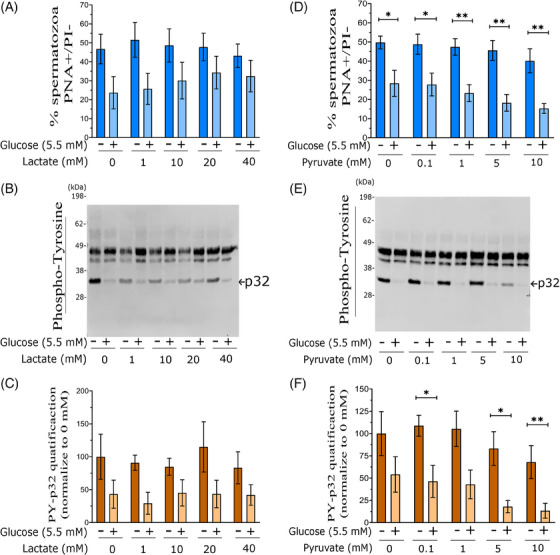
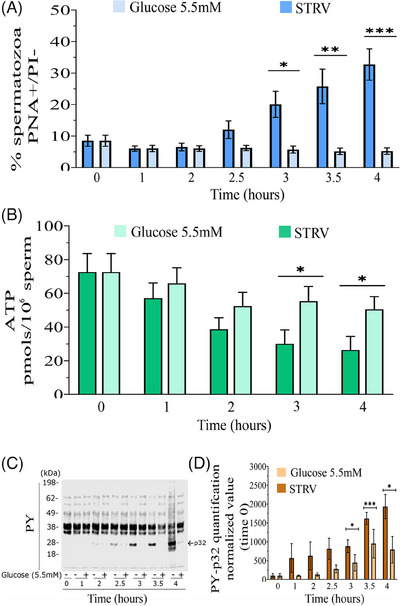
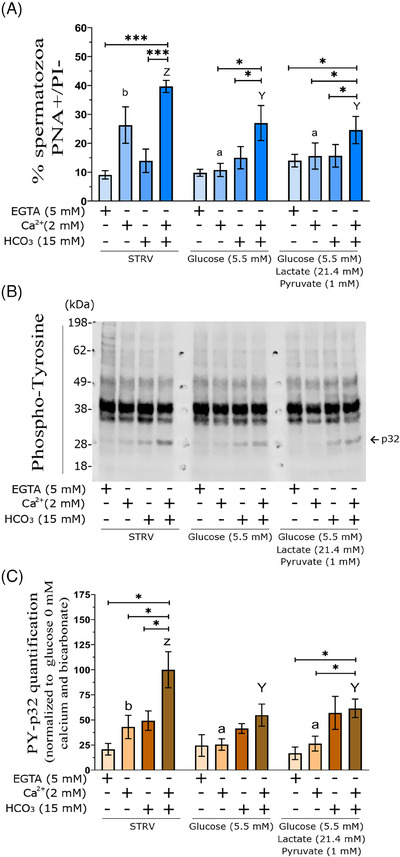
The presence of glucose in the in vitro capacitating medium diminishes, in a concentration-dependent manner, parameters associated with the capacitated status: induced acrosome exocytosis, plasma membrane destabilization, and protein tyrosine phosphorylation. Conversely, sperm incubation with pyruvate or lactate, either individually or in combination, allows the attainment of the capacitated status. Unexpectedly, pig spermatozoa incubated without any extracellular energy substrates or with a non-metabolizable substrate (l-glucose) for 4 h displayed similar sperm viability to the control and exhibited a capacitated phenotype. The capacitation-like phenotype observed in starved pig spermatozoa (absence of glucose, lactate, and pyruvate) was dependent on extracellular bicarbonate and calcium levels, and these spermatozoa exhibited lower intracellular ATP content compared to those not capacitated. Nevertheless, the intracellular content of calcium was not modified in comparison to the control.
Our findings suggest that the metabolic substrates used to fuel pig sperm metabolism are important in achieving the capacitated status. The results of this work could be used to refine the capacitating medium employed in pig in vitro fertilization.
哺乳动物精子需要经历一个名为获能的过程才能使卵母细胞受精。在雌性生殖道中运行时,精子在接触包含各种代谢底物的变化环境的同时获取能量。精子获能的能量需求具有物种特异性。此外,可用能量来源会阻碍精子获能过程并最终影响顶体反应。
评估体外精子获能培养基中可用的代谢底物是否允许或干扰猪精子获能过程。
通过分析p32蛋白的磷酸化、顶体反应和细胞内ATP含量,评估不同代谢底物对精子获能过程的影响。
体外获能培养基中葡萄糖的存在以浓度依赖的方式降低了与获能状态相关的参数:诱导顶体胞吐、质膜去稳定化和蛋白质酪氨酸磷酸化。相反,精子单独或联合与丙酮酸或乳酸孵育可实现获能状态。出乎意料的是,在没有任何细胞外能量底物或与不可代谢底物(l-葡萄糖)孵育4小时的猪精子显示出与对照相似的精子活力,并表现出获能表型。在饥饿的猪精子(缺乏葡萄糖、乳酸和丙酮酸)中观察到的获能样表型依赖于细胞外碳酸氢盐和钙水平,并且与未获能的精子相比,这些精子的细胞内ATP含量较低。然而,与对照相比,钙的细胞内含量没有改变。
我们的研究结果表明,用于为猪精子代谢提供能量的代谢底物对于实现获能状态很重要。这项工作的结果可用于优化猪体外受精中使用的获能培养基。