Meeks Joshua J, Sjödahl Gottfrid, Lerner Seth P, Das Arighno, McConkey David J, Black Peter C
Department of Urology and Biochemistry, and Molecular Genetics, Feinberg School of Medicine, Chicago, IL, USA.
The Jesse Brown VAMC, Chicago, IL, USA.
Bladder Cancer. 2021 Mar 19;7(1):1-11. doi: 10.3233/BLC-200306. eCollection 2021.
Bladder cancers have high total mutation burdens resulting in genomic diversity and intra- and inter-tumor heterogeneity that may impact the diversity of gene expression, biologic aggressiveness, and potentially response to therapy. To compare bladder cancers among patients, an organizational structure is necessary that describes the tumor at the histologic and molecular level. These "molecular subtypes", or "expression subtypes" of bladder cancer were originally described in 2010 and continue to evolve secondary to next generation sequencing (NGS) and an increasing public repository of well-annotated cohorts.
To review the history and methodology of expression-based subtyping of non-muscle invasive (NMIBC) and muscle invasive bladder cancer (MIBC).
A literature review was performed of primary papers from PubMed that described subtyping methods and their descriptive feature including search terms of "subtype", and "bladder cancer".
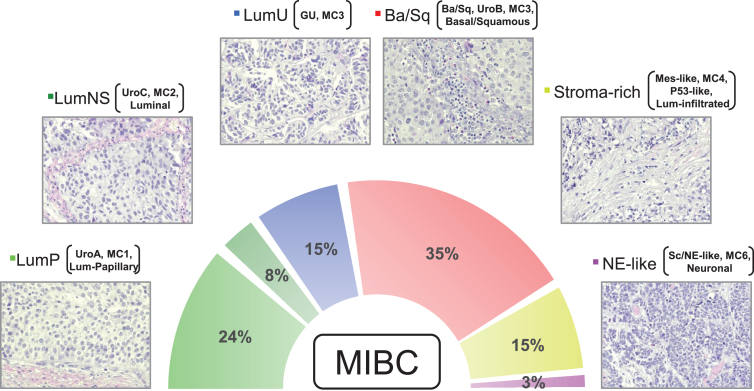
21 papers were identified for review. Tumor subtyping developed from N = 2 to N = 6 subtyping schemes with most subtypes comprised of at least luminal and basal tumors. Most NMIBCs are luminal cancers and luminal MIBCs may be associated with less aggressive features, while one study of basal tumors identified a better clinical outcome with systemic chemotherapy. Tumors with a P53-like may have intrinsic resistance to chemotherapy. The heterogeneity of tumors, which is likely derived from stromal components and immune cell infiltration, affect subtype calls.
Subtyping, while still evolving, is ready for testing in clinical trials. Improved patient selection with tumor subtyping may help with tumor classification and potentially match patient or tumor to therapy.
膀胱癌具有较高的总突变负担,导致基因组多样性以及肿瘤内和肿瘤间的异质性,这可能会影响基因表达的多样性、生物学侵袭性以及潜在的治疗反应。为了比较患者之间的膀胱癌,需要一种在组织学和分子水平描述肿瘤的组织结构。膀胱癌的这些“分子亚型”或“表达亚型”最初于2010年被描述,并且由于下一代测序(NGS)以及注释完善的队列的公共存储库不断增加而持续演变。
回顾非肌层浸润性(NMIBC)和肌层浸润性膀胱癌(MIBC)基于表达的亚型分类的历史和方法。
对来自PubMed的描述亚型分类方法及其描述特征的主要论文进行文献综述,搜索词包括“亚型”和“膀胱癌”。
确定了21篇论文进行综述。肿瘤亚型分类从N = 2发展到N = 6的分类方案,大多数亚型至少包括腔面型和基底型肿瘤。大多数NMIBC是腔面型癌症,腔面型MIBC可能与侵袭性较低的特征相关,而一项关于基底型肿瘤的研究发现全身化疗有更好的临床结果。具有P53样特征的肿瘤可能对化疗具有内在抗性。肿瘤的异质性可能源于基质成分和免疫细胞浸润,会影响亚型分类。
亚型分类虽然仍在发展,但已准备好在临床试验中进行测试。通过肿瘤亚型分类改善患者选择可能有助于肿瘤分类,并可能使患者或肿瘤与治疗相匹配。