Weiss Aaron, Kramer Axel, Taube Robert, Mattner Frauke, Premke Katrin
Institute of Hygiene and Environmental Medicine, University Medicine Greifswald, Greifswald, Germany.
Technical Microbiology, Faculty of Nature and Engineering, City University of Applied Sciences, Bremen, Germany.
GMS Hyg Infect Control. 2024 Jun 21;19:Doc35. doi: 10.3205/dgkh000490. eCollection 2024.
Health care workers (HCW) in Emergency Medical Services (EMS) frequently come into contact with carriers of methicillin-susceptible (MSSA) and methicillin-resistant (MRSA) strains and may acquire and transmit them to patients. However, there is little data on MSSA and MRSA colonization of medical personnel in the emergency services. Additionally, few studies have analyzed the association between personal hygiene of staff and colonization. Therefore, we examined the prevalence of MSSA and MRSA in EMS staff of two German regions and evaluated their personal hygiene behavior.
Throat and nasal swabs from 300 EMS workers were analyzed. Both direct and pre-enriched cultures of the swabs were cultivated on culture media to identify MSSA and MRSA. Results were analyzed together with questionnaires about sociodemographic data and a self-assessment of hygiene behavior. Statistical analysis was done using the R statistical software.
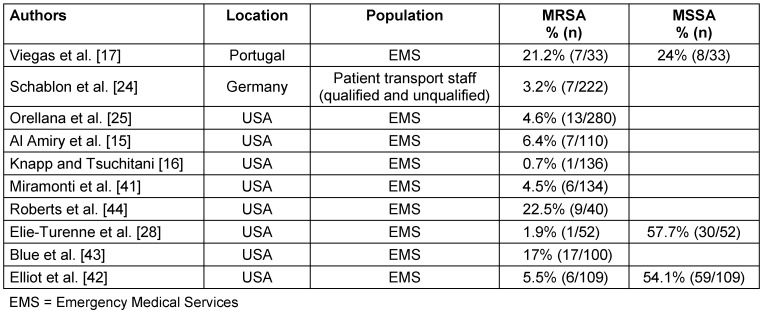
Of the total 300 swabs, 55% were from paramedics, 39% were from emergency medical technicians (EMT) and 5% were from emergency physicians. With 1%, the MRSA prevalence was comparable to that of the German population, while the MSSA rate - 43.7% - was higher than expected. Colonization with MSSA was significantly associated with poor hand hygiene and male sex, and was inversely correlated to time on the job in EMS.
The sample size of 300 and a MRSA prevalence of 1% made a meaningful analysis of potential influencing factors on the prevalence of MRSA infeasible. The comparatively high prevalence of MSSA and the association with decreasing frequency of hand antisepsis suggests an influence of personal hygiene on MSSA colonization. HCW in EMS should be encouraged to make use of their personal protective equipment and practice frequent hand hygiene. The implementation of diagnostic tools such as the Hand Hygiene Self-Assessment Framework of the WHO could be utilized to reveal problems in organizations, followed by an individual program to promote hand hygiene.
紧急医疗服务(EMS)中的医护人员经常接触对甲氧西林敏感(MSSA)和耐甲氧西林(MRSA)菌株的携带者,并可能感染这些病菌并将其传播给患者。然而,关于紧急服务中医护人员的MSSA和MRSA定植的数据很少。此外,很少有研究分析工作人员的个人卫生与定植之间的关联。因此,我们调查了德国两个地区EMS工作人员中MSSA和MRSA的流行情况,并评估了他们的个人卫生行为。
对300名EMS工作人员的咽喉和鼻腔拭子进行分析。将拭子的直接培养物和预富集培养物在培养基上培养,以鉴定MSSA和MRSA。结果与关于社会人口统计学数据的问卷以及个人卫生行为的自我评估一起进行分析。使用R统计软件进行统计分析。
在总共300份拭子中,55%来自护理人员,39%来自急救医疗技术员(EMT),5%来自急救医生。MRSA患病率为1%,与德国人群相当,而MSSA率为43.7%,高于预期。MSSA定植与手部卫生不良和男性显著相关,并且与在EMS工作的时间呈负相关。
300人的样本量和1%的MRSA患病率使得对MRSA患病率的潜在影响因素进行有意义的分析变得不可行。MSSA相对较高的患病率以及与手部消毒频率降低的关联表明个人卫生对MSSA定植有影响。应鼓励EMS中的医护人员使用个人防护设备并经常洗手。可以利用世界卫生组织手部卫生自我评估框架等诊断工具来揭示组织中的问题,随后制定个人促进手部卫生的计划。