Boucherabine Syrine, Giddey Alexander, Nassar Rania, Al-Hroub Hamza M, Mohamed Lobna, Harb Mohammad, Soares Nelson Cruz, Senok Abiola
College of Medicine, Mohammed Bin Rashid University of Medicine and Health Sciences, Dubai, United Arab Emirates.
Center for Applied and Translational Genomics, Mohammed Bin Rashid University of Medicine and Health Sciences, Dubai, United Arab Emirates.
Front Microbiol. 2024 Jun 26;15:1402796. doi: 10.3389/fmicb.2024.1402796. eCollection 2024.
Understanding the biology of methicillin resistant (MRSA) is crucial to unlocking insights for new targets in our fight against this antimicrobial resistant priority pathogen. Although proteomics and metabolomic profiling offer the potential to elucidating such biological markers, reports of methodological approaches for carrying this out in isolates remain limited. We describe the use of a dual-functionality methanol extraction method for the concurrent extraction of protein and metabolites from and report on the comparative analysis of the proteomic and metabolomic profiles of MRSA versus methicillin sensitive (MSSA).
Bacterial reference strains MRSA ATCC43300 and MSSA ATCC25923 were used. The conventional urea methodology was used for protein extraction and a methanol based method was used for concurrent proteins and metabolites extraction. Proteomic and metabolomic profiling was carried out using TimsTOF mass spectrometry. Data processing was carried out using the MaxQuant version 2.1.4.0.
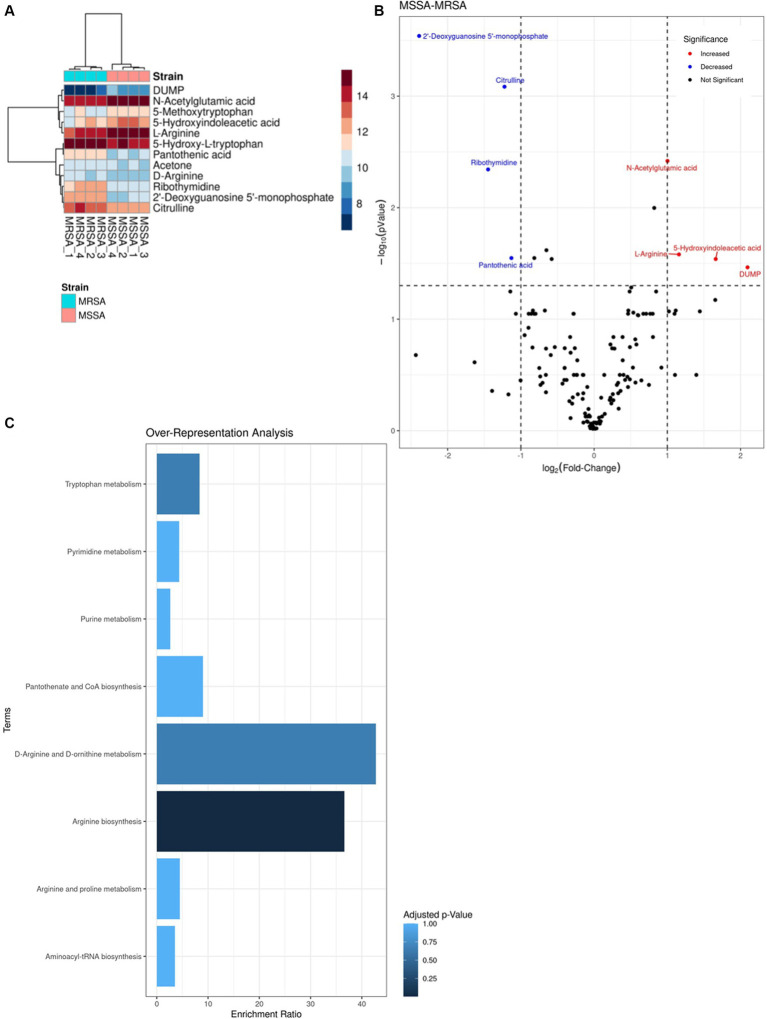
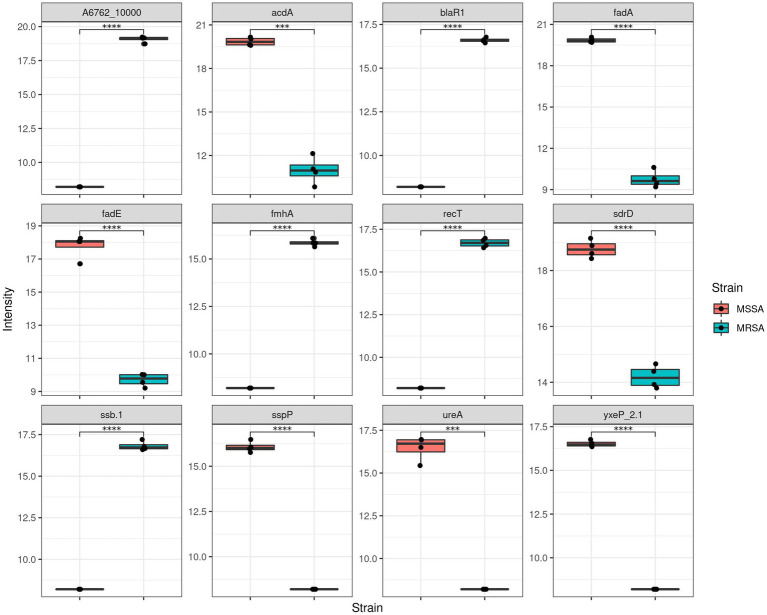
This study represents the first report on the utilization of the methanol extraction method for concurrent protein and metabolite extraction in Gram positive bacteria. Our findings demonstrate good performance of the method for the dual extraction of proteins and metabolites from with demonstration of reproducibility. Comparison of MRSA and MSSA strains revealed 407 proteins with significantly different expression levels. Enrichment analysis of those proteins revealed distinct pathways involved in fatty acid degradation, metabolism and beta-lactam resistance. Penicillin-binding protein PBP2a, the key determinant of MRSA resistance, exhibited distinct expression patterns in MRSA isolates. Metabolomic analysis identified 146 metabolites with only one exclusive to the MRSA. The enriched pathways identified were related to arginine metabolism and biosynthesis.
Our findings demonstrate the effectiveness of the methanol-based dual-extraction method, providing simultaneous insights into the proteomic and metabolomic landscapes of strains. These findings demonstrate the utility of proteomic and metabolomic profiling for elucidating the biological basis of antimicrobial resistance.
了解耐甲氧西林金黄色葡萄球菌(MRSA)的生物学特性对于揭示对抗这种耐药性重点病原体的新靶点至关重要。尽管蛋白质组学和代谢组学分析有潜力阐明此类生物标志物,但关于在分离株中进行此项研究的方法学报道仍然有限。我们描述了一种双功能甲醇提取方法用于同时从金黄色葡萄球菌中提取蛋白质和代谢物,并报告了MRSA与甲氧西林敏感金黄色葡萄球菌(MSSA)蛋白质组和代谢组图谱的比较分析。
使用细菌参考菌株MRSA ATCC43300和MSSA ATCC25923。采用传统尿素方法提取蛋白质,基于甲醇的方法用于同时提取蛋白质和代谢物。使用TimsTOF质谱进行蛋白质组和代谢组分析。使用MaxQuant 2.1.4.0版本进行数据处理。
本研究是关于在革兰氏阳性菌中利用甲醇提取方法同时提取蛋白质和代谢物的首次报道。我们的研究结果表明该方法在从金黄色葡萄球菌中双重提取蛋白质和代谢物方面表现良好,并证明了其可重复性。MRSA和MSSA菌株的比较显示有407种蛋白质表达水平存在显著差异。对这些蛋白质的富集分析揭示了参与脂肪酸降解、代谢和β-内酰胺抗性的不同途径。青霉素结合蛋白PBP2a是MRSA耐药性的关键决定因素,在MRSA分离株中表现出独特的表达模式。代谢组分析鉴定出146种代谢物,其中只有一种是MRSA特有的。鉴定出的富集途径与精氨酸代谢和生物合成有关。
我们的研究结果证明了基于甲醇的双重提取方法的有效性,同时提供了对金黄色葡萄球菌菌株蛋白质组和代谢组情况的见解。这些发现证明了蛋白质组学和代谢组学分析在阐明抗菌药物耐药性生物学基础方面的实用性。