Guangxi Key Laboratory of Major Infectious Disease Prevention Control and Biosafety Emergency Response, Guangxi Key Laboratory of AIDS Prevention Control and Translation, Guangxi Zhuang Autonomous Region Center for Disease Control and Prevention, Nanning, China.
Front Cell Infect Microbiol. 2024 Jun 27;14:1415123. doi: 10.3389/fcimb.2024.1415123. eCollection 2024.
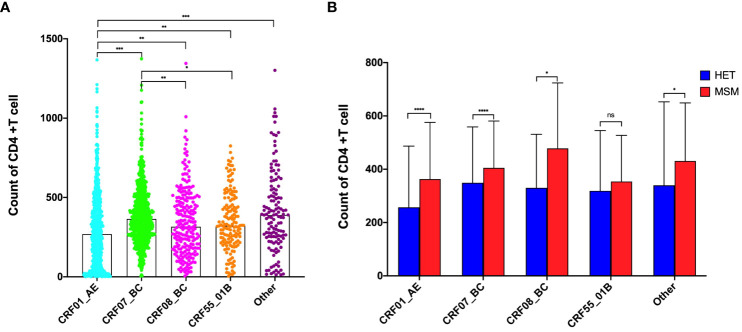
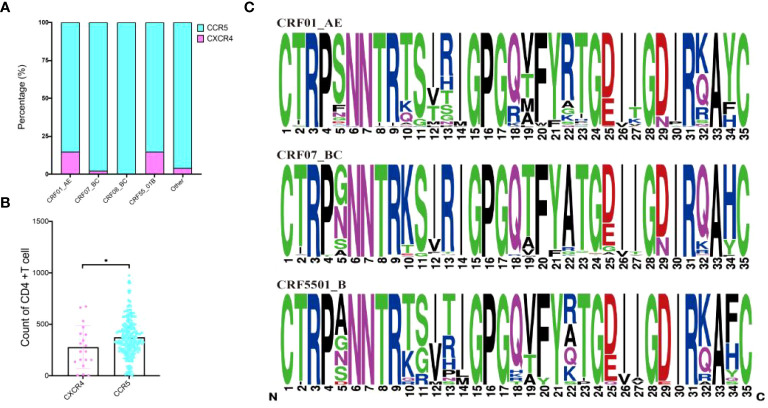
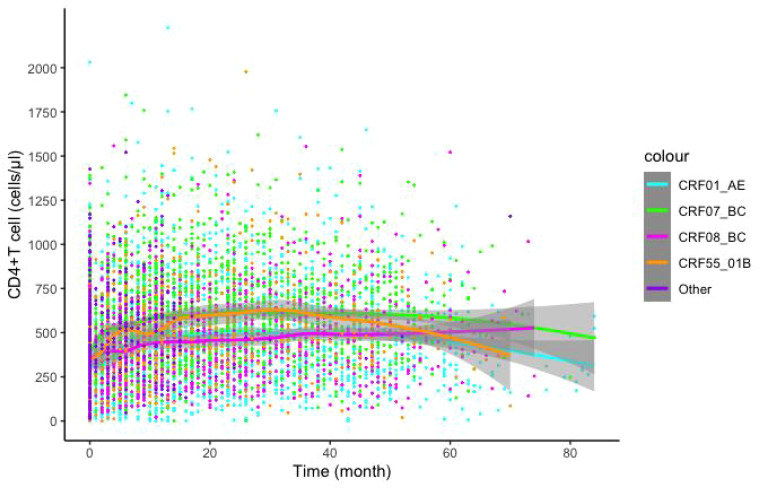
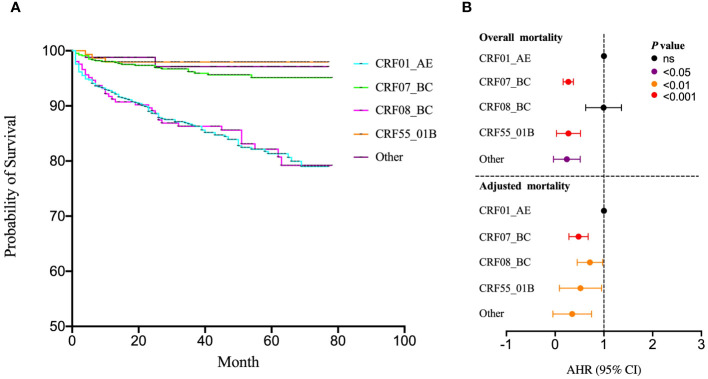
The high proportion of AIDS cases and mortality rates in Guangxi underscores the urgency to investigate the influence of HIV-1 genetic diversity on disease progression in this region. Newly diagnosed HIV-1 patients were enrolled from January 2016 to December 2021, and the follow-up work and detection of CD4+T lymphocytes were carried out every six months until December 2022. Multivariate logistic regression was used to analyze the factors affecting pre-treatment CD4+T lymphocyte counts, while local weighted regression models (LOESS) and generalized estimating equation models (GEE) were conducted to assess factors influencing CD4+T Lymphocyte Recovery. Cox regression analysis was utilized to examine the impact of subtypes on survival risk. Additionally, HIV-1 env sequences were utilized for predicting CXCR4 and CCR5 receptors. The study encompassed 1867 individuals with pol sequences and 281 with env sequences. Our findings indicate that age over 30, divorced/widowed, peasant, heterosexual infection, CRF01_AE, long-term infection, and Pre-treatment Viral load >10000 copies/ml were factors associated with higher risk for pre-treatment CD4+T lymphocyte decline. Specifically, male gender, age over 30, heterosexual infection (HETs), long-term infection, CRF01_AE, and Pre-treatment CD4 T cell counts below 350/µL were identified as risk factors impeding CD4+T lymphocyte recovery. Pre-treatment CD4+T lymphocyte counts and recovery in individuals infected with CRF01_AE were lower compared to CRF07_BC and CRF55_01B. Additionally, CRF01_AE and CRF08_BC subtypes exhibited higher mortality rates than CRF07_BC, CRF55_01B, and other subtypes. Notably, CRF01_AE demonstrated the highest percentage of CXCR4 affinity ratios. This research unveils the intricate influence of HIV-1 gene diversity on CD4+T lymphocyte dynamics and clinical outcomes. It highlights the multifaceted nature of HIV infection in Guangxi, providing novel insights into subtype-specific disease progression among HIV-infected individuals in this region.
广西艾滋病病例和死亡率的高比例突显了调查 HIV-1 遗传多样性对该地区疾病进展影响的紧迫性。从 2016 年 1 月至 2021 年 12 月,新诊断的 HIV-1 患者被纳入研究,每 6 个月进行一次随访工作和 CD4+T 淋巴细胞检测,直至 2022 年 12 月。采用多变量逻辑回归分析影响治疗前 CD4+T 淋巴细胞计数的因素,采用局部加权回归模型(LOESS)和广义估计方程模型(GEE)评估影响 CD4+T 淋巴细胞恢复的因素。采用 Cox 回归分析评估亚型对生存风险的影响。此外,还利用 HIV-1env 序列预测 CXCR4 和 CCR5 受体。该研究纳入了 1867 例具有 pol 序列的个体和 281 例具有 env 序列的个体。研究结果表明,年龄>30 岁、离异/丧偶、农民、异性恋感染、CRF01_AE、长期感染和治疗前病毒载量>10000 拷贝/ml 是与治疗前 CD4+T 淋巴细胞下降风险较高相关的因素。具体而言,男性、年龄>30 岁、异性恋感染(HETs)、长期感染、CRF01_AE 和治疗前 CD4 T 细胞计数<350/µL 是阻碍 CD4+T 淋巴细胞恢复的危险因素。感染 CRF01_AE 的个体的治疗前 CD4+T 淋巴细胞计数和恢复水平低于感染 CRF07_BC 和 CRF55_01B 的个体。此外,CRF01_AE 和 CRF08_BC 亚型的死亡率高于 CRF07_BC、CRF55_01B 和其他亚型。值得注意的是,CRF01_AE 显示出最高比例的 CXCR4 亲和力比值。本研究揭示了 HIV-1 基因多样性对 CD4+T 淋巴细胞动力学和临床结局的复杂影响。它突显了广西 HIV 感染的多面性,为该地区 HIV 感染者的亚型特异性疾病进展提供了新的见解。