
理解锆催化的氢胺烷基化反应中机理驱动的区域选择性:由共轭二烯合成高烯丙基胺
Understanding mechanism driven regioselectivity in zirconium-catalysed hydroaminoalkylation: homoallylic amines from conjugated dienes.
作者信息
Nuñez Bahena Erick, Hosseini Kimia, Curto Sheila Galván, Schafer Laurel L
机构信息
Department of Chemistry, University of British Columbia 2036 Main Mall Vancouver British Columbia Canada V6T 1Z1
出版信息
Chem Sci. 2024 Jun 12;15(27):10571-10576. doi: 10.1039/d4sc00636d. eCollection 2024 Jul 10.
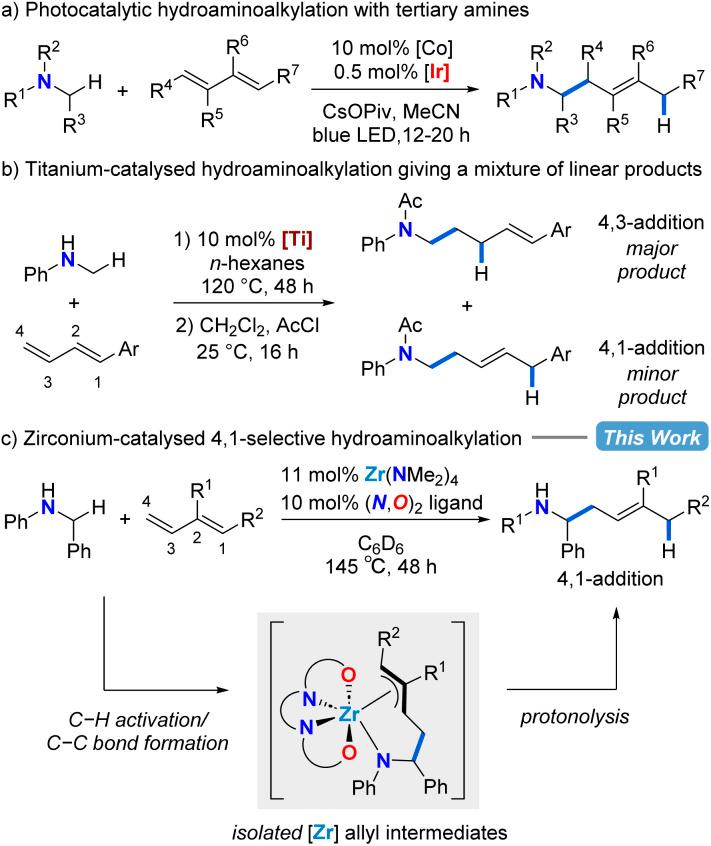
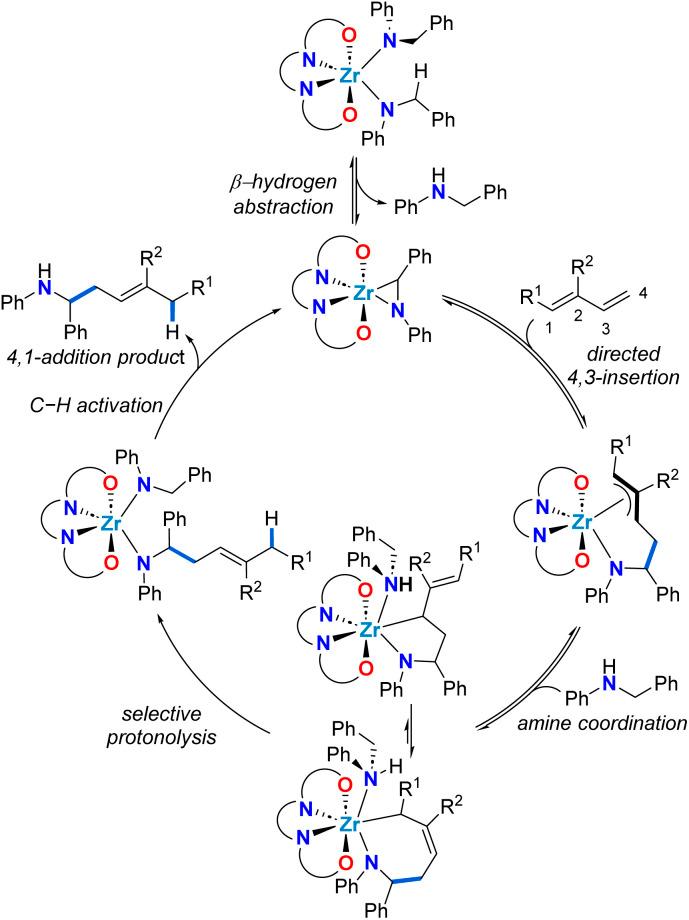
The unexpected 4,1-hydroaminoalkylation of dienes provides selective access to linear homoallylic amines by zirconium catalysis. This switch from the traditional branched preferred regioselectivity to selective linear product formation using this early transition metal can be attributed to π-allyl intermediates. The reactivity of these isolated intermediates on a sterically accessible and coordinatively flexible chelating bis(ureate) Zr(iv) complex confirmed reversible C-C bond formation in hydroaminoalkylation catalysis.
二烯意外的4,1-氢氨基烷基化反应通过锆催化可选择性地生成线性高烯丙基胺。使用这种早期过渡金属,从传统的支链优先区域选择性转变为选择性地形成线性产物,这可归因于π-烯丙基中间体。这些分离出的中间体在空间可及且配位灵活的螯合双(脲酸酯)Zr(IV)配合物上的反应性证实了氢氨基烷基化催化中C-C键的可逆形成。



 Zotero 插件