Professorship for Social Brain Sciences, ETH Zurich, Zurich, Switzerland.
School of Psychological Sciences, Macquarie University, Sydney, New South Wales, Australia.
Hum Brain Mapp. 2024 Jul 15;45(10):e26786. doi: 10.1002/hbm.26786.
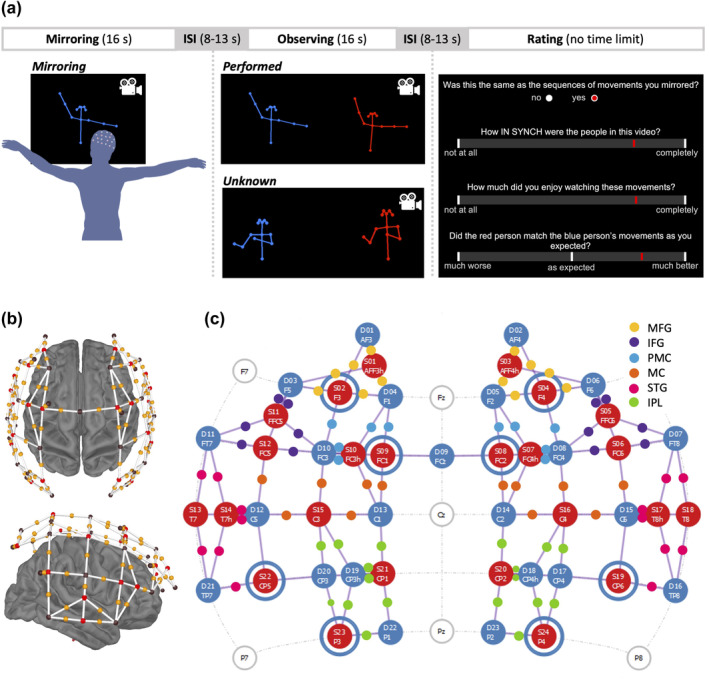
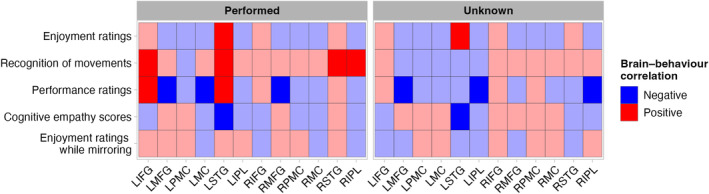
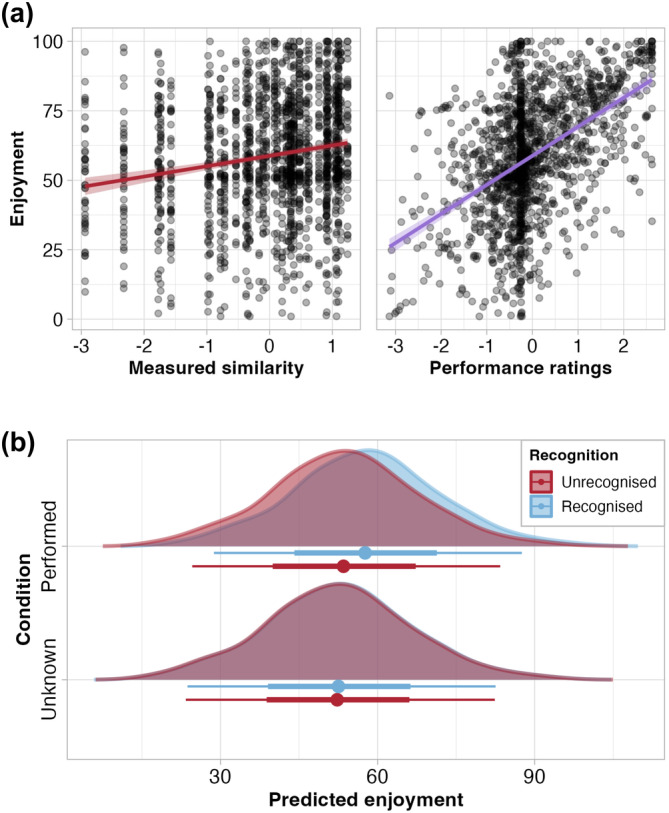
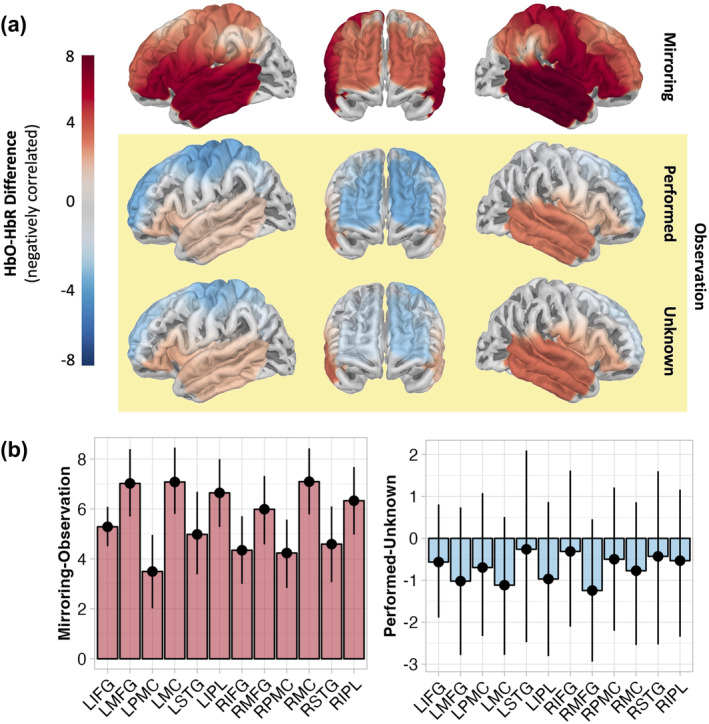
Whether in performing arts, sporting, or everyday contexts, when we watch others move, we tend to enjoy bodies moving in synchrony. Our enjoyment of body movements is further enhanced by our own prior experience with performing those movements, or our 'embodied experience'. The relationships between movement synchrony and enjoyment, as well as embodied experience and movement enjoyment, are well known. The interaction between enjoyment of movements, synchrony, and embodiment is less well understood, and may be central for developing new approaches for enriching social interaction. To examine the interplay between movement enjoyment, synchrony, and embodiment, we asked participants to copy another person's movements as accurately as possible, thereby gaining embodied experience of movement sequences. Participants then viewed other dyads performing the same or different sequences synchronously, and we assessed participants' recognition of having performed these sequences, as well as their enjoyment of each movement sequence. We used functional near-infrared spectroscopy to measure cortical activation over frontotemporal sensorimotor regions while participants performed and viewed movements. We found that enjoyment was greatest when participants had mirrored the sequence and recognised it, suggesting that awareness of embodiment may be central to enjoyment of synchronous movements. Exploratory analyses of relationships between cortical activation and enjoyment and recognition implicated the sensorimotor cortices, which subserve action observation and aesthetic processing. These findings hold implications for clinical research and therapies seeking to foster successful social interaction.
无论是在表演艺术、体育运动还是日常生活中,当我们观看他人运动时,我们往往会欣赏身体同步运动的美感。我们对身体运动的欣赏还会因我们自身之前有过执行这些运动的经验(即“具身经验”)而进一步增强。运动同步性与享受、具身经验与运动享受之间的关系是众所周知的。运动享受、同步性和具身经验之间的相互作用则不太为人所知,而这可能是开发丰富社交互动新方法的关键。为了研究运动享受、同步性和具身经验之间的相互作用,我们要求参与者尽可能准确地复制另一个人的动作,从而获得运动序列的具身经验。然后,参与者观看其他两个参与者同步执行相同或不同的序列,我们评估参与者对执行这些序列的认知,以及他们对每个运动序列的享受程度。我们使用功能性近红外光谱技术来测量参与者执行和观看动作时的额颞叶感觉运动区域的皮质激活。我们发现,当参与者镜像了序列并识别出序列时,享受程度最高,这表明对具身经验的意识可能是同步运动享受的核心。对皮质激活与享受和认知之间关系的探索性分析表明,感觉运动皮层在动作观察和审美处理中起作用。这些发现对寻求促进成功社交互动的临床研究和治疗具有重要意义。