
极化 C 和 P MRS 可检测肥胖症患者心脏能量学、代谢和功能的差异,以及治疗后的反应。
Hyperpolarized C and P MRS detects differences in cardiac energetics, metabolism, and function in obesity, and responses following treatment.
机构信息
Division of Cardiovascular Medicine, Radcliffe Department of Medicine, University of Oxford, Oxford, UK.
Department of Physiology, Anatomy and Genetics, University of Oxford, Oxford, UK.
出版信息
NMR Biomed. 2024 Nov;37(11):e5206. doi: 10.1002/nbm.5206. Epub 2024 Jul 12.
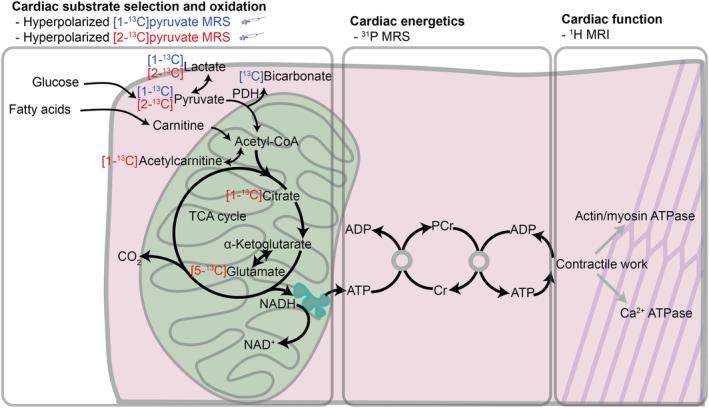
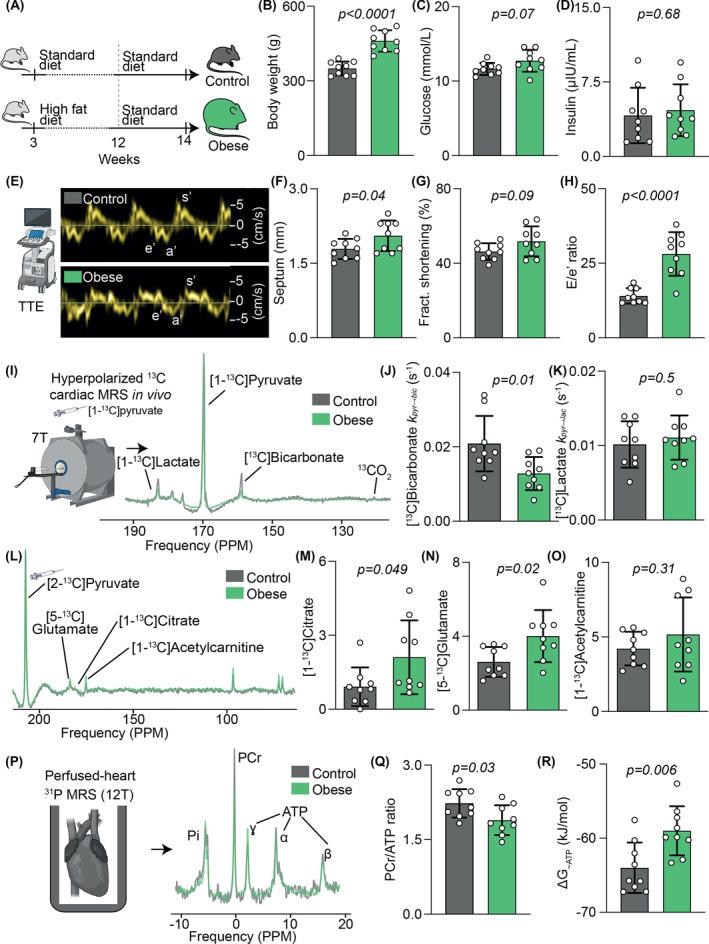
Obesity is associated with important changes in cardiac energetics and function, and an increased risk of adverse cardiovascular outcomes. Multi-nuclear MRS and MRI techniques have the potential to provide a comprehensive non-invasive assessment of cardiac metabolic perturbation in obesity. A rat model of obesity was created by high-fat diet feeding. This model was characterized using in vivo hyperpolarized [1-C]pyruvate and [2-C]pyruvate MRS, echocardiography and perfused heart P MRS. Two groups of obese rats were subsequently treated with either caloric restriction or the glucagon-like peptide-1 analogue/agonist liraglutide, prior to reassessment. The model recapitulated cardiovascular consequences of human obesity, including mild left ventricular hypertrophy, and diastolic, but not systolic, dysfunction. Hyperpolarized C and P MRS demonstrated that obesity was associated with reduced myocardial pyruvate dehydrogenase flux, altered cardiac tricarboxylic acid (TCA) cycle metabolism, and impaired myocardial energetic status (lower phosphocreatine to adenosine triphosphate ratio and impaired cardiac ΔG). Both caloric restriction and liraglutide treatment were associated with normalization of metabolic changes, alongside improvement in cardiac diastolic function. In this model of obesity, hyperpolarized C and P MRS demonstrated abnormalities in cardiac metabolism at multiple levels, including myocardial substrate selection, TCA cycle, and high-energy phosphorus metabolism. Metabolic changes were linked with impairment of diastolic function and were reversed in concert following either caloric restriction or liraglutide treatment. With hyperpolarized C and P techniques now available for human use, the findings support a role for multi-nuclear MRS in the development of new therapies for obesity.
肥胖与心脏能量学和功能的重要变化有关,并增加了不良心血管结局的风险。多核 MRS 和 MRI 技术有可能提供肥胖中心脏代谢紊乱的全面非侵入性评估。通过高脂肪饮食喂养建立肥胖大鼠模型。使用体内 1-¹³C 丙酮酸和 2-¹³C 丙酮酸 MRS、超声心动图和灌注心脏 P MRS 对该模型进行了表征。随后,两组肥胖大鼠分别接受热量限制或胰高血糖素样肽-1 类似物/激动剂利拉鲁肽治疗,然后进行重新评估。该模型再现了人类肥胖的心血管后果,包括轻度左心室肥厚和舒张功能障碍,但无收缩功能障碍。极化 C 和 P MRS 表明,肥胖与心肌丙酮酸脱氢酶通量降低、心脏三羧酸(TCA)循环代谢改变和心肌能量状态受损(磷酸肌酸与三磷酸腺苷比值降低和心脏 ΔG 受损)有关。热量限制和利拉鲁肽治疗均与代谢变化的正常化相关,同时改善了舒张功能。在肥胖模型中,极化 C 和 P MRS 显示心脏代谢在多个层面存在异常,包括心肌底物选择、TCA 循环和高能磷代谢。代谢变化与舒张功能障碍有关,并在热量限制或利拉鲁肽治疗后同时逆转。随着极化 C 和 P 技术现在可用于人体,这些发现支持多核 MRS 在肥胖症新疗法开发中的作用。
 Zotero 插件