College of Health Sciences, School of Medical, Health, and Applied Sciences, Central Queensland University, Brisbane, Queensland, Australia.
School of Psychological Sciences, Macquarie University, Sydney, New South Wales, Australia.
J Gerontol A Biol Sci Med Sci. 2024 Sep 1;79(9). doi: 10.1093/gerona/glae175.
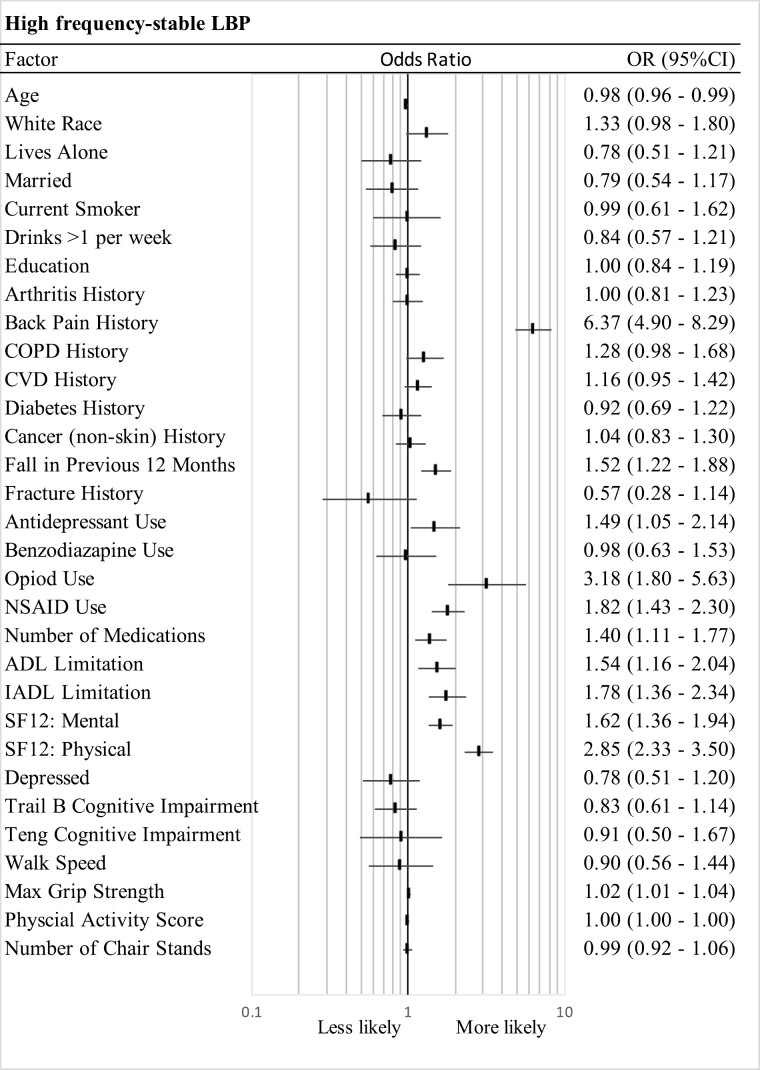
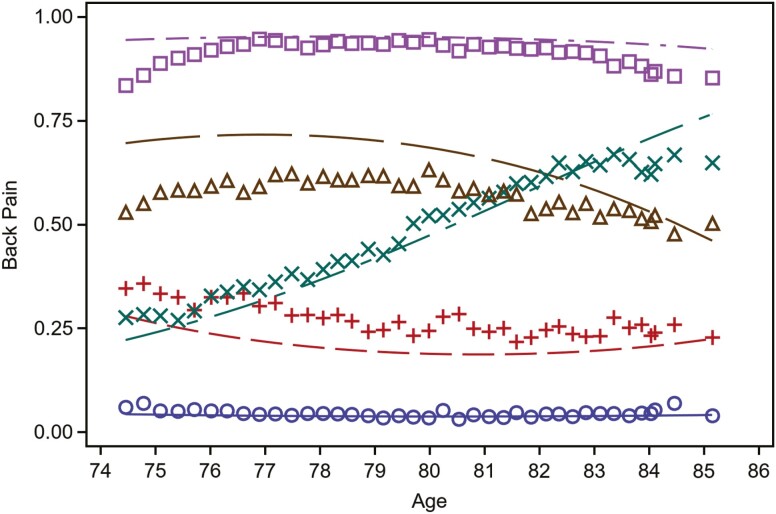
Although low back pain (LBP) may persist or recur over time, few studies have evaluated the individual course of LBP over a long-term period, particularly among older adults. Based on data from the longitudinal Osteoporotic Fractures in Men (MrOS) Study, we aimed to identify and describe different LBP trajectories in older men and characterize members in each trajectory group. A total of 5 976 community-dwelling men (mean age = 74.2) enrolled at 6 U.S. sites were analyzed. Participants self-reported LBP (yes/no) every 4 months for a maximum of 10 years. Latent class growth modeling was performed to identify unique LBP trajectory groups that explained variation in the LBP data. The association of baseline characteristics with trajectory group membership was assessed using univariable and multivariable multinominal logistic regression. A 5-class solution was chosen; no/rare LBP (n = 2 442/40.9%), low frequency-stable LBP (n = 1 040/17.4%), low frequency-increasing LBP (n = 719/12%), moderate frequency-decreasing LBP (n = 745/12.5%), and high frequency-stable LBP (n = 1 030/17.2%). History of falls (OR = 1.52), history of LBP (OR = 6.37), higher physical impairment (OR = 1.51-2.85), and worse psychological function (OR = 1.41-1.62) at baseline were all associated with worse LBP trajectory groups in this sample of older men. These findings present an opportunity for targeted interventions and/or management to older men with worse or increasing LBP trajectories and associated modifiable risk factors to reduce the impact of LBP and improve quality of life.
虽然下背痛(LBP)可能随着时间的推移而持续或复发,但很少有研究评估老年人的 LBP 在长期内的个体病程,特别是在老年人中。基于来自纵向男性骨质疏松性骨折(MrOS)研究的数据,我们旨在确定和描述老年男性中不同的 LBP 轨迹,并描述每个轨迹组的成员。共分析了 6 个美国地点的 5976 名社区居住男性(平均年龄 74.2 岁)。参与者每 4 个月自我报告一次 LBP(是/否),最长可达 10 年。采用潜在类别增长模型确定了独特的 LBP 轨迹组,这些轨迹组解释了 LBP 数据的变化。使用单变量和多变量多项逻辑回归评估基线特征与轨迹组归属的关系。选择了 5 类解决方案;无/罕见 LBP(n=2442/40.9%)、低频稳定 LBP(n=1040/17.4%)、低频递增 LBP(n=719/12%)、中频递减 LBP(n=745/12.5%)和高频稳定 LBP(n=1030/17.2%)。基线时的跌倒史(OR=1.52)、LBP 史(OR=6.37)、较高的身体损伤(OR=1.51-2.85)和较差的心理功能(OR=1.41-1.62)均与该老年男性样本中较差的 LBP 轨迹组相关。这些发现为有较差或递增 LBP 轨迹和相关可改变风险因素的老年男性提供了有针对性的干预和/或管理机会,以减轻 LBP 的影响并提高生活质量。