Department of Neurology, Expert Centre for Hereditary Neurologic and Metabolic Disorders, University Hospital "Alexandrovska", Sofia, Bulgaria.
Medical University Sofia, Sofia, Bulgaria.
J Neuromuscul Dis. 2024;11(5):1011-1020. doi: 10.3233/JND-230235.
Congenital myasthenic syndromes (CMS) are a group of rare but often treatable inherited disorders of neuromuscular transmission characterized by fatigable skeletal muscle weakness. In this paper we present the largest phenotypic analysis to date of a cohort of patients carrying the pathogenic variant c.1327delG in the CHRNE gene, leading to CHRNE-CMS.
This study aims to identify the phenotypic variability in CMS associated with c.1327delG mutation in the CHRNE gene.
Disease specific symptoms were assessed using specific standardized tests for autoimmune myasthenia (Quantitative Myasthenia Gravis score) as well as patient-reported scales for symptom severity. Evaluated clinical manifestations included ocular symptoms (ophthalmoparesis and ptosis), bulbar weakness, axial muscle weakness, proximal and distal muscle weakness, and respiratory function. Patients were allocated into three groups according to clinical impression of disease severity: mild, moderate, and severe.
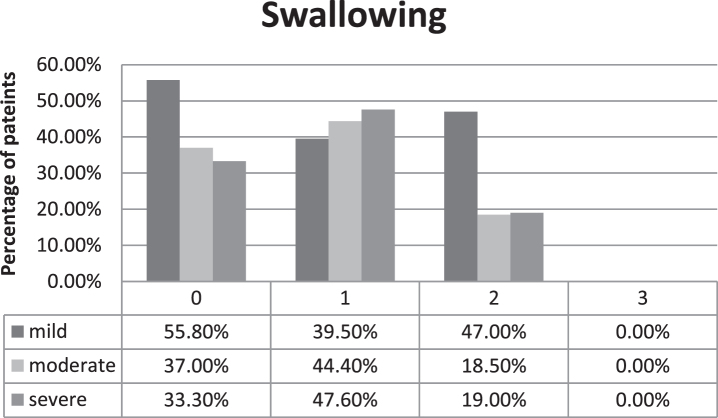
We studied 91 Bulgarian Roma patients, carrying the same causative homozygous CHRNE c.1327delG mutation. Bulbar weakness was present in patients throughout all levels of severity of CHRNE-CMS in this study. However, difficulties in eating and swallowing are more prominent characteristics in the moderate and severe clinical phenotypes. Diplopia and ptosis resulting from fatigue of the extraocular muscles were permanent features regardless of disease severity or age. Levels of axial, proximal and distal muscle weakness were variable between disease groups. The statistical analysis showed significant differences between the patients in the three groups, emphasizing a possible variation in symptom manifestation in the evaluated patient population despite the disease originating from the same genetic mutation. Impairment of respiratory function was more prominent in severely affected patients, which might result from loss of compensatory muscle function in those individuals.
Results from our study indicate significant phenotypic heterogeneity leading to mild, moderate, or severe clinical manifestation in CHRNE-CMS, despite the genotypic homogeneity.
先天性肌无力综合征(CMS)是一组罕见但常可治疗的遗传性神经肌肉传递障碍,其特征为骨骼肌易疲劳性无力。本文报告了迄今为止携带 CHRNE 基因致病性变异 c.1327delG 导致 CHRNE-CMS 的患者队列的最大表型分析。
本研究旨在确定 CHRNE 基因 c.1327delG 突变相关 CMS 的表型变异性。
使用针对自身免疫性重症肌无力的特定标准化测试(定量重症肌无力评分)以及患者报告的症状严重程度量表评估疾病特异性症状。评估的临床表现包括眼部症状(眼肌瘫痪和上睑下垂)、延髓肌无力、轴性肌无力、近端和远端肌肉无力以及呼吸功能。根据疾病严重程度的临床印象,患者分为三组:轻度、中度和重度。
我们研究了 91 名携带相同致病纯合 CHRNE c.1327delG 突变的保加利亚罗姆人患者。在本研究中,CHRNE-CMS 所有严重程度的患者均存在延髓肌无力。然而,在中度和重度临床表型中,进食和吞咽困难是更为突出的特征。由于眼外肌疲劳导致的复视和上睑下垂是无论疾病严重程度或年龄如何的永久性特征。轴性、近端和远端肌肉无力的水平在疾病组之间存在差异。统计分析显示三组患者之间存在显著差异,强调了在评估的患者人群中,尽管疾病起源于相同的基因突变,但症状表现可能存在差异。呼吸功能障碍在重度受影响的患者中更为突出,这可能是由于这些个体丧失了代偿性肌肉功能。
尽管基因型同质,但本研究结果表明 CHRNE-CMS 存在显著的表型异质性,导致轻度、中度或重度临床表现。