Medical College, Qingdao University, Qingdao, 266000, China.
School of Athletic Performance, Shanghai University of Sport, Shanghai, 200438, China.
Sci Rep. 2024 Jul 12;14(1):16097. doi: 10.1038/s41598-024-67052-3.
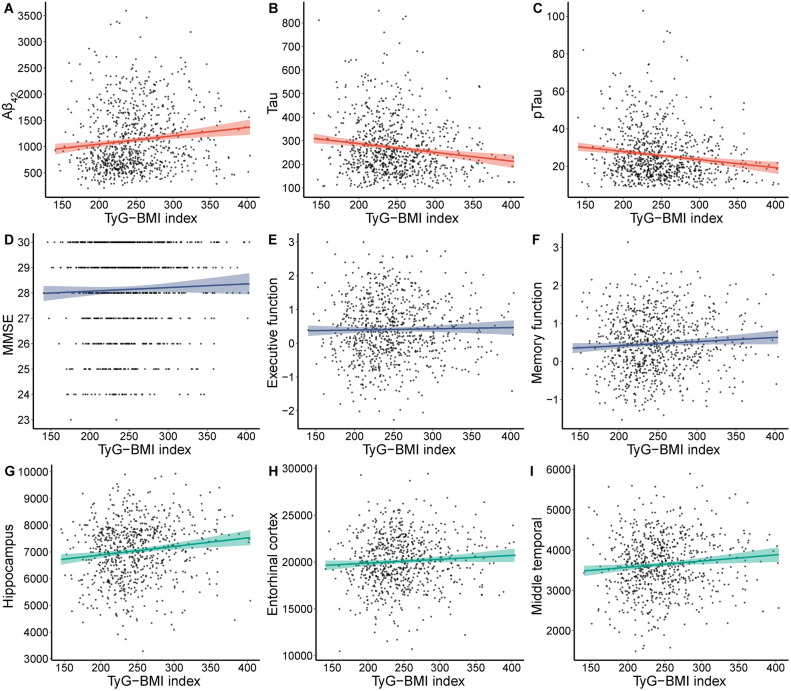
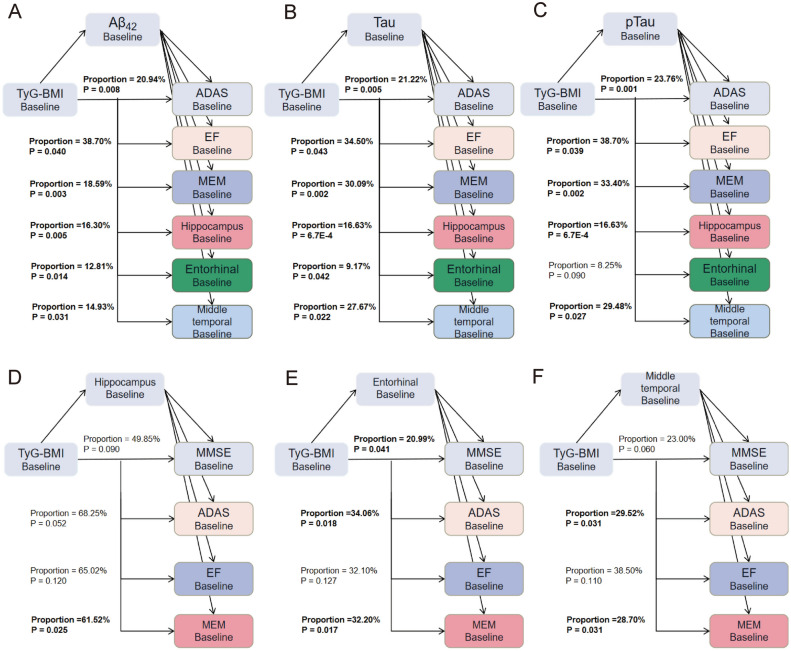
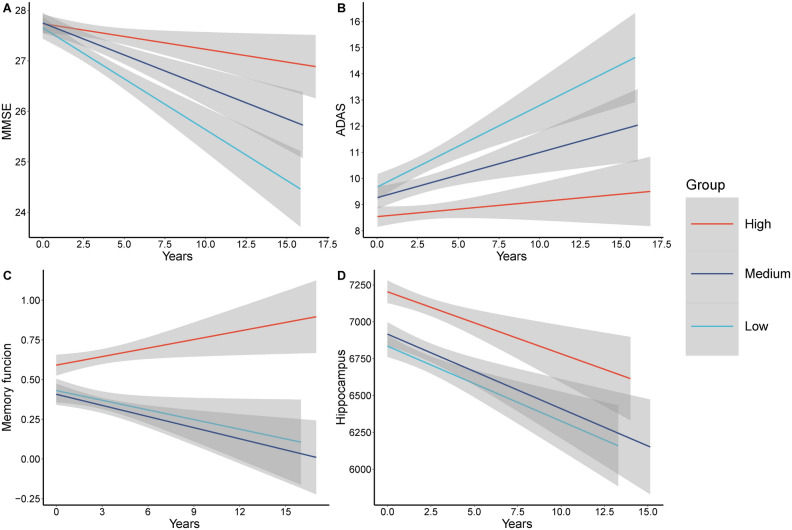
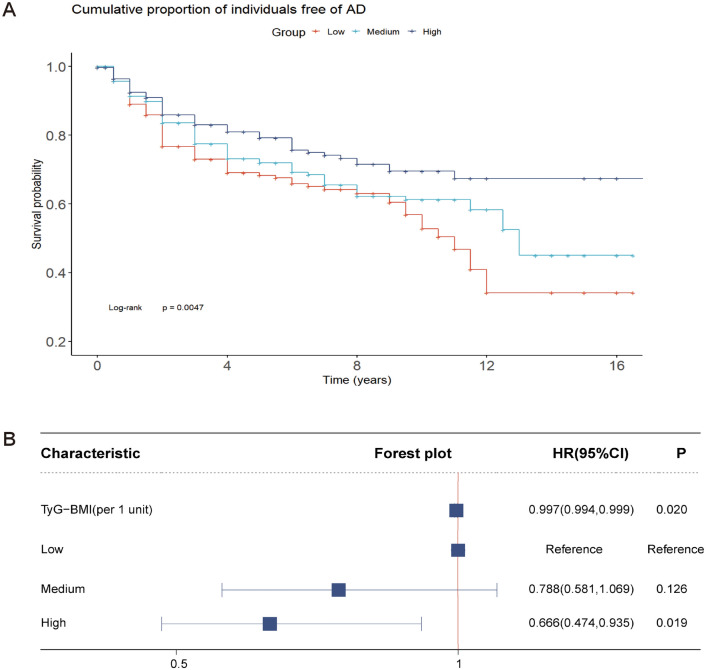
The relationship between the triglyceride glucose-body mass index (TyG-BMI) index and Alzheimer's disease (AD) pathology, cognition, and brain structure remains unclear. This study aimed to investigate these associations, focusing on cerebrospinal fluid (CSF) biomarkers, cognitive measures, and brain imaging data. Eight hundred and fifty-five non-demented participants were included. Linear regression was used to explore associations between the TyG-BMI index and AD pathology, cognition, and brain structure. The association between the TyG-BMI index and AD risk was assessed using Kaplan-Meier and Cox proportional hazards models. Longitudinal relationships were assessed using linear mixed-effects models. Mediation analyses were conducted to examine AD pathology's potential mediating role between the TyG-BMI index and cognition as well as brain structure. In the linear regression analyses, higher TyG-BMI levels were associated with increased Aβ and decreased Tau, pTau, Tau/Aβ, pTau/Aβ, and pTau/Tau. Positive correlations were observed with mini-mental state examination (MMSE), memory (MEM), executive function (EF), and the volumes of the hippocampus, entorhinal cortex, and middle temporal regions, while negative correlations were found with Alzheimer's Disease Assessment Scale (ADAS). Longitudinally, the TyG-BMI index was inversely associated with ADAS, and positively with MMSE, MEM, EF, hippocampus, entorhinal, and middle temporal. High TyG-BMI levels were correlated with lower AD risk (HR 0.996 [0.994, 0.999]). Mediation analyses revealed AD pathology mediated the association between TyG-BMI index and cognition as well as brain structure. Additionally, the TyG-BMI index could mediate cognitive changes by influencing brain structure. The TyG-BMI index is associated with AD pathology, cognition, and brain structure.
三酰甘油-葡萄糖-体重指数(TyG-BMI)指数与阿尔茨海默病(AD)病理、认知和脑结构之间的关系尚不清楚。本研究旨在探讨这些关联,重点关注脑脊液(CSF)生物标志物、认知测量和脑影像学数据。纳入了 855 名非痴呆参与者。采用线性回归探讨 TyG-BMI 指数与 AD 病理、认知和脑结构之间的关联。采用 Kaplan-Meier 和 Cox 比例风险模型评估 TyG-BMI 指数与 AD 风险的关联。采用线性混合效应模型评估纵向关系。进行中介分析以检验 AD 病理在 TyG-BMI 指数与认知以及脑结构之间的潜在中介作用。在线性回归分析中,较高的 TyG-BMI 水平与 Aβ 增加和 Tau、pTau、Tau/Aβ、pTau/Aβ 和 pTau/Tau 减少相关。与简易精神状态检查(MMSE)、记忆(MEM)、执行功能(EF)以及海马体、内嗅皮质和颞中回的体积呈正相关,与阿尔茨海默病评估量表(ADAS)呈负相关。纵向来看,TyG-BMI 指数与 ADAS 呈负相关,与 MMSE、MEM、EF、海马体、内嗅皮质和颞中回呈正相关。高 TyG-BMI 水平与较低的 AD 风险相关(HR 0.996 [0.994, 0.999])。中介分析显示 AD 病理介导了 TyG-BMI 指数与认知和脑结构之间的关联。此外,TyG-BMI 指数可通过影响脑结构来介导认知变化。TyG-BMI 指数与 AD 病理、认知和脑结构相关。