Department of Orthopedics, The Second Affiliated Hospital, Soochow University, Suzhou, 215004, China.
Department of Orthopedics, The Affiliated Hospital of Guizhou Medical University, Guiyang, 550004, China.
J Nanobiotechnology. 2024 Jul 12;22(1):411. doi: 10.1186/s12951-024-02679-y.
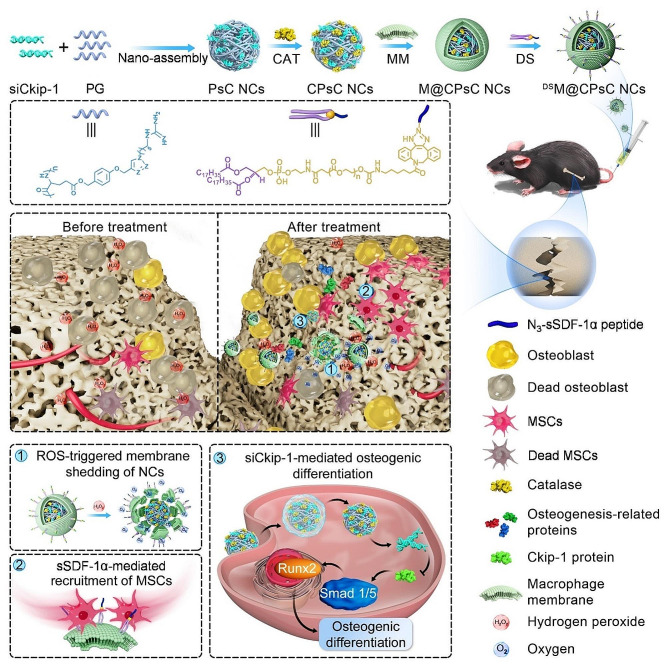
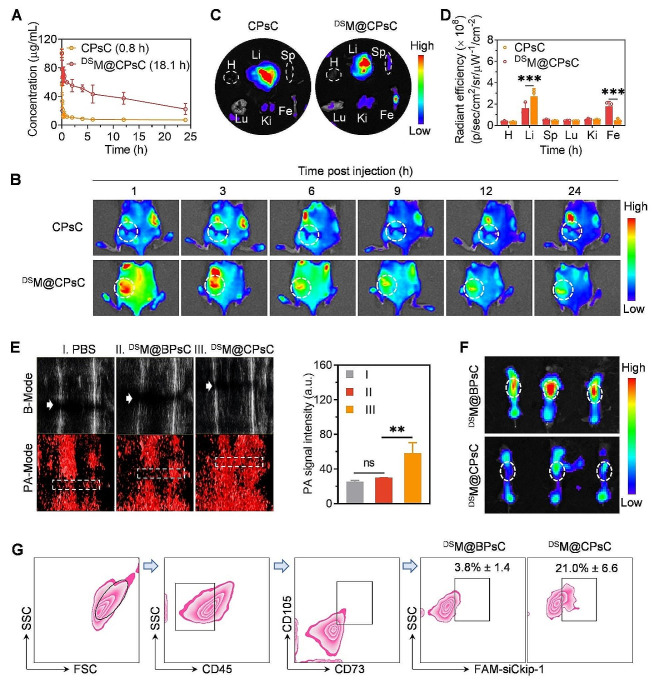
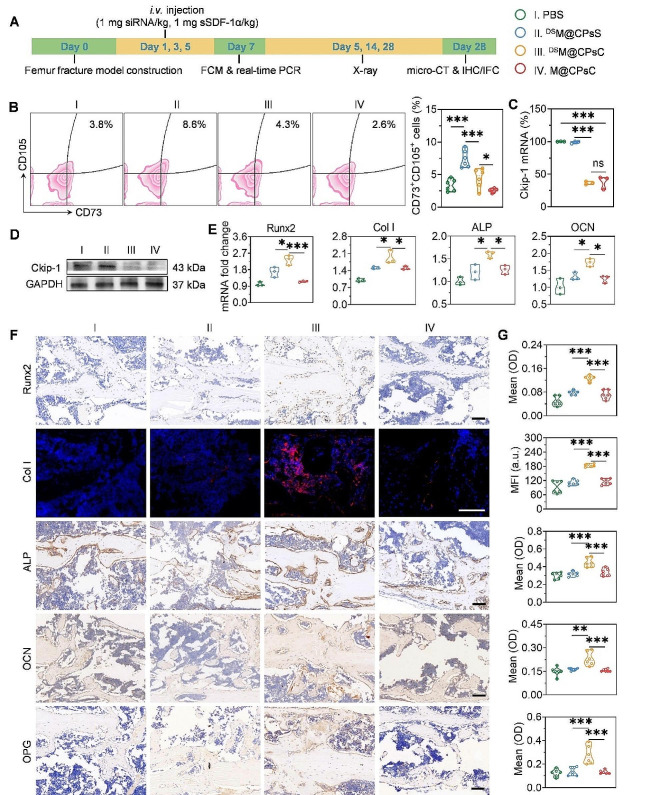
The fracture healing outcome is largely dependent on the quantities as well as osteogenic differentiation capacities of mesenchymal stem cells (MSCs) at the lesion site. Herein, macrophage membrane (MM)-reversibly cloaked nanocomplexes (NCs) are engineered for the lesion-targeted and hierarchical co-delivery of short stromal derived factor-1α peptide (sSDF-1α) and Ckip-1 small interfering RNA (Ckip-1 siRNA, siCkip-1) to promote bone repair by concurrently fostering recruitment and osteogenic differentiation of endogenous MSCs. To construct the NCs, a membrane-penetrating α-helical polypeptide first assembles with siCkip-1, and the cationic NCs are sequentially coated with catalase and an outer shell of sSDF-1α-anchored MM. Due to MM-assisted inflammation homing, intravenously injected NCs could efficiently accumulate at the fractured femur, where catalase decomposes the local hydrogen peroxide to generate oxygen bubbles that drives the shedding of sSDF-1α-anchored MM in the extracellular compartment. The exposed, cationic inner core thus enables robust trans-membrane delivery into MSCs to induce Ckip-1 silencing. Consequently, sSDF-1α-guided MSCs recruitment cooperates with siCkip-1-mediated osteogenic differentiation to facilitate bone formation and accelerate bone fracture healing. This study provides an enlightened strategy for the hierarchical co-delivery of macromolecular drugs into different cellular compartments, and it also renders a promising modality for the management of fracture healing.
骨折愈合的结果在很大程度上取决于病变部位间充质干细胞(MSCs)的数量和成骨分化能力。在此,设计了一种巨噬细胞膜(MM)可还原包裹的纳米复合物(NCs),用于短基质衍生因子-1α肽(sSDF-1α)和 Ckip-1 小干扰 RNA(Ckip-1 siRNA,siCkip-1)的病变靶向和分级共递送来促进骨修复,通过同时促进内源性 MSCs 的募集和成骨分化。为了构建 NCs,首先将一种膜穿透α-螺旋多肽与 siCkip-1 组装,然后将阳离子 NCs 依次用过氧化氢酶和 sSDF-1α 锚定 MM 的外壳包被。由于 MM 辅助炎症归巢,静脉注射的 NCs 可以有效地在骨折股骨处积聚,在该处过氧化氢酶分解局部的过氧化氢以产生氧气泡,从而驱动细胞外腔中 sSDF-1α 锚定 MM 的脱落。暴露的阳离子内核因此能够强力地转位进入 MSCs 以诱导 Ckip-1 沉默。因此,sSDF-1α 引导的 MSCs 募集与 siCkip-1 介导的成骨分化协同作用,促进骨形成并加速骨折愈合。该研究为大分子药物向不同细胞区室的分级共递供了一个有启发性的策略,并且为骨折愈合的管理提供了一种有前途的方式。