Department of Environmental Systems Science, ETH Zürich, 8092 Zürich, Switzerland.
Swiss Tropical and Public Health Institute, 4123 Allschwil, Switzerland.
Nutrients. 2024 Jun 23;16(13):1998. doi: 10.3390/nu16131998.
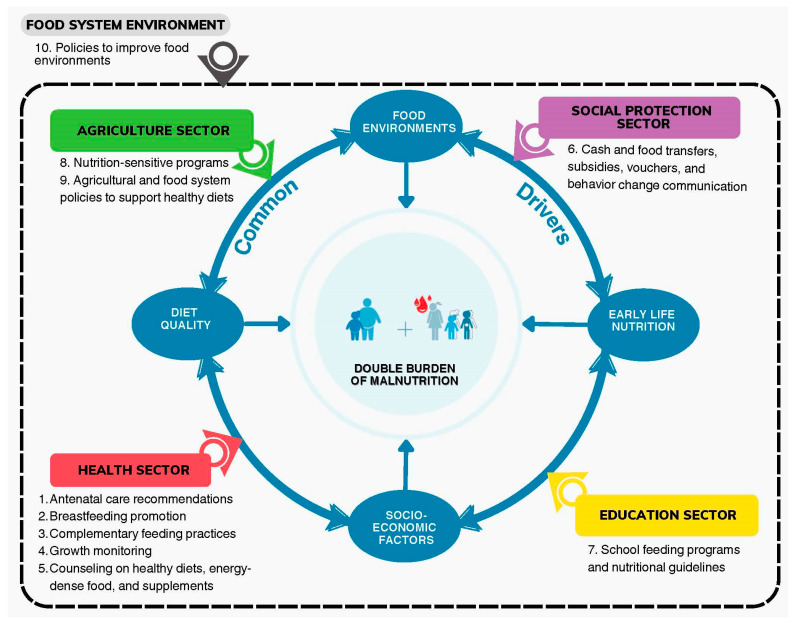
The double burden of malnutrition (DBM) is escalating in low- and middle-income countries (LMICs), including in Rwanda, most notably in urbanizing areas. The 2019-2020 Rwanda Demographic Health Survey (DHS) revealed that 33% of children under 5 years old are stunted while 42% of women in urban areas are overweight or obese. This coexistence has contributed to a surge in non-communicable diseases (NCDs), particularly in secondary cities. Using the World Health Organization's (WHOs) "double-duty action" (DDA) concept, this study aims to identify and evaluate interventions with double-duty potential in Rwanda's Rusizi and Rubavu districts and generate key recommendations for their improvement. A desk review of national policies pinpointed four programs with the greatest DDA potential: early childhood development (ECD) centers, the school feeding program, farmer field schools (FFS), and the provision of nutrition-sensitive direct support. In-person interviews with key stakeholders assessed the implementation of each program and a Strengths, Weaknesses, Opportunities, and Threats (SWOT) analysis was used to generate context-specific recommendations for their improvement. The main finding of this research is that Rwanda's potential to address the DBM can be improved across multiple sectors by implementing a few key changes: targeting beliefs surrounding nutrition, improving trainings for community educators, enhancing parent-particularly father-involvement, and engaging in close monitoring and follow-up. These findings offer actionable streps that governments and nutrition stakeholders can take to improve similar interventions in other rapidly urbanizing LMICs.
营养不良的双重负担(DBM)在包括卢旺达在内的中低收入国家(LMICs)不断加剧,尤其是在城市化地区。2019-2020 年卢旺达人口健康调查(DHS)显示,33%的5 岁以下儿童发育迟缓,而 42%的城市地区妇女超重或肥胖。这种共存导致了非传染性疾病(NCDs)的激增,特别是在二级城市。本研究利用世界卫生组织(WHO)的“双重职责行动”(DDA)概念,旨在确定和评估卢旺达 Rusizi 和 Rubavu 地区具有双重职责潜力的干预措施,并为其改进提出关键建议。对国家政策的案头审查确定了四个具有最大 DDA 潜力的计划:幼儿发展(ECD)中心、学校供餐计划、农民田间学校(FFS)和提供营养敏感的直接支持。对主要利益攸关方的实地访谈评估了每个计划的实施情况,并进行了强弱分析(SWOT)分析,以提出具体的改进建议。这项研究的主要发现是,卢旺达可以通过实施一些关键变革,在多个部门改善解决 DBM 的能力:针对与营养相关的观念、改进社区教育者的培训、增强家长特别是父亲的参与度,以及进行密切监测和跟进。这些发现为政府和营养利益攸关方提供了可行的措施,以改进其他快速城市化的 LMICs 中类似的干预措施。