School of Social Work, Boston College, Chestnut Hill, Massachusetts, USA.
Lynch School of Education and Human Development, Boston College, Chestnut Hill, Massachusetts, USA.
BMJ Glob Health. 2021 Jan;6(1). doi: 10.1136/bmjgh-2020-003508.
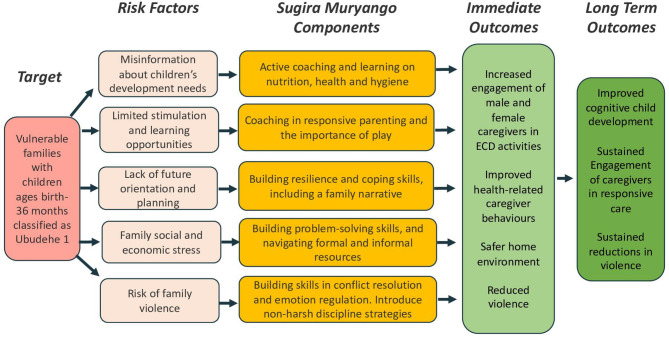
Families living in extreme poverty require interventions to support early-childhood development (ECD) due to broad risks. This longitudinal cluster randomised trial examines the effectiveness of Sugira Muryango (SM), a home-visiting intervention linked to Rwanda's social protection system to promote ECD and reduce violence compared with usual care (UC).
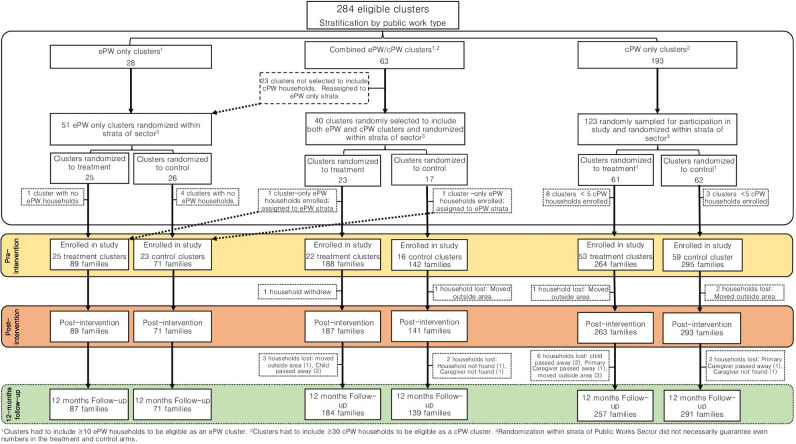
Families with children aged 6-36 months were recruited in 284 geographical clusters across three districts. Cluster-level randomisation (allocated 1:1 SM:UC) was used to prevent diffusion. SM was hypothesised to improve child development, reduce violence and increase father engagement. Developmental outcomes were assessed using the Ages and Stages Questionnaire (ASQ-3) and the Malawi Development Assessment Tool (MDAT) and anthropometric assessments of growth. Violence was assessed using questions from UNICEF Multiple Indicators Cluster Survey (MICS) and Rwanda Demographic and Health Surveys (DHS). Father engagement was assessed using the Home Observation for Measurement of the Environment. Blinded enumerators conducted interviews and developmental assessments.
A total of 541 SM families and 508 UC families were enrolled and included in the analyses. Study attrition (2.0% children; 9.6% caregivers) was addressed by hot deck imputation. Children in SM families improved more on gross motor (d=0.162, 95% CI 0.065 to 0.260), communication (d=0.081, 95% CI 0.005 to 0.156), problem solving (d=0.101, 95% CI 0.002 to 0.179) and personal-social development (d=0.096, 95% CI -0.015 to 0.177) on the ASQ-3. SM families showed increased father engagement (OR=1.592, 95% CI 1.069 to 2.368), decreased harsh discipline (incidence rate ratio, IRR=0.741, 95% CI 0.657 to 0.835) and intimate partner violence (IRR=0.616, 95% CI:0.458 to 0.828). There were no intervention-related improvements on MDAT or child growth.
Social protection programmes provide a means to deliver ECD intervention.
NCT02510313.
由于存在广泛的风险,生活在极端贫困中的家庭需要干预措施来支持儿童早期发展 (ECD)。这项纵向群组随机试验研究了 Sugira Muryango (SM) 的有效性,这是一种与卢旺达社会保障系统相联系的家访干预措施,旨在促进 ECD 并减少暴力行为,与常规护理 (UC) 相比。
在三个地区的 284 个地理群组中招募了 6-36 个月大的儿童家庭。采用群组级随机化 (SM:UC 分配 1:1) 以防止扩散。假设 SM 可以改善儿童发育,减少暴力行为并增加父亲的参与度。使用年龄和阶段问卷 (ASQ-3) 和马拉维发育评估工具 (MDAT) 以及生长的人体测量评估来评估发育结果。使用联合国儿童基金会多指标类集调查 (MICS) 和卢旺达人口与健康调查 (DHS) 的问题来评估暴力行为。使用家庭观察评估环境来评估父亲的参与度。盲目的计数员进行了访谈和发育评估。
共有 541 个 SM 家庭和 508 个 UC 家庭被纳入并进行了分析。通过热门甲板插补解决了研究流失(2.0%的儿童;9.6%的照顾者)。SM 家庭的儿童在粗大运动 (d=0.162, 95%CI 0.065-0.260)、沟通 (d=0.081, 95%CI 0.005-0.156)、解决问题 (d=0.101, 95%CI 0.002-0.179) 和个人社会发展 (d=0.096, 95%CI -0.015-0.177) 方面的 ASQ-3 表现出更好的发展。SM 家庭表现出增加的父亲参与度 (OR=1.592, 95%CI 1.069-2.368)、减少严厉纪律 (发生率比,IRR=0.741, 95%CI 0.657-0.835) 和亲密伴侣暴力 (IRR=0.616, 95%CI:0.458-0.828)。在 MDAT 或儿童生长方面,没有与干预相关的改善。
社会保护计划为提供 ECD 干预措施提供了一种手段。
NCT02510313。