Department of Psychological Health and Territorial Sciences, School of Medicine and Health Sciences, "G. d'Annunzio" University of Chieti-Pescara, 66100 Chieti, Italy.
Unit of Molecular Genetics, Center for Advanced Studies and Technology (CAST), "G. d'Annunzio" University of Chieti-Pescara, 66100 Chieti, Italy.
Int J Mol Sci. 2024 Jun 22;25(13):6855. doi: 10.3390/ijms25136855.
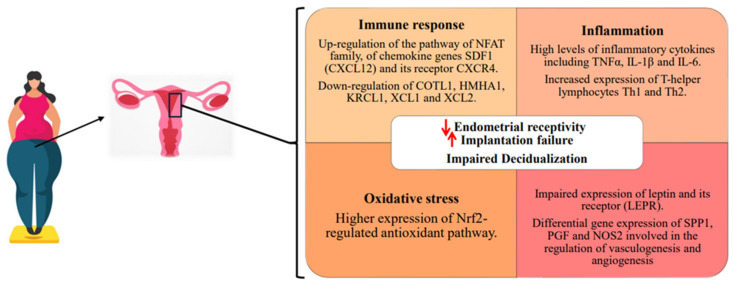
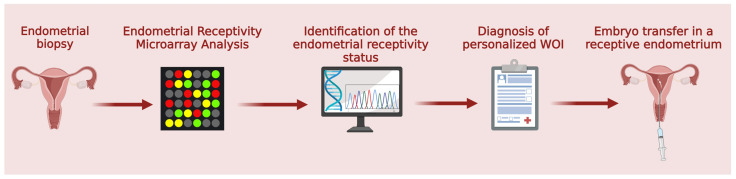
Female infertility constitutes a growing health problem in developing countries and could be associated with several possible causes including reproductive disorders, congenital malformations, infections and hormonal dysfunction. Nonetheless, a series of additional factors can also negatively impact female fertility and are represented by chronic exposure to environmental pollutants, stress, unhealthy lifestyle choices such as cigarette smoking and, among others, obesity. Excess weight is associated with several chronic diseases, and growing evidence demonstrates that it can compromise reproductive physiology due to its influence on endometrial gene expression and receptivity. Thus, the current review of the literature mainly focused on how obesity can impair uterine receptivity, mostly from a molecular point of view throughout the window of implantation (WOI) period at an endometrial level. It was also highlighted that an obesity-related increase in adipose tissue may lead to a modulation in the expression of multiple pathways, which could cause a hostile endometrial environment with a consequent negative impact on the uterine receptivity and the establishment of pregnancy. Thanks to the use of the endometrial receptivity assay (ERA), a specific microarray that studies the expression of a series of genes, it is now possible to evaluate the endometrial status of patients with infertility problems in a more detailed manner. Moreover, female fertility and endometrial receptivity could be affected by endometriosis, a chronic benign gynecological disease, whose cause-and-effect relationship to obesity is still uncertain. Therefore, further investigations would be required to better elucidate these mechanisms that govern embryo implantation and could be potentially useful for the generation of new strategies to overcome implantation failure and improve the pregnancy rates in obese women.
女性不孕是发展中国家日益严重的健康问题,可能与多种原因有关,包括生殖障碍、先天畸形、感染和激素功能障碍。然而,一系列其他因素也会对女性生育能力产生负面影响,包括慢性暴露于环境污染物、压力、不健康的生活方式选择,如吸烟,以及肥胖等。超重与多种慢性疾病有关,越来越多的证据表明,它会影响子宫内膜基因表达和容受性,从而损害生殖生理。因此,目前对文献的综述主要集中在肥胖如何通过影响子宫内膜的基因表达和容受性来损害子宫的容受性,主要从分子角度在子宫内膜水平上的着床窗口期(WOI)进行研究。此外,还强调了肥胖相关的脂肪组织增加可能导致多种途径的表达发生变化,从而导致子宫内膜环境恶劣,对子宫容受性和妊娠的建立产生负面影响。通过使用子宫内膜容受性检测(ERA),一种研究一系列基因表达的特定微阵列,可以更详细地评估不孕患者的子宫内膜状态。此外,女性生育能力和子宫内膜容受性可能受到子宫内膜异位症的影响,子宫内膜异位症是一种慢性良性妇科疾病,其与肥胖的因果关系尚不确定。因此,需要进一步的研究来更好地阐明这些控制胚胎着床的机制,并可能有助于制定新的策略来克服着床失败,提高肥胖女性的妊娠率。