Sevinyan Lusine, Asaalaarchchi Hasanthi, Tailor Anil, Williams Peter, Evans Matthew, Hodnett Darragh, Arakkal Darshana, Prabhu Pradeep, Flint Melanie S, Madhuri Thumuluru Kavitha
Department of Gynaecological Oncology, Royal Surrey NHS Foundation Trust, Guildford GU2 7XX, UK.
School of Applied Sciences, University of Brighton, Brighton BN2 4GJ, UK.
Cancers (Basel). 2024 Jun 22;16(13):2297. doi: 10.3390/cancers16132297.
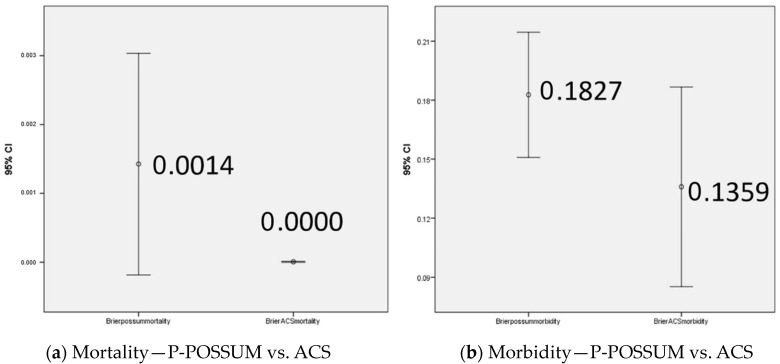
: In this retrospective pilot study, we aim to evaluate the accuracy and reliability of the P-POSSUM and ACS-NSQIP surgical risk calculators in predicting postoperative complications in gynaecological-oncological (GO) robotic surgery (RS). : Retrospective data collection undertaken through a dedicated GO database and patient notes at a tertiary referral cancer centre. Following data lock with the actual post-op event/complication, the risk calculators were used to measure predictive scores for each patient. Baseline analysis of 153 patients, based on statistician advice, was undertaken to evaluate P-POSSUM and ACS-NSQIP validity and relevance in GO patients undergoing RS performed. : P-POSSUM reports on mortality and morbidity only; ACS-NSQIP reports some individual complications as well. ACS-NSQIP risk prediction was most accurate for venous thromboembolism (VTE) (area under the curve (AUC)-0.793) and pneumonia (AUC-0.657) and it showed 90% accuracy in prediction of five major complications (Brier score 0.01). Morbidity was much better predicted by ACS-NSQIP than by P-POSSUM (AUC-0.608 vs. AUC-0.551) with the same result in mortality prediction (Brier score 0.0000). Moreover, a statistically significant overestimation of morbidity has been shown by the P-POSSUM calculator ( = 0.018). : Despite the limitations of this pilot study, the ACS-NSQIP risk calculator appears to be a better predictor of major complications and mortality, making it suitable for use by GO surgeons as an informed consent tool. Larger data collection and analyses are ongoing to validate this further.
在这项回顾性试点研究中,我们旨在评估P-POSSUM和美国外科医师学会国家外科质量改进计划(ACS-NSQIP)手术风险计算器在预测妇科肿瘤(GO)机器人手术(RS)术后并发症方面的准确性和可靠性。通过一个专门的GO数据库和一家三级转诊癌症中心的患者病历进行回顾性数据收集。在数据与实际术后事件/并发症锁定后,使用风险计算器来测量每位患者的预测分数。根据统计学家的建议,对153例患者进行了基线分析,以评估P-POSSUM和ACS-NSQIP在接受RS的GO患者中的有效性和相关性。P-POSSUM仅报告死亡率和发病率;ACS-NSQIP还报告一些个体并发症。ACS-NSQIP对静脉血栓栓塞(VTE)(曲线下面积(AUC)-0.793)和肺炎(AUC-0.657)的风险预测最为准确,并且在预测五种主要并发症方面显示出90%的准确率(Brier评分0.01)。ACS-NSQIP对发病率的预测比P-POSSUM好得多(AUC-0.608对AUC-0.551),在死亡率预测方面结果相同(Brier评分0.0000)。此外,P-POSSUM计算器显示出发病率的统计学显著高估(P = 0.018)。尽管这项试点研究存在局限性,但ACS-NSQIP风险计算器似乎是主要并发症和死亡率的更好预测工具,使其适合GO外科医生用作知情同意工具。正在进行更大规模的数据收集和分析以进一步验证这一点。