Himmelsbach Vera, Jeschke Matthias, Lange Christian M, Scheiner Bernhard, Pinter Matthias, Sinner Friedrich, Venerito Marino, Queck Alexander, Trojan Jörg, Waidmann Oliver, Finkelmeier Fabian
Department of Gastroenterology and Hepatology, University Hospital Frankfurt, 60590 Frankfurt, Germany.
Department of Gastroenterology, Hepatology and Transplant Medicine, University Hospital Essen, 45147 Essen, Germany.
Cancers (Basel). 2024 Jul 3;16(13):2442. doi: 10.3390/cancers16132442.
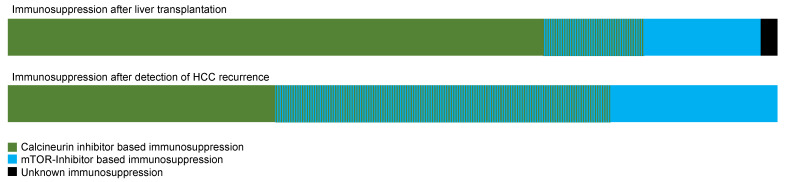
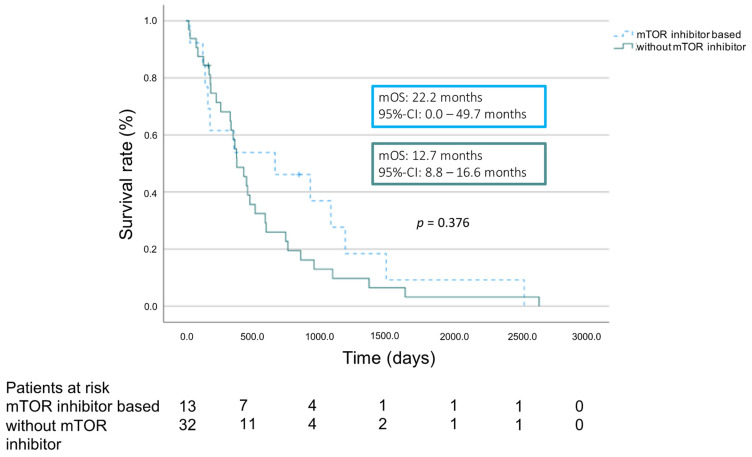
The tyrosine kinase inhibitors (TKIs) sorafenib and lenvatinib represent the first-line systemic therapy of choice for patients with hepatocellular carcinoma (HCC) recurrence after liver transplantation (LT). Under sorafenib and lenvatinib, HCC patients have shown increasingly improved overall survival in clinical studies over the years. In contrast, data on overall survival for patients with HCC recurrence after LT under TKIs are scarce and limited to small retrospective series. In this retrospective, multicenter study, we investigated the efficacy of TKI therapy and the influence of immunosuppression in patients with HCC recurrence after LT.
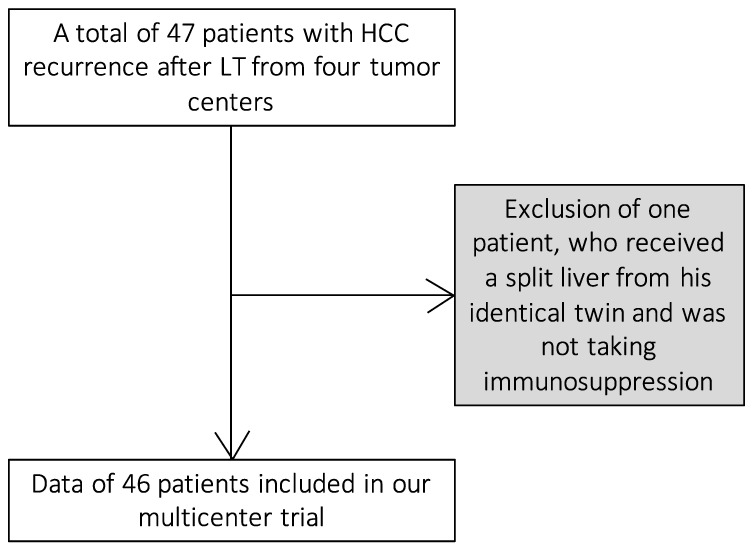
Retrospective data were collected from four transplant centers from Germany and Austria. We included patients with HCC recurrence after LT between 2007 and 2020 who were treated with a TKI.
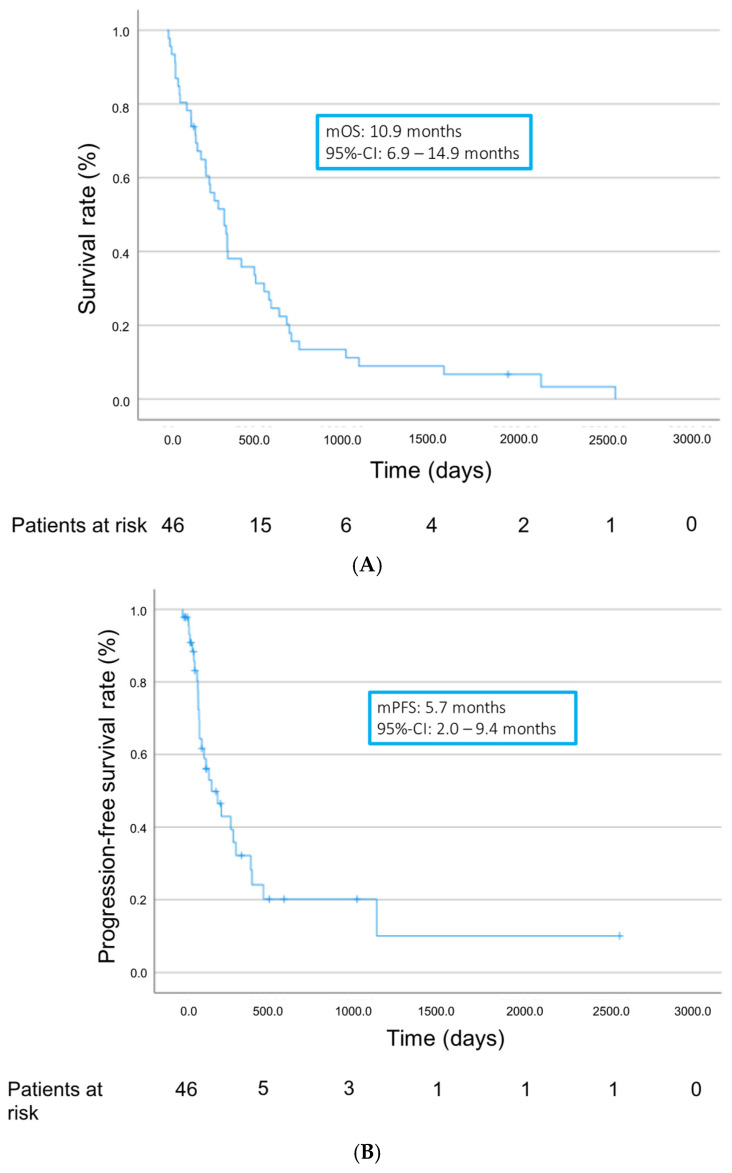
In total, we analyzed data from 46 patients with HCC recurrence after LT. The most common underlying liver disease was hepatitis C, accounting for 52.2%. The median time to relapse was 11.8 months (range 0-117.7 months). The liver graft was affected in 21 patients (45.7%), and 36 patients (78.3%) had extrahepatic metastases at initial diagnosis of recurrence, with the lung being the most commonly affected ( = 25, 54.3%). Of the total, 54.3% ( = 25) of the patients were initially treated locally; 39 (85.8%) and 7 (15.2%) patients received sorafenib and lenvatinib, respectively, as first-line systemic therapy. Median overall survival of the whole cohort was 10.9 months (95% confidence interval (95% CI) 6.9-14.9 months) and median progression free survival was 5.7 months (95% CI 2.0-9.4 months) from treatment initiation.
Since history of liver transplantation is considered a contraindication for immunotherapy, prognosis of patients with HCC recurrence after LT remains poor.
酪氨酸激酶抑制剂(TKIs)索拉非尼和仑伐替尼是肝移植(LT)后肝细胞癌(HCC)复发患者的一线全身治疗选择。多年来,在索拉非尼和仑伐替尼治疗下,HCC患者在临床研究中的总生存期日益改善。相比之下,关于LT后HCC复发患者在TKIs治疗下的总生存期数据稀缺,且仅限于小型回顾性系列研究。在这项回顾性多中心研究中,我们调查了TKI治疗对LT后HCC复发患者的疗效以及免疫抑制的影响。
从德国和奥地利的四个移植中心收集回顾性数据。我们纳入了2007年至2020年间接受TKI治疗的LT后HCC复发患者。
我们总共分析了46例LT后HCC复发患者的数据。最常见的潜在肝脏疾病是丙型肝炎,占52.2%。复发的中位时间为11.8个月(范围0 - 117.7个月)。21例患者(45.7%)的肝移植受影响,36例患者(78.3%)在复发初诊时有肝外转移,其中肺是最常受影响的部位(n = 25,54.3%)。总体而言,54.3%(n = 25)的患者最初接受局部治疗;39例(85.8%)和7例(15.2%)患者分别接受索拉非尼和仑伐替尼作为一线全身治疗。从治疗开始,整个队列的中位总生存期为10.9个月(95%置信区间(95%CI)6.9 - 14.9个月),中位无进展生存期为5.7个月(95%CI 2.0 - 9.4个月)。
由于肝移植史被认为是免疫治疗的禁忌症,LT后HCC复发患者的预后仍然很差。