Center for Marine Research, Ruđer Bošković Institute, Rovinj, Croatia.
Sci Rep. 2024 Jul 13;14(1):16209. doi: 10.1038/s41598-024-67043-4.
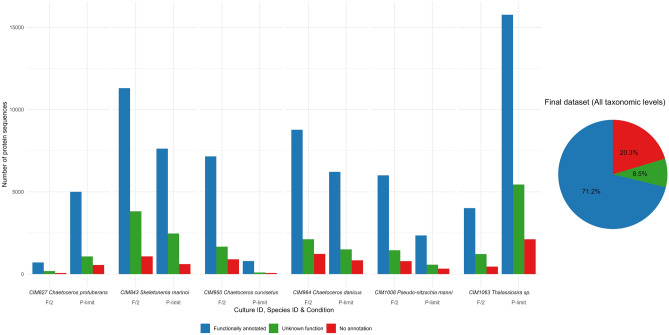
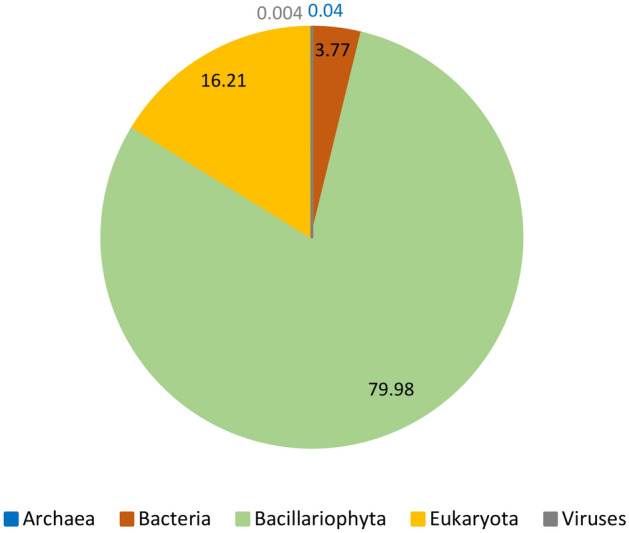
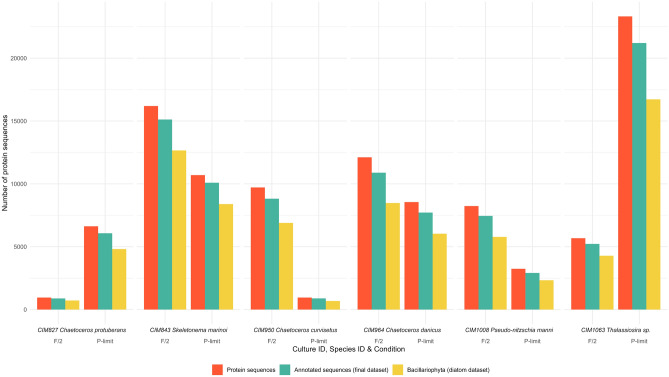
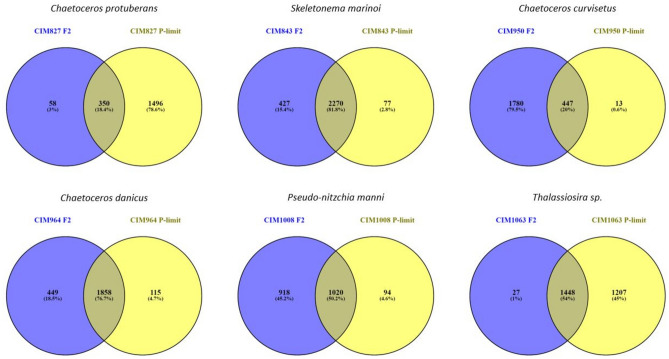
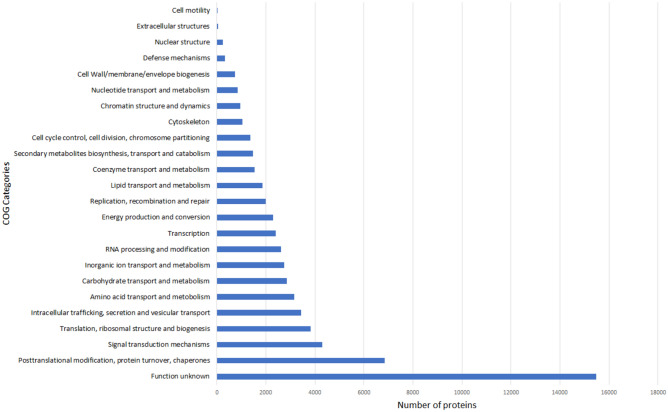
Marine microbial communities form the basis for the functioning of marine ecosystems and the conservation of biodiversity. With the application of metagenomics and metatranscriptomics in marine environmental studies, significant progress has been made in analysing the functioning of microbial communities as a whole. These molecular techniques are highly dependent on reliable, well-characterised, comprehensive and taxonomically diverse sequenced reference transcriptomes of microbial organisms. Here we present a set of 12 individual transcriptome assemblies derived from 6 representative diatom species from the northern Adriatic Sea grown under 2 environmentally relevant growth conditions (phosphate replete vs. phosphate deprived). After filtering the reads and assembly, an average number of 64,932 transcripts per assembly was obtained, of which an average of 8856 were assigned to functionally known proteins. Of all assigned transcripts, an average of 6483 proteins were taxonomically assigned to diatoms (Bacillariophyta). On average, a higher number of assigned proteins was detected in the transcriptome assemblies of diatoms grown under replete media condition. On average, 50% of the mapped proteins were shared between the two growth conditions. All recorded proteins in the dataset were classified into 24 COG categories, with approximately 25% belonging to the unknown function and the remaining 75% belonging to all other categories. The resulting diatom reference database for the northern Adriatic, focussing on the response to nutrient limitation as characteristic for the region and predicted for the future world oceans, provides a valuable resource for analysing environmental metatranscriptome and metagenome data. Each northern Adriatic transcriptome can also be used by itself as a reference database for the (meta)transcriptomes and gene expression studies of the associated species that will be generated in the future.
海洋微生物群落是海洋生态系统功能和生物多样性保护的基础。随着宏基因组学和宏转录组学在海洋环境研究中的应用,在分析微生物群落整体功能方面取得了重大进展。这些分子技术高度依赖于可靠、特征良好、全面和分类多样化的微生物生物序列参考转录组。在这里,我们展示了一组来自北亚得里亚海的 6 种代表性硅藻物种的 12 个个体转录组组装,这些物种在两种环境相关的生长条件下(磷充足和磷缺乏)生长。在过滤了reads 和组装后,每个组装平均获得 64932 个转录本,其中平均有 8856 个被分配到功能已知的蛋白质中。在所有分配的转录本中,平均有 6483 个蛋白质被分类为硅藻(Bacillariophyta)。在富含营养的培养基中生长的硅藻转录组组装中,平均检测到更多的分配蛋白。平均而言,两种生长条件下有 50%的映射蛋白是共享的。数据集中记录的所有蛋白质被分为 24 个 COG 类别,其中约 25%属于未知功能,其余 75%属于其他所有类别。该数据集记录的所有蛋白质被分为 24 个 COG 类别,其中约 25%属于未知功能,其余 75%属于其他所有类别。该数据集记录的所有蛋白质被分为 24 个 COG 类别,其中约 25%属于未知功能,其余 75%属于其他所有类别。该数据集记录的所有蛋白质被分为 24 个 COG 类别,其中约 25%属于未知功能,其余 75%属于其他所有类别。该数据集记录的所有蛋白质被分为 24 个 COG 类别,其中约 25%属于未知功能,其余 75%属于其他所有类别。北亚得里亚海的参考数据库,重点关注该地区特有的营养限制响应,并预测未来世界海洋,为分析环境宏转录组和宏基因组数据提供了有价值的资源。未来生成的相关物种的(meta)转录组和基因表达研究也可以单独使用每个北亚得里亚海转录组作为参考数据库。