Program in Developmental and Stem Cell Biology, Hospital for Sick Children, Toronto, Ontario, Canada.
Department of Laboratory Medicine & Pathobiology, University of Toronto, Toronto, Ontario, Canada.
Nat Commun. 2024 Jul 13;15(1):5898. doi: 10.1038/s41467-024-50281-5.
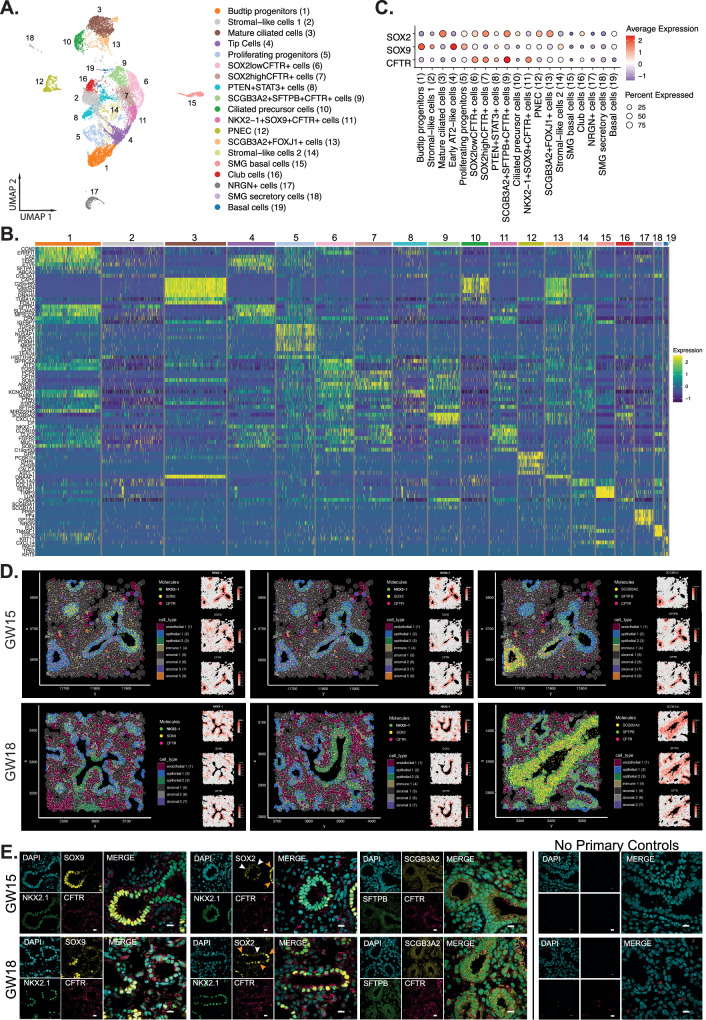
Studying human fetal lungs can inform how developmental defects and disease states alter the function of the lungs. Here, we sequenced >150,000 single cells from 19 healthy human pseudoglandular fetal lung tissues ranging between gestational weeks 10-19. We capture dynamic developmental trajectories from progenitor cells that express abundant levels of the cystic fibrosis conductance transmembrane regulator (CFTR). These cells give rise to multiple specialized epithelial cell types. Combined with spatial transcriptomics, we show temporal regulation of key signalling pathways that may drive the temporal and spatial emergence of specialized epithelial cells including ciliated and pulmonary neuroendocrine cells. Finally, we show that human pluripotent stem cell-derived fetal lung models contain CFTR-expressing progenitor cells that capture similar lineage developmental trajectories as identified in the native tissue. Overall, this study provides a comprehensive single-cell atlas of the developing human lung, outlining the temporal and spatial complexities of cell lineage development and benchmarks fetal lung cultures from human pluripotent stem cell differentiations to similar developmental window.
研究人类胎儿肺脏可以了解发育缺陷和疾病状态如何改变肺的功能。在这里,我们对 19 个人类假腺期胎儿肺组织进行了测序,这些组织来自妊娠 10-19 周的 19 名健康个体。我们从表达大量囊性纤维化跨膜电导调节因子 (CFTR) 的祖细胞中捕获了动态发育轨迹。这些细胞产生了多种特化的上皮细胞类型。结合空间转录组学,我们展示了关键信号通路的时空调控,这些信号通路可能驱动特化上皮细胞(包括纤毛细胞和肺神经内分泌细胞)的时空出现。最后,我们表明人多能干细胞衍生的胎儿肺模型包含表达 CFTR 的祖细胞,这些祖细胞能够捕获与在原组织中鉴定出的类似的谱系发育轨迹。总的来说,这项研究提供了人类肺部发育的全面单细胞图谱,概述了细胞谱系发育的时空复杂性,并将人多能干细胞分化的胎儿肺培养物与类似的发育窗口进行了基准比较。