National Institute for Health and Care Research, Applied Research Collaboration Greater Manchester, School of Health Sciences, Faculty of Biology, Medicine and Health, The University of Manchester, Manchester, M13 9PL, UK.
School of Health Sciences, Faculty of Biology, Medicine and Health, The University of Manchester, Manchester, M13 9PL, UK.
BMC Womens Health. 2024 Jul 13;24(1):399. doi: 10.1186/s12905-024-03243-4.
Women experiencing problematic menopausal symptoms report lower health-related quality of life and greater healthcare use than women without symptoms. Not all women want to or are able to take hormone replacement therapy. Strengthening the evidence for menopause symptom-management options, including physical activity, improves agency for women.
This overview assesses effectiveness of physical activity and exercise interventions targeting women experiencing menopause symptoms.
Medline, Embase, CINAHL, Scopus, The Cochrane Database of Systematic Reviews and Social Science Citation Index were searched (June 2023) for systematic reviews of physical activity and exercise interventions targeting women experiencing menopause. Reviews were assessed using AMSTAR-2 and a best-evidence approach to synthesis without meta-analysis (SWIM) was adopted. The protocol was registered on PROSPERO (CRD42022298908).
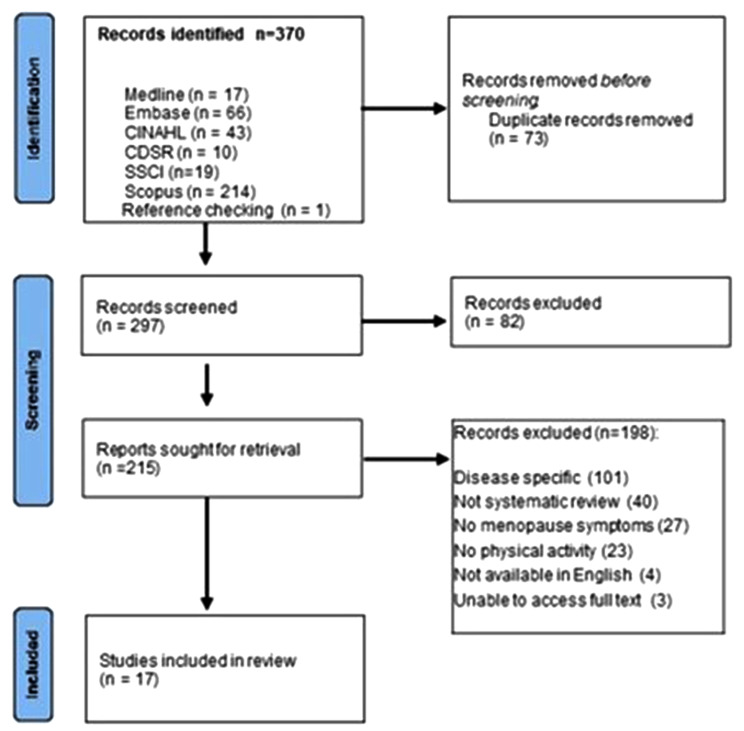
Seventeen reviews included 80 unique relevant primary studies with 8983 participants. There is evidence showing improvement of physical, urogenital, and total symptoms following yoga interventions. Evidence for vasomotor and psychological symptoms was inconclusive. Findings for aerobic exercise were inconclusive although there were some examples of beneficial effects on total and vasomotor symptoms. Evidence was very limited for other types of physical activity and impact on physical, sexual and urogenital symptoms.
There is some evidence that yoga, and to lesser extent, aerobic exercise may be beneficial for some menopause symptoms, but there is insufficient evidence to recommend a particular form of exercise. Current reviews categorise women on menopause status; broadening this to include ethnicity, income status, employment and other factors will allow better understanding of context for successful interventions.
有更年期症状的女性报告称,其健康相关生活质量较低,且对医疗保健的需求更大,而无症状的女性则不然。并非所有女性都希望或能够接受激素替代疗法。加强对更年期症状管理选择的证据,包括身体活动,可增强女性的自主权。
本综述评估了针对有更年期症状的女性的身体活动和运动干预措施的有效性。
检索了 Medline、Embase、CINAHL、Scopus、The Cochrane Database of Systematic Reviews 和 Social Science Citation Index,以获取针对有更年期症状的女性的身体活动和运动干预措施的系统评价(2023 年 6 月)。使用 AMSTAR-2 评估综述,并采用最佳证据综合方法(SWIM)进行无荟萃分析的综合。该方案已在 PROSPERO(CRD42022298908)上注册。
17 项综述纳入了 80 项具有 8983 名参与者的独特相关原始研究。有证据表明,瑜伽干预可改善身体、尿生殖和总体症状。关于血管舒缩和心理症状的证据尚无定论。有氧运动的证据尚无定论,但有一些关于总体和血管舒缩症状有益影响的例子。其他类型的身体活动和对身体、性和尿生殖症状的影响的证据非常有限。
有一些证据表明瑜伽,在较小程度上,有氧运动可能对某些更年期症状有益,但没有足够的证据推荐特定形式的运动。目前的综述根据女性的更年期状况对其进行分类;将其扩展到包括种族、收入状况、就业和其他因素,将有助于更好地了解成功干预的背景。