Department of Civil and Environmental Engineering, University of California, Irvine, California 92697-2175, United States.
Environ Sci Technol. 2024 Jul 23;58(29):12888-12898. doi: 10.1021/acs.est.4c01690. Epub 2024 Jul 14.
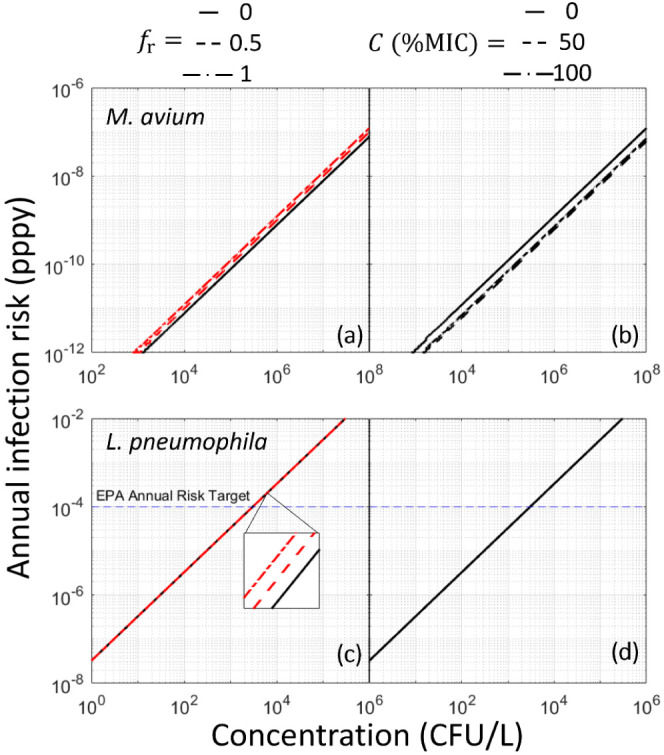
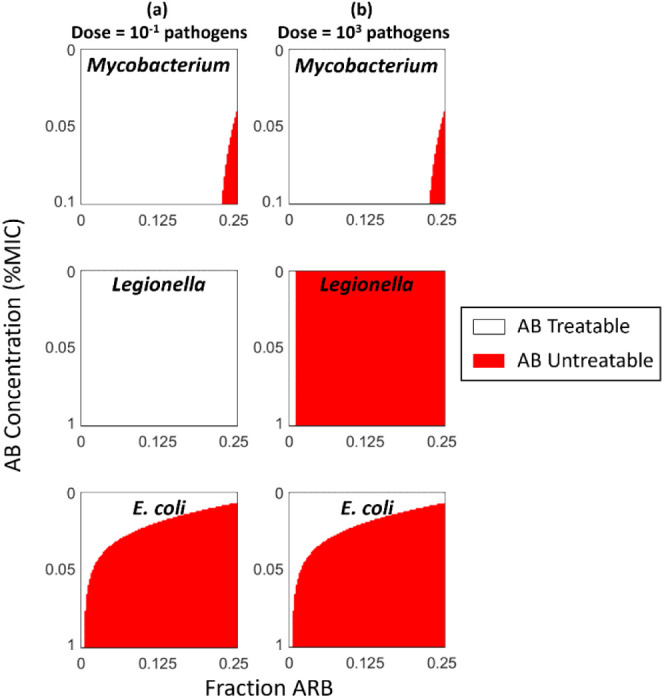
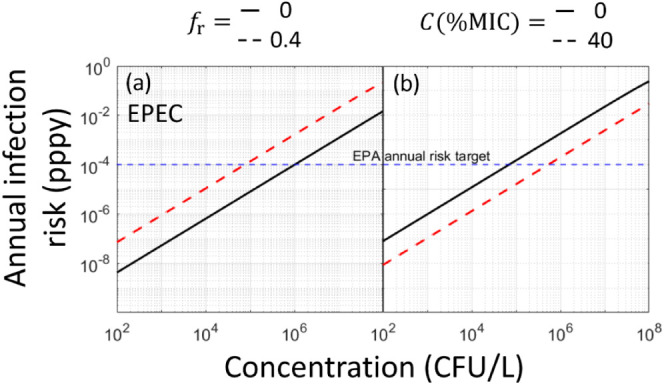
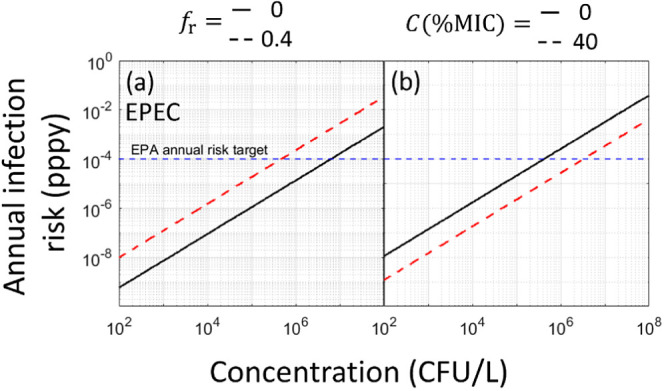
Antibiotic-resistant bacteria (ARB) have become a major threat to public health and modern medicine. A simple death kinetics-based dose-response model (SD-DRM) was incorporated into a quantitative microbial risk assessment (QMRA) to assess the risks of exposure to reclaimed wastewater harboring antibiotic-resistant , , and for multiple exposure scenarios. The fractions of ARB and trace antibiotics present in the body were incorporated to demonstrate their impact on infection risks. Both ARB and antibiotic susceptible bacteria, ASB, are assumed to have the same dose-response in the absence of antibiotics but behave differently in the presence of residual antibiotics in the body. Annual risk of infection exceeded the EPA 10 pppy (per person per year) benchmark at concentrations in reclaimed water greater than 10-10 CFU/L, depending on parameter variation. Enteropathogenic infection risks meet the EPA annual benchmark at concentrations around 10-10 total . The results illustrated that an increase in residual antibiotics from 0 to 40% of the minimum inhibitory concentration (MIC) reduced the risk by about 1 order of magnitude for but was more likely to result in an untreatable infection.
耐药细菌(ARB)已成为公共卫生和现代医学的主要威胁。本研究将基于简单死亡动力学的剂量反应模型(SD-DRM)纳入定量微生物风险评估(QMRA)中,以评估接触含有耐药 、 和 的再生水的风险,共考虑了多种暴露场景。本研究还纳入了体内 ARB 和痕量抗生素的分数,以证明其对感染风险的影响。在不存在抗生素的情况下,假定 ARB 和抗生素敏感菌(ASB)具有相同的剂量反应,但在体内存在残留抗生素时,其行为则不同。在再生水中的浓度大于 10-10 CFU/L 时, 感染的年风险超过了 EPA 的 10 pppy(每人每年)基准,具体取决于参数变化。肠致病性 感染风险在大约 10-10 总 浓度时符合 EPA 的年度基准。结果表明,残留抗生素浓度从最低抑菌浓度(MIC)的 0%增加到 40%,会使 的风险降低约 1 个数量级,但更有可能导致无法治疗的感染。