
结合表型和基因型方法,利用微流控离心盘快速检测废水中的抗生素抗性细菌。
Combining Phenotypic and Genotypic Methods for the Rapid Detection of Antibiotic-Resistant Bacteria in Wastewater Using a Microfluidic Centrifugal Disc.
作者信息
Huang Yen-Hsiang, Jiang Sunny
机构信息
Department of Civil and Environmental Engineering, University of California Irvine, Irvine, California 92697, United States.
出版信息
ACS ES T Eng. 2025 May 8;5(8):1943-1952. doi: 10.1021/acsestengg.5c00107. eCollection 2025 Aug 8.
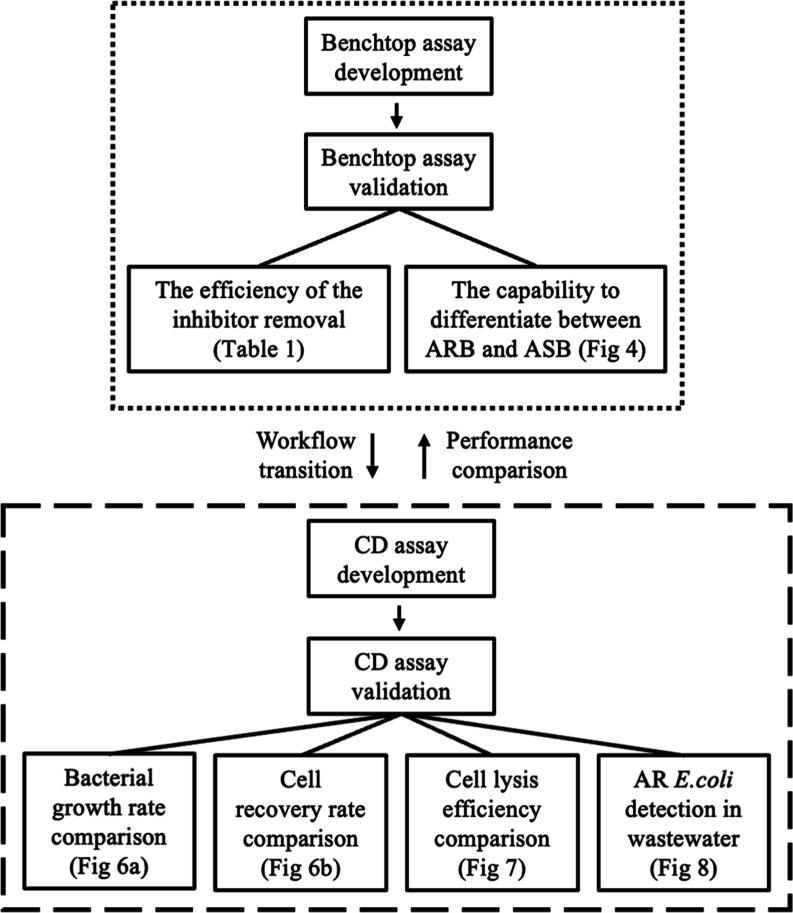
Antimicrobial resistance (AMR) has emerged as a critical global health threat, leading to untreatable infectious diseases and significantly increasing human morbidity and mortality. Rapid, portable, and user-friendly detection of antibiotic-resistant bacteria (ARB) in the environment plays a key role in controlling the spread of diseases and combating the emergence of AMR. In this study, we report a portable microfluidic centrifugal disc (CD) assay incorporating both phenotypic and genotypic methods for ARB detection. This assay significantly reduces the time required for bacterial culturing from days to hours while maintaining the reliability of phenotypic methods. Moreover, the CD assay eliminates the need for a centralized laboratory and well-trained personnel. The on-CD ARB detection can be completed in less than 3 h after sample and reagent loading. The results demonstrated that the on-CD assay provided performance comparable to that of the benchtop ARB detection assay. Analysis of variance (ANOVA) comparing the benchtop and on-CD assays yielded a -value of 0.08 for the bacterial growth rate and a -value of 0.73 for the cell recovery rate after the sample purification, confirming no significant differences between the two approaches. The ARB detection assay was able to identify ampicillin-resistant spiked in wastewater at concentrations as low as 10 CFU/μL. Additionally, the CD assay detected indigenous ampicillin-resistant in wastewater, demonstrating the potential of this platform for environmental applications.
抗菌药物耐药性(AMR)已成为全球重大的健康威胁,导致出现无法治疗的传染病,并显著增加人类发病率和死亡率。对环境中的抗生素耐药菌(ARB)进行快速、便携且用户友好的检测,在控制疾病传播和对抗AMR的出现方面发挥着关键作用。在本研究中,我们报告了一种便携式微流控离心盘(CD)检测方法,该方法结合了表型和基因型方法用于ARB检测。这种检测方法显著减少了细菌培养所需的时间,从数天缩短至数小时,同时保持了表型方法的可靠性。此外,CD检测无需集中实验室和训练有素的人员。在加载样品和试剂后,不到3小时即可完成CD上的ARB检测。结果表明,CD检测的性能与台式ARB检测方法相当。对台式和CD检测进行方差分析(ANOVA),细菌生长速率的p值为0.08,样品纯化后的细胞回收率的p值为0.73,证实两种方法之间无显著差异。ARB检测方法能够识别废水中低至10 CFU/μL浓度的氨苄青霉素耐药菌。此外,CD检测还检测到了废水中的本地氨苄青霉素耐药菌,证明了该平台在环境应用中的潜力。



 Zotero 插件