Sarıcaoğlu Elif M, Yörük Fügen
Department of Infectious Disease and Clinical Microbiology, Ankara University School of Medicine, Ankara, Türkiye.
Infect Dis Clin Microbiol. 2024 Jun 28;6(2):102-111. doi: 10.36519/idcm.2024.330. eCollection 2024 Jun.
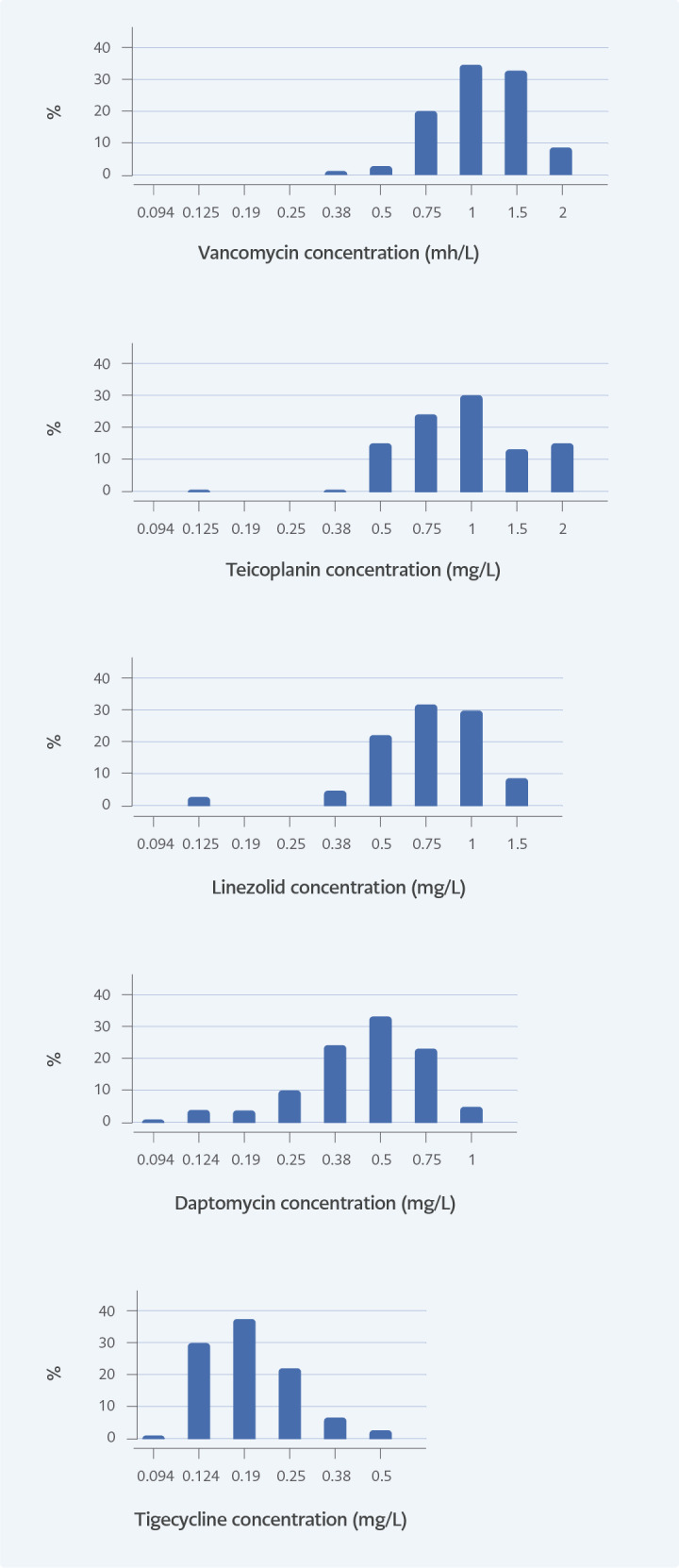
While vancomycin has remained the mainstay of the treatment for methicillin-resistant (MRSA) infections, there is growing evidence of the clinical impact of increased glycopeptide minimum inhibitory concentrations (MICs) in MRSA isolates. This study aimed to determine the susceptibility of various MRSA isolates to different antibiotics with antistaphylococcal activity and the impact of glycopeptide MICs on clinical and microbiological outcomes.
This retrospective cohort study, conducted between 2013 and 2017, evaluated the susceptibility of MRSA strains isolated from various clinical samples to antistaphylococcal antibiotics using the gradient strip method. The clinical and laboratory features of patients infected with MRSA isolates with elevated glycopeptide MICs (>1 mg/L) and with isolates that had low glycopeptide MICs (≤1 mg/L) were compared.
A total of 104 patients infected with MRSA strains were included in this study. Male sex (odds ratio [OR]=2.48, 95% confidence interval [CI]=1.01-6.10, =0.048), two or more comorbidities (OR=2.48, 95% CI=1.03-6.50, =0.044), history of MRSA infection (OR=4.91, 95% CI=1.70-14.28, =0.003) and a longer hospital stay prior to MRSA infection (OR=2.32, 95% CI=1.05-7.85, =0.040) were independent risk factors for high glycopeptide MICs. In MRSA infections with a teicoplanin MIC of >0.75mg/L, the microbiological and treatment failures were 46.2% (=0.044) and 60.6% (=0.042), respectively.
This study showed that the critical MIC value, which suggested treatment failure as well as microbiological failure in the teicoplanin-treated MRSA infections, was >0.75 mg/L rather than >1 mg/L in our study cohort. The identification of high-risk patients;for treatment failures and mortality considering gradient strip method MIC values is crucial for the effective management of MRSA infections.
虽然万古霉素一直是耐甲氧西林金黄色葡萄球菌(MRSA)感染治疗的主要药物,但越来越多的证据表明,MRSA菌株中糖肽类药物最低抑菌浓度(MIC)升高对临床有影响。本研究旨在确定各种MRSA菌株对具有抗葡萄球菌活性的不同抗生素的敏感性,以及糖肽类MIC对临床和微生物学结果的影响。
这项回顾性队列研究于2013年至2017年进行,使用梯度纸条法评估从各种临床样本中分离出的MRSA菌株对抗葡萄球菌抗生素的敏感性。比较了感染糖肽类MIC升高(>1mg/L)的MRSA菌株和糖肽类MIC较低(≤1mg/L)的菌株的患者的临床和实验室特征。
本研究共纳入104例感染MRSA菌株的患者。男性(优势比[OR]=2.48,95%置信区间[CI]=1.01-6.10,P=0.048)、两种或更多合并症(OR=2.48,95%CI=1.03-6.50,P=0.044)、MRSA感染史(OR=4.91,95%CI=1.70-14.28,P=0.003)以及MRSA感染前住院时间较长(OR=2.32,95%CI=1.05-7.85,P=0.040)是糖肽类MIC升高的独立危险因素。在替考拉宁MIC>0.75mg/L的MRSA感染中,微生物学和治疗失败率分别为46.2%(P=0.044)和60.6%(P=0.042)。
本研究表明,在我们的研究队列中,在替考拉宁治疗的MRSA感染中提示治疗失败以及微生物学失败的临界MIC值为>0.75mg/L,而非>1mg/L。考虑梯度纸条法MIC值来识别治疗失败和死亡的高危患者对于MRSA感染的有效管理至关重要。