Ciulkinyte Austeja, Mountford Hayley S, Fontanillas Pierre, Bates Timothy C, Martin Nicholas G, Fisher Simon E, Luciano Michelle
Translational Neuroscience PhD Programme, University of Edinburgh, Edinburgh, UK.
School of Philosophy, Psychology and Language Sciences, University of Edinburgh, Edinburgh, UK.
Mol Psychiatry. 2025 Jan;30(1):140-150. doi: 10.1038/s41380-024-02649-8. Epub 2024 Jul 15.
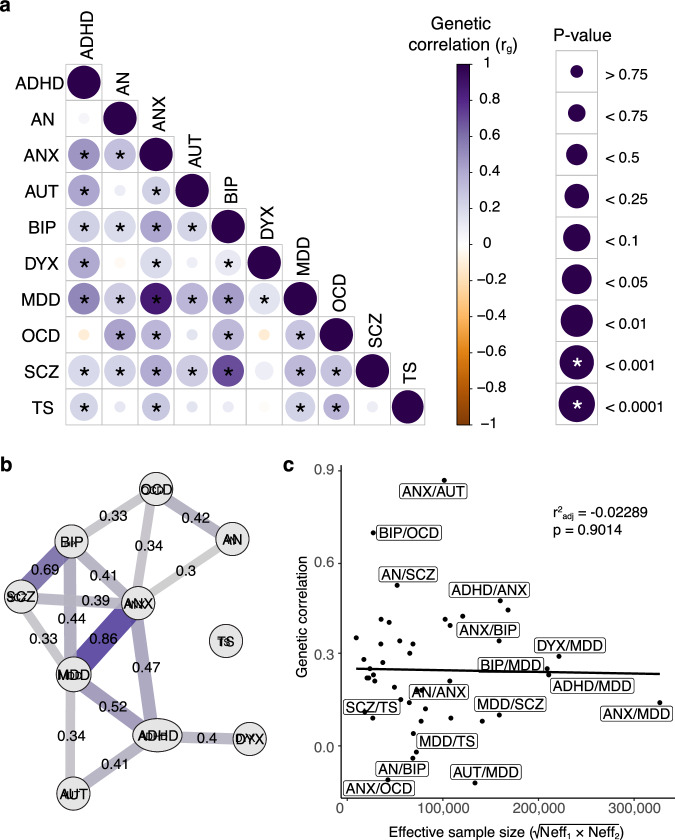
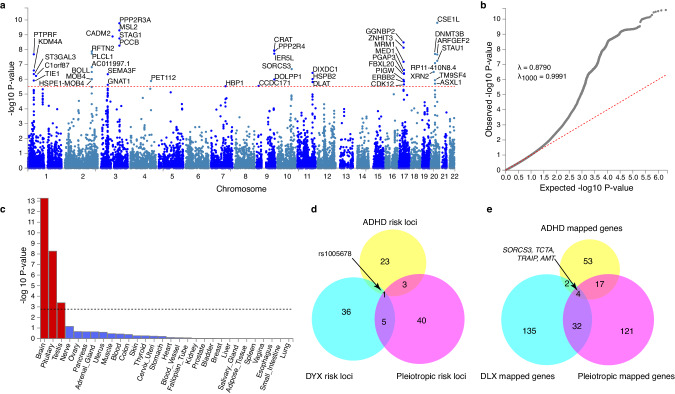
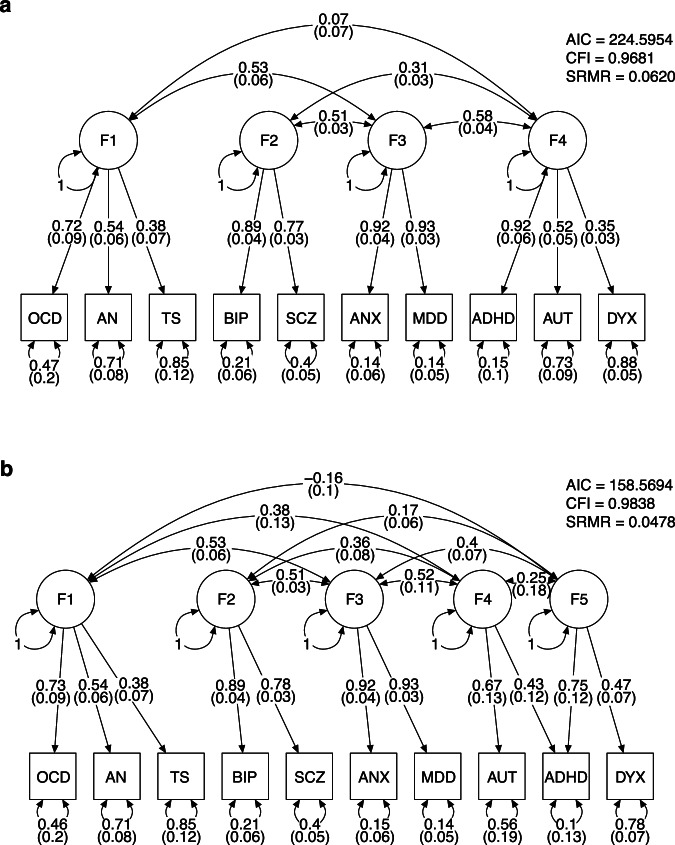
Dyslexia is a learning difficulty with neurodevelopmental origins, manifesting as reduced accuracy and speed in reading and spelling. It is substantially heritable and frequently co-occurs with other neurodevelopmental conditions, particularly attention deficit-hyperactivity disorder (ADHD). Here, we investigate the genetic structure underlying dyslexia and a range of psychiatric traits using results from genome-wide association studies of dyslexia, ADHD, autism, anorexia nervosa, anxiety, bipolar disorder, major depressive disorder, obsessive compulsive disorder, schizophrenia, and Tourette syndrome. Genomic Structural Equation Modelling (GenomicSEM) showed heightened support for a model consisting of five correlated latent genomic factors described as: F1) compulsive disorders (including obsessive-compulsive disorder, anorexia nervosa, Tourette syndrome), F2) psychotic disorders (including bipolar disorder, schizophrenia), F3) internalising disorders (including anxiety disorder, major depressive disorder), F4) neurodevelopmental traits (including autism, ADHD), and F5) attention and learning difficulties (including ADHD, dyslexia). ADHD loaded more strongly on the attention and learning difficulties latent factor (F5) than on the neurodevelopmental traits latent factor (F4). The attention and learning difficulties latent factor (F5) was positively correlated with internalising disorders (.40), neurodevelopmental traits (.25) and psychotic disorders (.17) latent factors, and negatively correlated with the compulsive disorders (-.16) latent factor. These factor correlations are mirrored in genetic correlations observed between the attention and learning difficulties latent factor and other cognitive, psychological and wellbeing traits. We further investigated genetic variants underlying both dyslexia and ADHD, which implicated 49 loci (40 not previously found in GWAS of the individual traits) mapping to 174 genes (121 not found in GWAS of individual traits) as potential pleiotropic variants. Our study confirms the increased genetic relation between dyslexia and ADHD versus other psychiatric traits and uncovers novel pleiotropic variants affecting both traits. In future, analyses including additional co-occurring traits such as dyscalculia and dyspraxia will allow a clearer definition of the attention and learning difficulties latent factor, yielding further insights into factor structure and pleiotropic effects.
阅读障碍是一种源于神经发育的学习困难,表现为阅读和拼写的准确性及速度下降。它具有较高的遗传性,且常与其他神经发育疾病同时出现,尤其是注意力缺陷多动障碍(ADHD)。在此,我们利用阅读障碍、ADHD、自闭症、神经性厌食症、焦虑症、双相情感障碍、重度抑郁症、强迫症、精神分裂症和抽动秽语综合征的全基因组关联研究结果,探究阅读障碍及一系列精神特质背后的遗传结构。基因组结构方程模型(GenomicSEM)显示,对一个由五个相关潜在基因组因素组成的模型有更强的支持,这五个因素分别为:F1)强迫性障碍(包括强迫症、神经性厌食症、抽动秽语综合征),F2)精神障碍(包括双相情感障碍、精神分裂症),F3)内化性障碍(包括焦虑症、重度抑郁症),F4)神经发育特质(包括自闭症、ADHD),以及F5)注意力和学习困难(包括ADHD、阅读障碍)。ADHD在注意力和学习困难潜在因素(F5)上的负荷比在神经发育特质潜在因素(F4)上更强。注意力和学习困难潜在因素(F5)与内化性障碍(.40)、神经发育特质(.25)和精神障碍(.17)潜在因素呈正相关,与强迫性障碍(-.16)潜在因素呈负相关。这些因素间的相关性反映在注意力和学习困难潜在因素与其他认知、心理和幸福感特质之间观察到的遗传相关性中。我们进一步研究了阅读障碍和ADHD共同的遗传变异,发现49个位点(40个在单个特质的全基因组关联研究中未曾发现)映射到174个基因(121个在单个特质的全基因组关联研究中未曾发现),这些位点可能是多效性变异。我们的研究证实了阅读障碍和ADHD之间相对于其他精神特质而言增加的遗传关系,并发现了影响这两种特质的新的多效性变异。未来,纳入计算障碍和发育性运动障碍等更多共发特质的分析,将能更清晰地定义注意力和学习困难潜在因素,从而对因素结构和多效性效应有更深入的了解。