Anbalagan Savani
Institute of Molecular Biology and Biotechnology, Faculty of Biology, Adam Mickiewicz University, Poznań, Poland.
RNA Biol. 2024 Jan;21(1):1-6. doi: 10.1080/15476286.2024.2379118. Epub 2024 Jul 17.
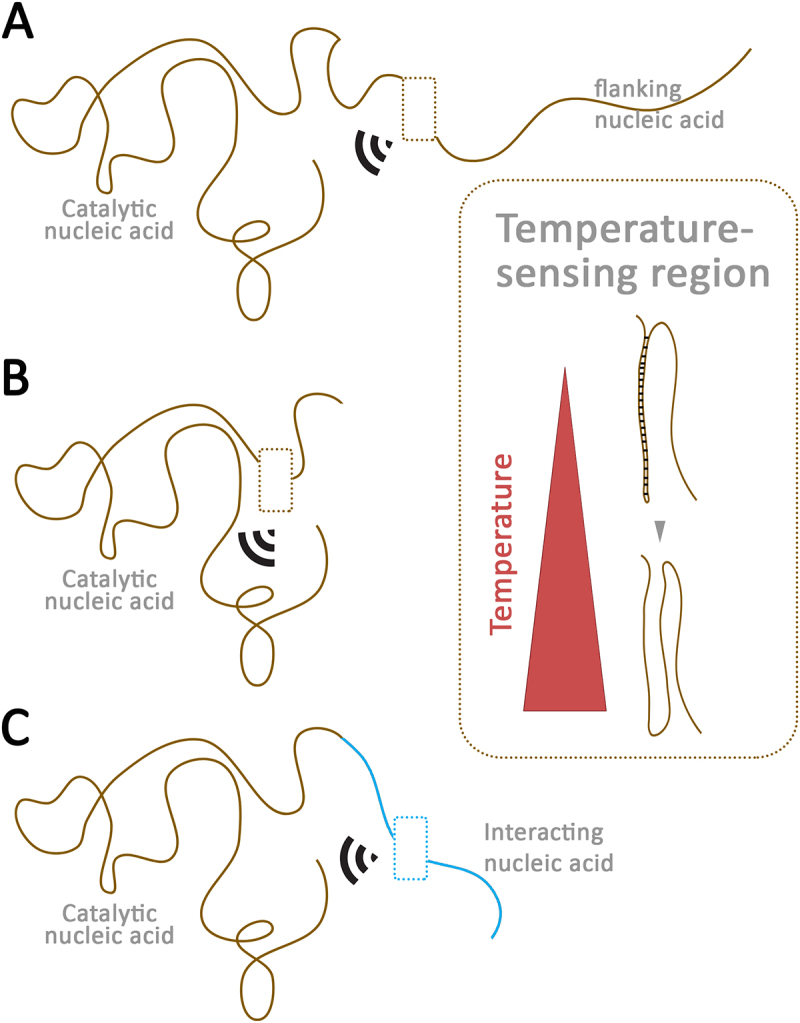
Understanding how cells sense temperature is a fundamental question in biology and is pivotal for the evolution of life. In numerous organisms, temperature is not only sensed but also generated due to cellular processes. Consequently, the mechanisms governing temperature sensation in various organisms have been experimentally elucidated. Extending upon others' proposals and demonstration of protein- and nucleic acid-based thermosensors, and utilizing a colonial India 'punkah-wallahs' analogy, I present my rationale for the necessity of temperature sensing in every organelle in a cell. Finally, I propose temperature-sensing (nucleic acid re) to integrate all the RNA molecules (mRNA, non-coding RNA, and so forth) capable of sensing temperature and triggering a signaling event, which I call as thermocrine signaling. This approach could enable the identification of riboceptors in every cell of almost every organism, not only for temperature but also for other classes of ligands, including gaseous solutes, and water.
了解细胞如何感知温度是生物学中的一个基本问题,对生命的进化至关重要。在众多生物体中,温度不仅能被感知,还会因细胞过程而产生。因此,各种生物体中控制温度感知的机制已通过实验得到阐明。在其他人基于蛋白质和核酸的温度传感器的提议和论证基础上,并利用殖民时期印度“风扇侍者”的类比,我阐述了细胞中每个细胞器进行温度感知的必要性的基本原理。最后,我提出温度传感(核酸重新编程)来整合所有能够感知温度并触发信号事件的RNA分子(信使RNA、非编码RNA等),我将此称为热分泌信号传导。这种方法不仅可以识别几乎每种生物体的每个细胞中的核糖受体,不仅用于温度,还用于其他类别的配体,包括气态溶质和水。