Anbalagan Savani
Institute of Molecular Biology and Biotechnology, Faculty of Biology, Adam Mickiewicz University, Poznań, Poland.
RNA Biol. 2024 Jan;21(1):1-6. doi: 10.1080/15476286.2024.2379607. Epub 2024 Jul 17.
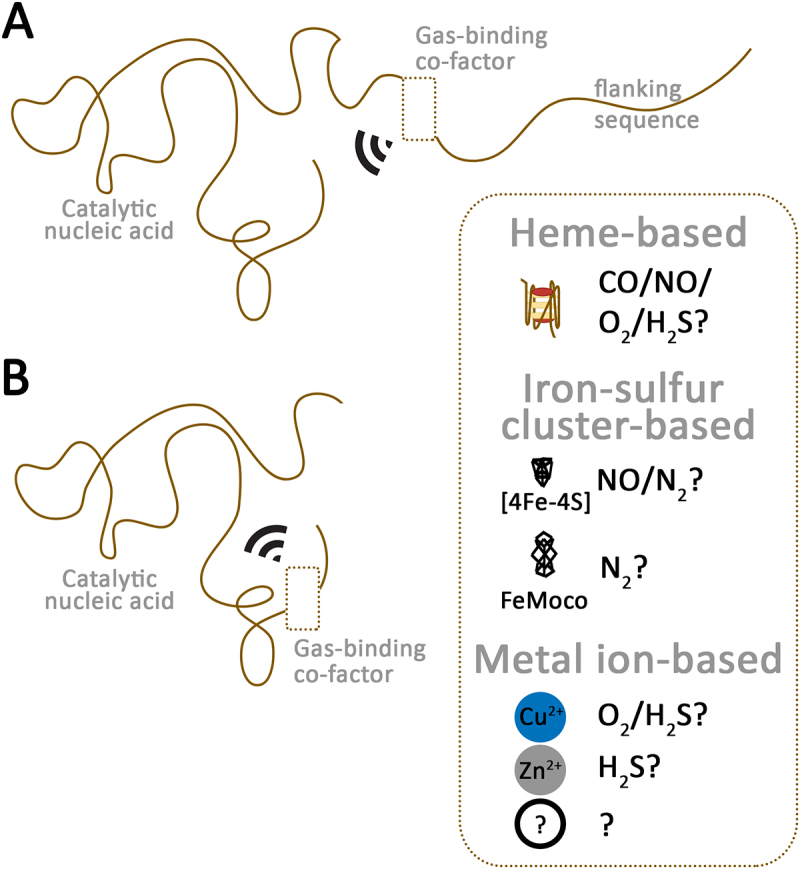
Understanding how cells sense gases or gaseous solutes is a fundamental question in biology and is pivotal for the evolution of molecular and organismal life. In numerous organisms, gases can diffuse into cells, be transported, generated, and sensed. Controlling gases in the cellular environment is essential to prevent cellular and molecular damage due to interactions with gas-dependent free radicals. Consequently, the mechanisms governing acute gas sensing are evolutionarily conserved and have been experimentally elucidated in various organisms. However, the scientific literature on direct gas sensing is largely based on hemoprotein-based gasoreceptors (or sensors). As RNA-based G-quadruplex (G4) structures can also bind to heme, I propose that some ribozymes can act as gas-sensing riboceptors (nucleic acid re). Additionally, I present a few other ideas for non-heme metal ion- or metal cluster-based gas-sensing riboceptors. Studying riboceptors can help understand the evolutionary origins of cellular and gasocrine signaling.
了解细胞如何感知气体或气态溶质是生物学中的一个基本问题,对于分子和生物生命的进化至关重要。在许多生物体中,气体可以扩散到细胞中,被运输、产生和感知。控制细胞环境中的气体对于防止因与气体依赖性自由基相互作用而导致的细胞和分子损伤至关重要。因此,控制急性气体感知的机制在进化上是保守的,并且已经在各种生物体中通过实验得到阐明。然而,关于直接气体感知的科学文献主要基于基于血蛋白的气体感受器(或传感器)。由于基于RNA的G-四链体(G4)结构也可以与血红素结合,我提出一些核酶可以作为气体传感核糖感受器(核酸感受器)。此外,我还提出了一些关于基于非血红素金属离子或金属簇的气体传感核糖感受器的其他想法。研究核糖感受器有助于理解细胞和气体分泌信号的进化起源。