Weber Benjamin, Zineh Issam, Lalonde Richard, Visser Sandra A G
NovoNordisk, Copenhagen, Denmark.
Office of Clinical Pharmacology, US Food and Drug Administration, Silverspring, Massachusetts, USA.
Clin Transl Sci. 2024 Jul;17(7):e13880. doi: 10.1111/cts.13880.
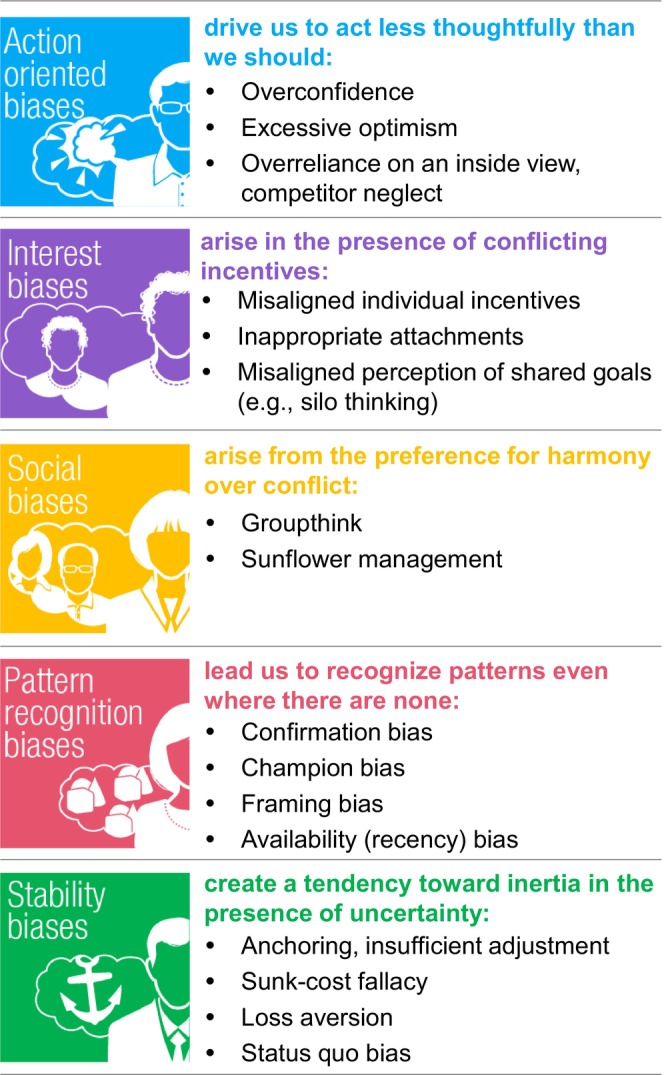
Decades of research have demonstrated that a variety of cognitive biases can affect our judgment and ability to make rational decisions in personal and professional environments. The lengthy, risky, and costly nature of pharmaceutical research and development (R&D) makes it vulnerable to biased decision-making. Moreover, cognitive biases can play a role in regulatory and clinical decision-making, the latter impacting diagnostic and treatment decisions in the therapeutic use of medicines. These inherent and/or institutionalized biases (e.g., in assumptions, data, or decision-making practices) could conceivably contribute to health inequities. In this mini-review, we provide a broad perspective on how cognitive biases can affect pharmaceutical R&D, regulatory evaluation, and therapeutic decision-making. Example approaches to mitigate the effect of common biases in the development, approval, and use of new therapeutics, such as quantitative decision criteria, multidisciplinary reviews, regulatory and treatment guidelines, and evidence-based clinical decision support systems are illustrated. Mitigating the impact of cognitive biases could increase pharma R&D efficiency, change the perspective and prioritization of unmet medical needs, increase representativeness and quality of evidence generated through clinical trials and real-world research, leading to higher quality insights and more effective medication use, and as such could eventually contribute to more equitable healthcare.
数十年的研究表明,多种认知偏差会影响我们在个人和职业环境中做出理性决策的判断力和能力。制药研发(R&D)过程漫长、风险高且成本高昂,容易受到决策偏差的影响。此外,认知偏差会在监管和临床决策中发挥作用,后者会影响药物治疗用途中的诊断和治疗决策。这些内在和/或制度化的偏差(例如在假设、数据或决策实践中)可能会导致健康不平等。在本综述中,我们广泛探讨了认知偏差如何影响制药研发、监管评估和治疗决策。文中举例说明了一些减轻新疗法研发、审批和使用过程中常见偏差影响的方法,如定量决策标准、多学科评审、监管和治疗指南以及循证临床决策支持系统。减轻认知偏差的影响可以提高制药研发效率,改变对未满足医疗需求的看法和优先级,提高临床试验和真实世界研究产生证据的代表性和质量,从而带来更高质量的见解和更有效的药物使用,最终有助于实现更公平的医疗保健。