Lopacinska-Jørgensen Joanna, Vestergaard Lau K, Schejbel Lone, Høgdall Claus K, Poulsen Tim Svenstrup, Høgdall Estrid V
Department of Pathology, Herlev Hospital, University of Copenhagen, Borgmester Ib Juuls Vej 25, Herlev, 2730, Denmark.
Department of Gynaecology, Juliane Marie Centre, Rigshospitalet, University of Copenhagen, Copenhagen, Denmark.
Mol Biol Rep. 2024 Jul 17;51(1):820. doi: 10.1007/s11033-024-09715-y.
Next-generation sequencing (NGS) has been implemented in clinical oncology as a personalized medicine tool to identify targetable genetic alterations and to guide treatment decisions. However, the optimal NGS test strategy and target genes for clinical use are still being discussed. The aim was to compare the performance of the Oncomine™ Comprehensive Assay v3 (OCAv3) (targeted gene panel) and whole-exome sequencing (WES) to investigate somatic single and multiple nucleotide variants and small indels in ovarian cancer patients.
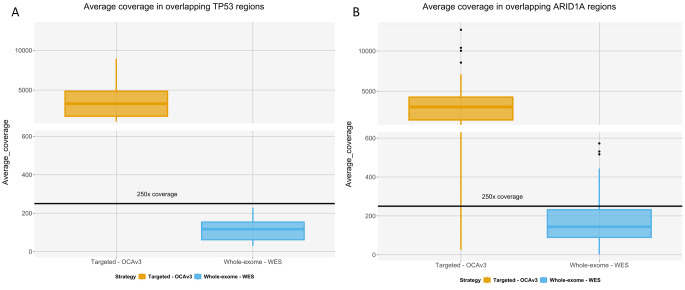
Genomic DNA was isolated from fresh frozen samples of five high-grade serous (HGSC) and three clear cell ovarian (oCCC) cancer patients. Exome sequencing libraries were prepared by using the Ion AmpliSeq Exome RDY kit, whereas libraries for OCAv3 were prepared using by Ion AmpliSeq™ Library Kit Plus. Sequencing was performed using the Ion S5XL System (Thermo Fisher Scientific). When including only variants classified as pathogenic, likely pathogenic or unknown significance based on ClinVar database verdicts and comparing overlapping regions covered both by the OCAv3 assay and WES, 23 variants were detected by both assays. However, OCAv3 detected additionally two variants: ARID1A: p.Gln563Ter and TP53: p.Ser261ValfsTer84 that have not passed WES filtering criteria due to low coverage.
With the present treatment possibilities, OCAv3 panel testing provided higher diagnostic yield due to better coverage. Our study emphasizes that WES, although offering the potential to identify novel findings in genes not covered by OCAv3, might overlook variants in genes relevant for OC.
下一代测序(NGS)已在临床肿瘤学中作为一种个性化医疗工具得以应用,用于识别可靶向的基因改变并指导治疗决策。然而,临床应用的最佳NGS检测策略和靶基因仍在讨论之中。本研究旨在比较Oncomine™综合分析v3(OCAv3)(靶向基因panel)和全外显子组测序(WES)在卵巢癌患者中检测体细胞单核苷酸和多核苷酸变异以及小插入缺失的性能。
从5例高级别浆液性(HGSC)和3例透明细胞卵巢癌(oCCC)患者的新鲜冷冻样本中分离基因组DNA。外显子组测序文库使用Ion AmpliSeq Exome RDY试剂盒制备,而OCAv3文库使用Ion AmpliSeq™文库试剂盒Plus制备。使用Ion S5XL系统(赛默飞世尔科技公司)进行测序。当仅纳入基于ClinVar数据库判定分类为致病性、可能致病性或意义不明的变异,并比较OCAv3分析和WES均覆盖的重叠区域时,两种分析均检测到23个变异。然而,OCAv3还额外检测到两个变异:ARID1A:p.Gln563Ter和TP53:p.Ser261ValfsTer84,由于覆盖度低,未通过WES筛选标准。
在目前的治疗可能性下,由于覆盖度更好,OCAv3 panel检测提供了更高的诊断率。我们的研究强调,WES虽然有可能识别OCAv3未覆盖基因中的新发现,但可能会忽略与卵巢癌相关基因中的变异。