Jiang Junzhiwei, Irga Peter, Coe Robert, Gibbons Philip
Fenner School of Environment and Society, Australian National University, Canberra, ACT, Australia.
Faculty of Engineering and Information Technology, Plants and Environmental Quality Research Group, School of Civil and Environmental Engineering, University of Technology Sydney, Sydney, NSW, Australia.
PLoS One. 2024 Jul 17;19(7):e0305956. doi: 10.1371/journal.pone.0305956. eCollection 2024.
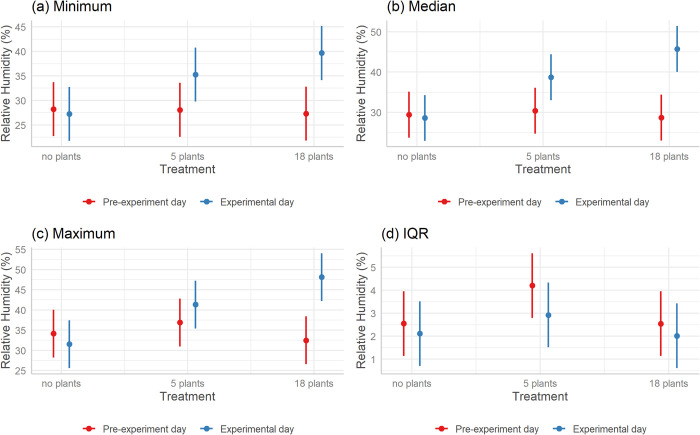
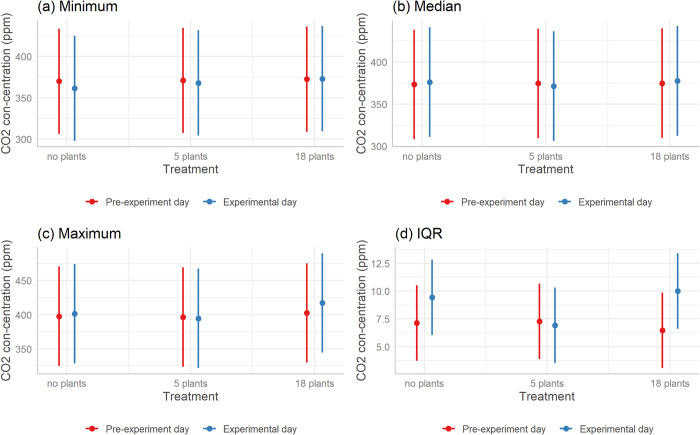
This experimental study investigates the influence of indoor plants on three aspects of air quality in office spaces: relative humidity, indoor air temperature, and carbon dioxide concentration. Employing a Latin square design, we rotated three different treatments across three offices over six time periods. These treatments included a control (no plants), a low-volume treatment (five plants), and a high-volume treatment (eighteen plants) of Nephrolepis exaltata (Boston fern). Air quality parameters were continuously monitored at five-minute intervals using Trace Gas Analyzers. Generalised linear mixed modelling (GLMM) was employed to examine the effect of each treatment on relative humidity, indoor air temperature and CO2 concentration. We observed a significant positive correlation between the number of indoor plants and relative humidity levels. In offices without any plants, the median relative humidity was 29.1%. This increased to 38.9% in offices with 5 plants and further to 49.2% in offices with 18 plants. However, we did not find significant associations between the number of indoor plants and indoor air temperature or corrected CO2 concentration. Our research provides support for the use of indoor plants to increase relative humidity, which can have health benefits in dry climates, but does not provide support for using indoor plants to regulate indoor air temperatures or CO2 concentration in office environments.
相对湿度、室内空气温度和二氧化碳浓度。采用拉丁方设计,我们在六个时间段内将三种不同的处理方式在三个办公室之间轮换。这些处理方式包括一个对照(无植物)、一个低数量处理(五株植物)和一个高数量处理(十八株植物)的波士顿蕨。使用痕量气体分析仪每隔五分钟连续监测空气质量参数。采用广义线性混合模型(GLMM)来检验每种处理方式对相对湿度、室内空气温度和二氧化碳浓度的影响。我们观察到室内植物数量与相对湿度水平之间存在显著的正相关。在没有任何植物的办公室中,相对湿度中位数为29.1%。在有五株植物的办公室中,这一数值增加到38.9%,在有十八株植物的办公室中进一步增加到49.2%。然而,我们没有发现室内植物数量与室内空气温度或校正后的二氧化碳浓度之间存在显著关联。我们的研究为使用室内植物来增加相对湿度提供了支持,这在干燥气候中可能对健康有益,但没有为在办公环境中使用室内植物来调节室内空气温度或二氧化碳浓度提供支持。