Reikersdorfer Kristen N, Singh Aaron, Young Jason D, Batty Miles B, Steele Amy E, Yuen Leslie C, Momtaz David A, Weissert Joleen N, Liu David S, Hogue Grant D
From the Department of Orthopaedic Surgery, Boston Children's Hospital, Boston, MA (Ms. Reikersdorfer, Dr. Young, Dr. Batty, Dr. Steele, Dr. Yuen, Dr. Liu, and Dr. Hogue) Department of Orthopaedics, UT Health San Antonio, San Antonio, TX (Mr. Singh, and Dr. Momtaz); and the Department of Pediatrics, Boston Children's Hospital, Boston, MA (Dr. Weissert).
J Am Acad Orthop Surg Glob Res Rev. 2024 Jul 15;8(7). doi: 10.5435/JAAOSGlobal-D-24-00162. eCollection 2024 Jul 1.
In the era of modern medicine, scurvy has been thought of as a rare disease of ancient times because of improved emphasis on diet and nutrition; however, isolated case reports are plentiful. This investigation presents a comprehensive review of scurvy, including an analysis on its rising incidence, with specific focus on its orthopaedic manifestations and commonly associated diagnoses.
This comprehensive review includes a retrospective analysis of 19,413,465 pediatric patients in the National Inpatient Sample database from 2016 through 2020. Patients with scurvy were identified by the ICD-10 code, and an estimated incidence of scurvy in the inpatient pediatric population was calculated. Concurrent diagnoses, musculoskeletal reports, and demographic variables were collected from patient records. Comparisons were made using analysis of variance or chi-square with Kendall tau, where appropriate.
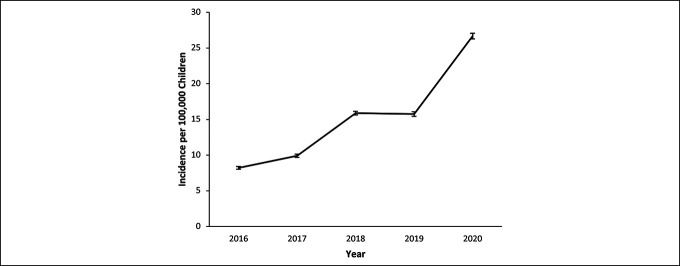
The incidence of scurvy increased over the study period, from 8.2 per 100,000 in 2016 to 26.7 per 100,000 in 2020. Patients with scurvy were more likely to be younger (P < 0.001), male (P = 0.010), in the lowest income quartile (P = 0.013), and obese (P < 0.001). A majority (64.2%) had a concomitant diagnosis of autism spectrum disorder. Common presenting musculoskeletal reports included difficulty walking, knee pain, and lower limb deformity. Burden of disease of scurvy was markedly greater than that of the average inpatient population, with these patients experiencing greater total charges and longer hospital stays.
Clinicians should be aware of the increasing incidence of scurvy in modern medicine. In cases of vague musculoskeletal reports without clear etiology, a diagnosis of scurvy should be considered, particularly if risk factors are present.
NA.
在现代医学时代,由于对饮食和营养的重视程度提高,坏血病被认为是一种古代的罕见疾病;然而,孤立的病例报告却很丰富。本研究对坏血病进行了全面综述,包括对其发病率上升的分析,特别关注其骨科表现和常见的相关诊断。
本全面综述包括对2016年至2020年国家住院样本数据库中19413465名儿科患者的回顾性分析。通过ICD - 10编码识别坏血病患者,并计算住院儿科人群中坏血病的估计发病率。从患者记录中收集并发诊断、肌肉骨骼报告和人口统计学变量。在适当的情况下,使用方差分析或卡方检验与肯德尔tau检验进行比较。
在研究期间,坏血病的发病率有所上升,从2016年的每10万人8.2例增至2020年的每10万人26.7例。坏血病患者更可能年龄较小(P < 0.001)、为男性(P = 0.010)、处于最低收入四分位数(P = 0.013)且肥胖(P < 0.001)。大多数(64.2%)患者同时被诊断为自闭症谱系障碍。常见的肌肉骨骼报告症状包括行走困难、膝关节疼痛和下肢畸形。坏血病的疾病负担明显高于普通住院人群,这些患者的总费用更高,住院时间更长。
临床医生应意识到现代医学中坏血病发病率的上升。在肌肉骨骼报告不明确且无明确病因的情况下,应考虑坏血病的诊断,特别是存在危险因素时。
无。