Yin Hang, Pang Jincong, Zhao Shan, Wu Haodi, Song Zihao, Li Xing, Zheng Zhiping, Xu Ling, Tang Jiang, Niu Guangda
Wuhan National Laboratory for Optoelectronics and School of Optical and Electronic Information, Huazhong University of Science and Technology, Wuhan 430074, China.
Institute of Microelectronics of the Chinese Academy of Sciences, Beijing 100029, China.
Innovation (Camb). 2024 Jun 5;5(4):100654. doi: 10.1016/j.xinn.2024.100654. eCollection 2024 Jul 1.
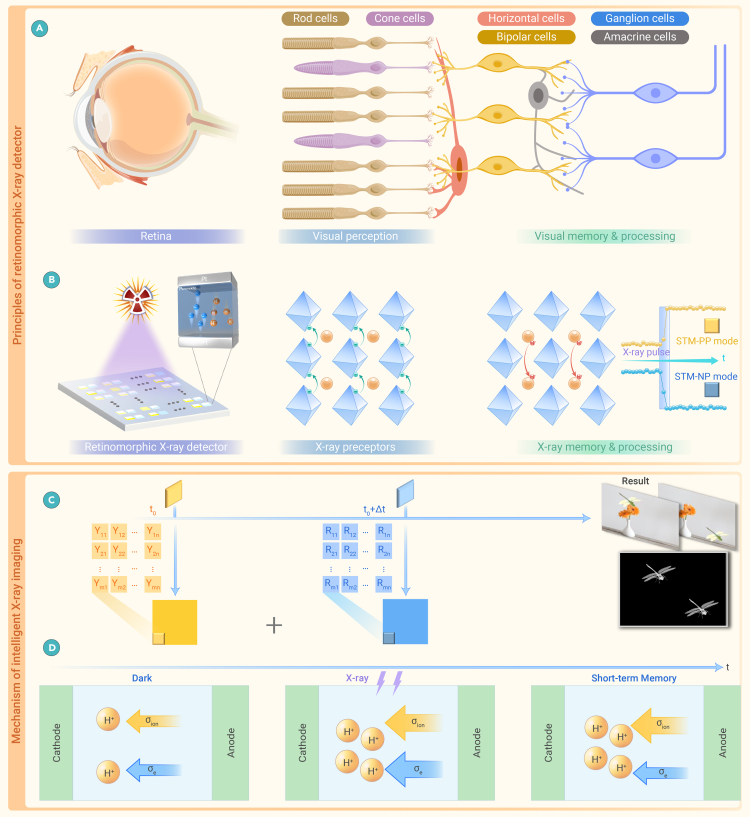
X-ray detection is crucial across various sectors, but traditional techniques face challenges such as inefficient data transmission, redundant sensing, high power consumption, and complexity. The innovative idea of a retinomorphic X-ray detector shows great potential. However, its implementation has been hindered by the absence of active layers capable of both detecting X-rays and serving as memory storage. In response to this critical gap, our study integrates hybrid perovskite with hydrion-conductive organic cations to develop a groundbreaking retinomorphic X-ray detector. This novel device stands at the nexus of technological innovation, utilizing X-ray detection, memory, and preprocessing capabilities within a single hardware platform. The core mechanism underlying this innovation lies in the transport of electrons and holes within the metal halide octahedral frameworks, enabling precise X-ray detection. Concurrently, the hydrion movement through organic cations endows the device with short-term resistive memory, facilitating rapid data processing and retrieval. Notably, our retinomorphic X-ray detector boasts an array of formidable features, including reconfigurable short-term memory, a linear response curve, and an extended retention time. In practical terms, this translates into the efficient capture of motion projections with minimal redundant data, achieving a compression ratio of 18.06% and an impressive recognition accuracy of up to 98.6%. In essence, our prototype represents a paradigm shift in X-ray detection technology. With its transformative capabilities, this retinomorphic hardware is poised to revolutionize the existing X-ray detection landscape.
X射线检测在各个领域都至关重要,但传统技术面临着数据传输效率低、传感冗余、功耗高和复杂度高等挑战。视网膜形态X射线探测器的创新理念显示出巨大潜力。然而,其实现受到缺乏既能检测X射线又能用作存储器的有源层的阻碍。针对这一关键差距,我们的研究将混合钙钛矿与氢离子传导有机阳离子相结合,开发出一种开创性的视网膜形态X射线探测器。这种新型器件处于技术创新的核心,在单个硬件平台内利用X射线检测、存储和预处理能力。这一创新背后的核心机制在于金属卤化物八面体框架内电子和空穴的传输,从而实现精确的X射线检测。同时,氢离子通过有机阳离子的移动赋予该器件短期电阻式记忆功能,便于快速数据处理和检索。值得注意的是,我们的视网膜形态X射线探测器拥有一系列强大特性,包括可重构短期记忆、线性响应曲线和延长的保持时间。实际上,这意味着以最少的冗余数据高效捕获运动投影,实现了18.06%的压缩率和高达98.6%的惊人识别准确率。本质上,我们的原型代表了X射线检测技术的范式转变。凭借其变革性能力,这种视网膜形态硬件有望彻底改变现有的X射线检测格局。