Leo Donato Giuseppe, Keller Simon S, Proietti Riccardo
Department of Cardiovascular and Metabolic Medicine, Institute of Life Course and Medical Sciences, Faculty of Health and Life Science, University of Liverpool, Liverpool, United Kingdom.
Liverpool Centre for Cardiovascular Science, University of Liverpool and Liverpool Heart and Chest Hospital, Liverpool, United Kingdom.
Front Psychol. 2024 Jul 5;15:1411835. doi: 10.3389/fpsyg.2024.1411835. eCollection 2024.
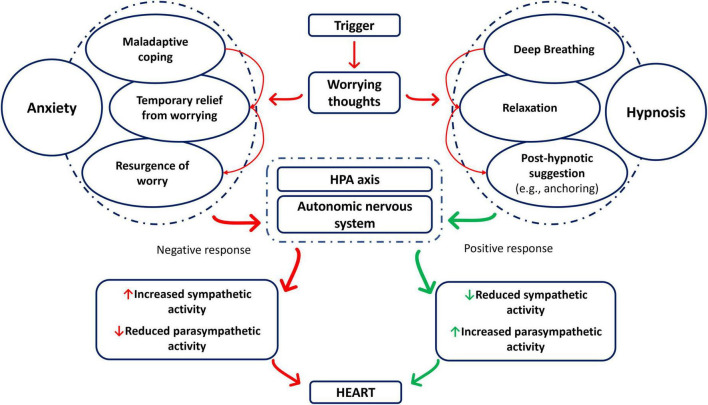
Anxiety is the most common form of mental health disorder, affecting millions of people worldwide. Psychosocial interventions such as mindfulness and cognitive behavioral therapy (CBT) have been suggested as an effective treatment in the management of general anxiety and anxiety disorders, with emerging evidence also suggesting the effectiveness of hypnosis. Moreover, anxiety has shown to be linked to the onset and development of several cardiovascular diseases (CVD), which are the leading cause of global death. In this paper, we review the current literature to examine the role that anxiety has on the onset and development of CVD and summarize the current knowledge on the role that hypnosis and hypnotherapy have in reducing anxiety, also explaining how this can impact the cardiovascular system and the prevention of CVD. Review of the evidence suggests that hypnosis and hypnotherapy are effective in treating anxiety and may positively affect the heart and the cardiovascular system, reducing sympathetic activation and increasing parasympathetic tone, potentially preventing the onset of CVD related to increased sympathetic activation. However, further studies are required to further understand how hypnosis and hypnotherapy affect the cardiovascular system through investigation of the neurophysiological components of the hypnotic state and of the mind-body relationship. Healthcare systems should embed mental health screening in patients at risk of developing CVD as part of the clinical pathway and consider the role that hypnosis and hypnotherapy may play in the management of CVD.
焦虑是最常见的心理健康障碍形式,影响着全球数百万人。正念和认知行为疗法(CBT)等社会心理干预措施已被认为是治疗一般性焦虑和焦虑症的有效方法,新出现的证据也表明催眠疗法有效。此外,焦虑已被证明与几种心血管疾病(CVD)的发病和发展有关,而心血管疾病是全球死亡的主要原因。在本文中,我们回顾当前的文献,以研究焦虑在心血管疾病发病和发展中的作用,并总结目前关于催眠和催眠疗法在减轻焦虑方面作用的认识,同时解释这如何影响心血管系统以及预防心血管疾病。对证据的回顾表明,催眠和催眠疗法在治疗焦虑方面有效,可能对心脏和心血管系统产生积极影响,减少交感神经激活并增加副交感神经张力,有可能预防与交感神经激活增加相关的心血管疾病的发生。然而,需要进一步研究,通过调查催眠状态的神经生理成分和身心关系,来进一步了解催眠和催眠疗法如何影响心血管系统。医疗保健系统应将心理健康筛查纳入有患心血管疾病风险的患者临床路径中,并考虑催眠和催眠疗法在心血管疾病管理中可能发挥的作用。