Singh Vijayata, Pathak Subhajit, Kumar Narendra, Jayandharan Giridhara R
Laurus Center for Gene Therapy, Department of Biological Sciences and Bioengineering and Mehta Family Center for Engineering in Medicine and Gangwal School of Medical Sciences and Technology, Indian Institute of Technology, Kanpur, Uttar Pradesh 208016, India.
ACS Omega. 2024 Jul 3;9(28):30945-30953. doi: 10.1021/acsomega.4c03949. eCollection 2024 Jul 16.
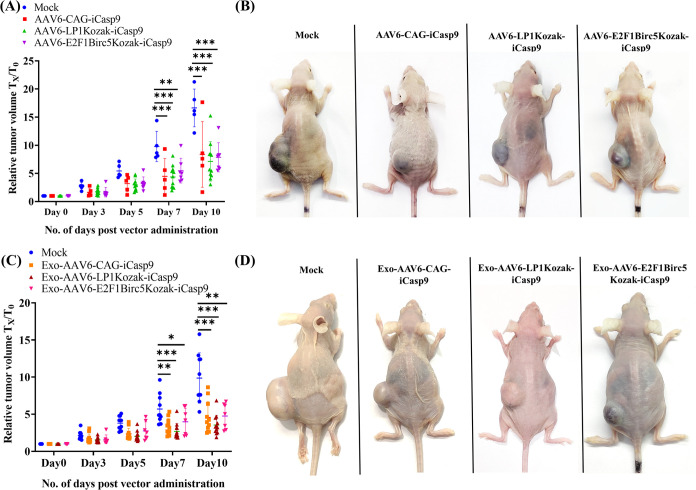
Suicide gene therapy is a promising strategy for the potential treatment of hepatocellular carcinoma (HCC). However, the lack of high transduction efficiency and targeted vectors in delivering the suicide genes to only the HCC cells is a major impediment. In the present study, we utilized an adeno-associated virus serotype 6 (AAV6) and its exosomal counterpart (exo-AAV) comprising of an inducible Caspase 9 () gene under the control of different promoter systems for targeting HCC cells. We employed a ubiquitous cytomegalovirus immediate early enhancer/chicken β actin promoter (CAG), a liver-specific promoter (LP1), and a baculoviral IAP repeat-containing protein 5 (BIRC5) promoter for liver and cancer cell-specific expression of , respectively. We further evaluated these vectors in Huh7 cells for their ability to kill the target cells. BIRC5 and LP1 promoter-driven iCasp9 vectors demonstrated superior cytotoxicity when compared to CAG promoter-driven iCasp9 vectors. Further validation in a murine model of HCC demonstrated that the LP1-iCasp9 or Birc5-iCasp9-based AAV6 vectors contributed to tumor regression (∼2 fold) as effectively as the AAV6-CAG-iCasp9 vectors (∼1.9 fold). Similarly, exo-AAV6 vectors showed ∼2.1 to 2.8 fold superior tumor regression when compared to mock-treated animals. Our study has developed two novel promoters (LP1 or BIRC5) whose efficacy is comparable to a strong ubiquitous promoter in both AAV and exo-AAV systems. This expands the toolkit of AAV vectors for safe and effective treatment of HCC.
自杀基因疗法是一种有前景的肝细胞癌(HCC)潜在治疗策略。然而,在将自杀基因仅递送至HCC细胞时缺乏高转导效率和靶向载体是一个主要障碍。在本研究中,我们利用了腺相关病毒6型(AAV6)及其外泌体对应物(exo - AAV),其包含在不同启动子系统控制下的可诱导半胱天冬酶9(iCasp9)基因以靶向HCC细胞。我们分别采用了一种普遍存在的巨细胞病毒立即早期增强子/鸡β肌动蛋白启动子(CAG)、一种肝脏特异性启动子(LP1)和一种杆状病毒IAP重复序列包含蛋白5(BIRC5)启动子,用于iCasp9在肝脏和癌细胞中的特异性表达。我们进一步在Huh7细胞中评估了这些载体杀死靶细胞的能力。与CAG启动子驱动的iCasp9载体相比,BIRC5和LP1启动子驱动的iCasp9载体表现出更强的细胞毒性。在HCC小鼠模型中的进一步验证表明,基于LP1 - iCasp9或Birc5 - iCasp9的AAV6载体与AAV6 - CAG - iCasp9载体一样有效地促进了肿瘤消退(约2倍)(约1.9倍)。同样,与 mock处理的动物相比,exo - AAV6载体显示出约2.1至2.8倍的肿瘤消退优势。我们的研究开发了两种新型启动子(LP1或BIRC5),其在AAV和exo - AAV系统中的功效与强普遍存在启动子相当。这扩展了AAV载体用于安全有效治疗HCC的工具集。